America’s ‘growing’ blockade of Iran is ‘going global’

Published April 24, 2026 11:08am ET | Updated April 24, 2026 11:10am ET


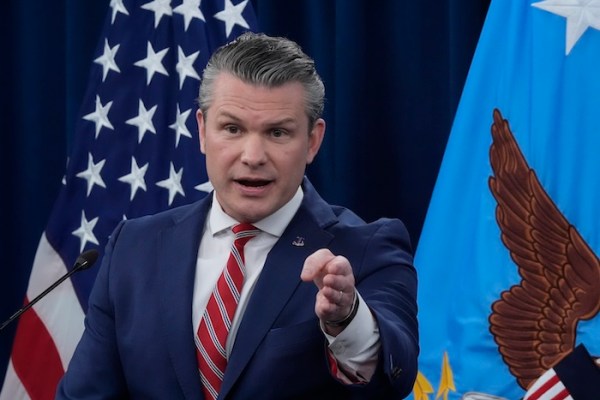
The latest evolution of the U.S.-Iran conflict is the American blockade of vessels going to or coming from Iranian ports, and this effort on the part of U.S. forces is “going global,” War Secretary Pete Hegseth said on Friday.

While the bombs, missiles, and drones have stopped flying, the United States and Iran are engaged in an economic war to see which side can withstand more pressure as both economies suffer.

The blockade went into effect more than a week and a half ago, and in that time, U.S. vessels have forced 34 vessels linked to Iran to turn around and go back to where they came, Hegseth told reporters during a Friday morning briefing at the Pentagon.

U.S. forces have seized or boarded multiple vessels in the last several days, including the M/T Majestic X, M/T Tifani, and M/V Touska, two of which were in the Indo-Pacific area. U.S. troops have turned away several over ships, some of which have tried to evade the U.S. blockade.

When ships don’t listen to the instructions of American forces, there is a series of escalatory decisions in place for U.S. troops to bring the vessel under their command.

“Just this week, we seized two Iranian Dark Fleet ships in the Indo-Pacific region that had left Iranian ports before the blockade went into effect. They thought they’d made it out just in time. They did not,” Hegseth said. “We seize their sanctioned ships, and we will seize more. Our blockade is growing and going global. America’s military is unmatched, projecting power, denying passage to adversaries, and protecting our interest at the time and place of our people.”

A cargo ship sails in the Persian Gulf toward the Strait of Hormuz, Wednesday, April 22, 2026. (AP Photo)

The dark fleet, or shadow fleet, is a group of old and outdated cargo vessels that Iran and Russia primarily use to ship oil while evading Western sanctions and requirements. Venezuela is also a part of the array of countries that use the shadow fleet, though the U.S. began interdicting those vessels amid its buildup around that country in late 2025 and early 2026.

To avoid detection, these vessels will often attempt to spoof their tracking data to hide their true location and turn off their automatic identification system in violation of International Maritime Organization requirements.

General Dan Caine, chairman of the Joint Chiefs of Staff, said the crew of the Touska, a large container ship about 965 feet in length and over 100 feet wide, failed to listen to “several clear and unambiguous warnings” for hours.

Ultimately, U.S. forces on the USS Spruance were able to disable the engine by firing nine inert rounds from the destroyers’ 5-inch MK 45 gun after U.S. troops fired five warning shots prior. He noted that “the ship and her crew remain safe in U.S. custody today.”

HARD-LINE IRANIAN REVOLUTIONARY GUARD COMMANDER EMERGES AS KEY PLAYER

To ensure these vessels cannot get to or from Iranian ports, Central Command has more than 17 warships and 10,000 troops involved in the blockade, with more support on the way.

“Not only is the blockade growing, in fact, a second aircraft carrier will join the blockade in just a few days,” Hegseth said, while CENTCOM put out a graphic saying three aircraft carriers — the USS Abraham Lincoln, USS Gerald R. Ford and USS George H.W. Bush — are operating in the Middle East at the same time for the first time since 2003.

Hegseth’s comments about the blockade going “global” echo sentiments from Sen. Lindsey Graham (R-SC), who said earlier this week after a conversation with Hegseth and President Donald Trump, “Not only expect this blockade to stay in place until Iran shows a commitment to change their ways, I expect the blockade will be growing and that it could become global soon.”