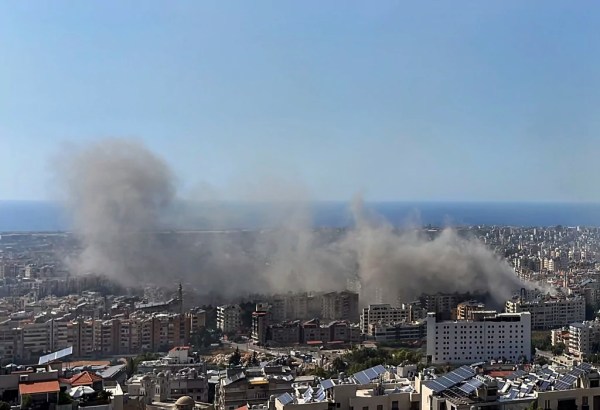
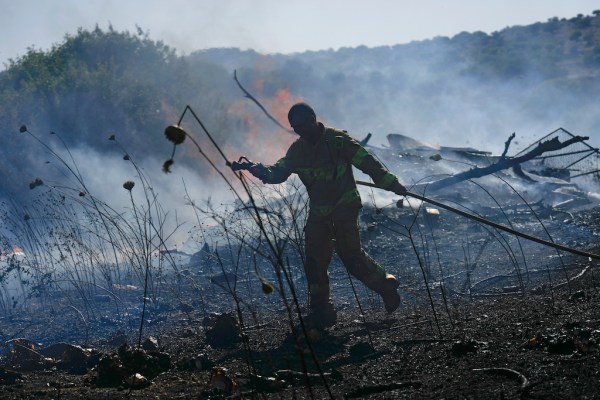
Iranian officials are set to halt their participation in the negotiations with the United States over Israel’s continued strikes in Lebanon targeting Hezbollah, according to Iranian state media.
Tasnim, which is close to Iran’s powerful Islamic Revolutionary Guard Corps, reported Monday that Iran would halt “talks and the exchange of texts through a mediator” given the “continuation of the Zionist regime’s crimes in Lebanon.” The U.S. and Iran have disputed for weeks whether the Israel-Hezbollah conflict is included in their agreed-upon ceasefire.
Recommended Stories
President Donald Trump posted on Truth Social early Monday that “Iran really wants to make a deal, and it will be a good one for the U.S.A.” He met with senior officials on Friday in the Situation Room, where he said he would make a “final determination” about an agreement, but he has not publicly commented since then about his decision. He has frequently hyped up Iran’s interest in making a deal even as its actions appear to contradict his comments.
The two sides appear to be focused on a short-term agreement that would allow for the Strait of Hormuz to gradually return to transit levels, given the damage its closure has caused to the global economy. The U.S. Navy has simultaneously also carried out a blockade of Iranian ports, effectively ensuring that Iran cannot escape the economic ramifications of its attacks on the rest of the world.
U.S. and Iranian forces exchanged fire multiple times over the weekend, highlighting the precarious nature of the ceasefire and the possibility for escalation. On Friday, U.S. forces issued more than 20 warnings to the Gambia-flagged M/V Lian Star transiting the Gulf of Oman that it was in violation of the blockade, and the U.S. troops ultimately fired a Hellfire missile into the ship’s engine room to disable it.
U.S. forces successfully intercepted two Iranian ballistic missiles targeting American forces in Kuwait late Sunday night, according to U.S. Central Command. Also over the weekend, Iranian forces were able to shoot down a U.S. MQ-1 drone, and the U.S. responded with strikes on Iranian radar and command and control sites for drones in Goruk, Iran, and Qeshm Island.
Despite these incidents, the brokered ceasefire, which Trump announced on April 7, broadly remains in effect.
Also on Monday, Iranian Foreign Minister Abbas Araghchi said the ceasefire “unequivocally” includes Lebanon and that “its violation on one front is a violation of the ceasefire on all fronts.”
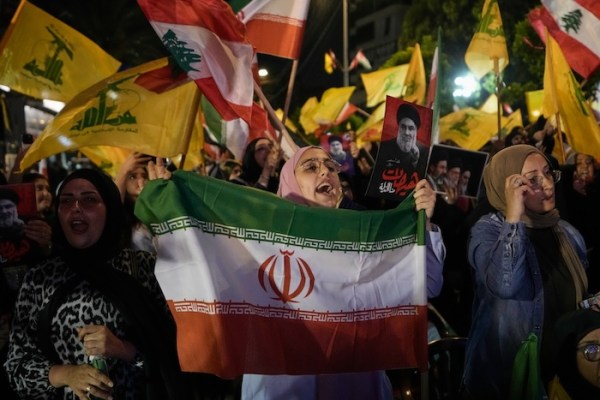
The Trump administration has simultaneously tried to negotiate an end to the Israel-Hezbollah conflict by empowering the Israeli and Lebanese governments to work together to reduce Hezbollah’s influence militarily and politically in the country. Iran, however, supports Hezbollah, which was widely viewed as its most sophisticated and largest proxy force in the region, though it, too, has been decimated by the Israeli military in the aftermath of Hamas’s Oct. 7, 2023, attacks that resulted in the ensuing conflicts.
WHAT TO KNOW ABOUT TRUMP’S ‘FINAL DETERMINATION’ ON POSSIBLE IRAN DEAL
Israel and Hezbollah had a ceasefire in place when Hezbollah restarted attacks on northern Israel in response to the start of the U.S.-Israel war against Iran. That agreement, however, called for Hezbollah to withdraw from the area south of the Litani River, which runs parallel about 20 miles north of the Israel-Lebanon border, and they have not. This stipulation was also included, but not followed, in the 2006 United Nations Security Council resolution that ended their last war.
Elbridge Colby, the undersecretary of war for policy, hosted Israeli and Lebanese delegations for talks on Friday at the Pentagon. The two sides discussed “the security track supporting the ongoing peace talks between their two countries,” and they collectively “held productive military-to-military discussions which will inform” State Department-led discussions this week.