

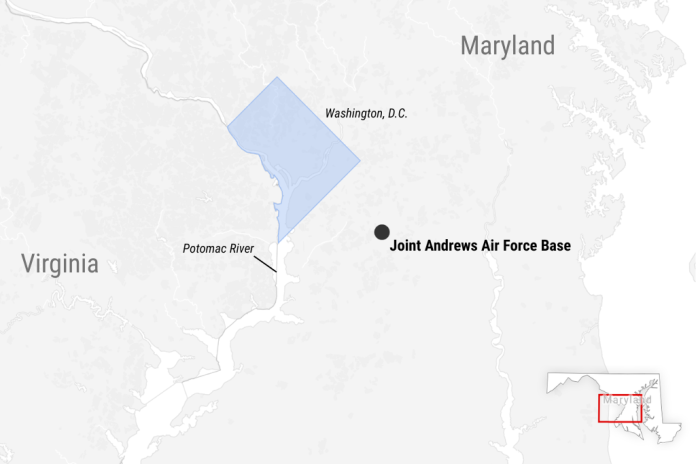
The Maryland Department of the Environment found that Joint Base Andrews’s fuel system had leaked roughly 32,000 gallons of jet fuel from December 2025 to April into creeks that flow to the Potomac River.
MDE first began investigating the incident last month after personnel from the military installation noticed a fuel sheen in the Piscataway Creek. The spill has drawn heightened scrutiny because Joint Base Andrews is one of the nation’s most prominent military installations and home to Air Force One.
Recommended Stories


(Graphic by Grace Hagerman / Washington Examiner)
Air Force and base faculty allegedly failed to report issues of a leak when the fuel system failed a leak safety test, despite Maryland’s strict regulations requiring them to do so. In that incident, the base’s fuel system had lost about 10,000 gallons of jet fuel between January and February, but the leak was thought to be contained to the installation and was not reported.
But when oil was found in the creek that flows through Prince George’s County on March 23, the Department of War chose to contact Maryland officials.
Between the two leaks, roughly 32,000 gallons of jet fuel were spilled into Maryland’s waterways, and it is unclear how much the creek has been contaminated.
Maryland officials found that the base failed to report field safety issues at their facilities for months, calling the situation “unacceptable.”
Despite the environmental effects of the jet fuel leaks, there is no threat to drinking water because the leak happened south of intake systems that provide water to Washington, D.C., and parts of Maryland.
The Environmental Protection Agency sent personnel to assess the creek two days after the leak was reported, and it said the base’s containment measures were working and no oil was migrating from the site of the initial spill.
After EPA officials assessed the creek, heavy rainfall hit the area twice, which Maryland officials said led to the containment measures failing on both occasions. The base disputes the claim that its containment measures failed, saying its systems were “robust” and held up.
Base officials have said contractors were sent to clean the spill site, and the Air Force has pledged to keep the affected system offline until it meets safety requirements.
Maryland inspectors are still not pleased with the actions taken at the base.
MARYLAND INVESTIGATING 32,000 GALLONS OF LEAKED JET FUEL AT JOINT BASE ANDREWS
They said JBA’s contractors haven’t properly analyzed the water affected by the leak, so there is no way to know how much oil was recovered. Additionally, inspectors said they are not receiving daily reports on the levels of jet fuel in the water, but JBA officials dispute this claim.
Maryland officials said they are confident that jet fuel is no longer leaking, but there are still questions about the long-term effects of the incident and the full extent of the oil contamination.
