

“April 2, 2025, will forever be remembered as the day American industry was reborn, the day America’s destiny was reclaimed, and the day that we began to make America wealthy again.”
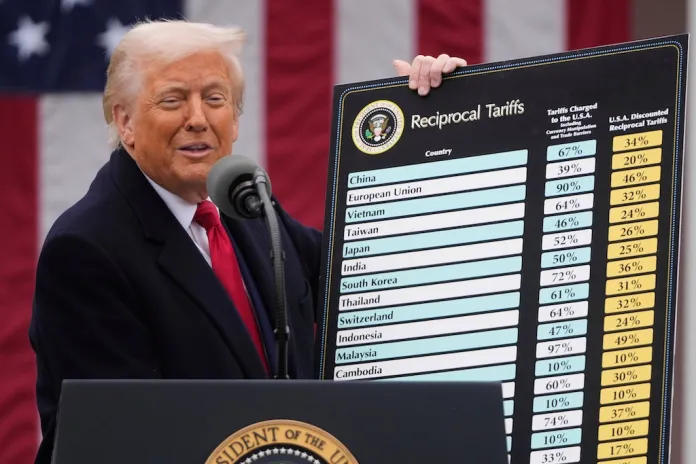
President Donald Trump spoke those words as he imposed historic tariffs on countries all over the world. One year on, the tariffs have led to massive changes in international relations, disruptions in global trade, a momentous Supreme Court ruling, and many other far-reaching effects. The full legacy of the tariffs is yet to be known, but this Washington Examiner series will take stock of the first year. The third installment looks at how we are likely over the worst of it. For Part 1 on manufacturing struggles, click here. For Part 2, on the “TACO” phenomenon, click here.
The United States will likely soon have weathered the bulk of the price hikes from the “Liberation Day” tariffs imposed last year by President Donald Trump.
Economists, starting with Federal Reserve Chairman Jerome Powell, generally say that any price increases on consumer goods from the tariffs have been implemented and absorbed and will not affect overall inflation much longer. Just how much longer, though, is a matter of debate.
Moving past the effects of the tariffs would help raise consumer sentiment, which is badly needed. Surveys show that households feel as negatively about the economy as they did during the 2008 financial crisis or at the worst of the pandemic disruptions.
Poor economic satisfaction, in turn, has dragged down Trump’s approval ratings and threatened the Republican Party’s grip on Washington.
Of course, upward price pressures from the tariffs are just one of many factors that will determine the performance of the economy this year. Even as the effects of the tariffs fade, new problems threaten to drive prices up — most prominently, the steep run-up in oil prices from the war with Iran.
Still, at some point, the effects of the tariffs will be in the rearview mirror. And that will only help the Fed in its efforts to keep inflation down and ease the financial crunch for households.
“The forecast is that we’ll be making progress on inflation,” Powell said at a press conference last week. “… It should come as we start to see in the middle of the year, progress on tariffs going through once and then tariff inflation coming down.”
Powell noted that tariffs raise costs on a one-time basis. In theory, the imposition of a tariff on a sweater, for example, raises the price of that sweater at the store but does not raise the inflation rate on an ongoing basis. Maybe the sweater goes from $25 to $30. That would show up in inflation measures in the months thereafter. But that would be it. There would be no more changes to the price of the sweater due to the tariff, unless the tariff were raised.
After a year, the tariff effect would have worked its way through the system, and the inflationary impact after that would be zero.
The question, then, is how quickly tariffs move through the system. On that question, analysts differ.
Powell suggested that “it takes eight, nine, 10, 11 months, a year to go through the system, and we’re waiting for the tariffs, which were put in place over the course of the middle part and later last year, we’re waiting for that to go through the system so that goods inflation will return closer to what it’s always been.”
Rajeev Dhawan, the director of the Economic Forecasting Center at the J. Mack Robinson College of Business at Georgia State University, said businesses are now mostly done passing tariffs on to consumers.
“I don’t think anybody has the capacity to eat up the tariffs for 12 months,” he told the Washington Examiner. “A few can, but not overall. So, for me, tariffs are done through the system.”
The question of whether and to what extent retailers raise prices because of tariffs is a complicated one. Trump has always maintained that tariffs are paid by foreigners. In a literal sense, tariffs are paid by domestic importers to U.S. customs. But it is a matter of economic sleuthing and guesswork to determine how much those tariffs are passed on to consumers in the form of higher prices.
Simply looking at overall consumer prices won’t do the trick. Too many factors go into the consumer price index, and many of them are not related to tariffs. For instance, services account for most of the CPI and should not be significantly affected by tariffs.
Some economists, though, would look at “core goods” — a subcategory of prices that excludes services and also the volatile categories of food and energy. In theory, this index should more closely track imports such as clothes, appliances, toys, and the like.
Core goods inflation picked up throughout 2025 and has trended down this year, consistent with the idea that the pressure from the tariffs is waning.
Some economists have tried to use advanced methods to suss out the exact effects of the tariffs on prices.
For example, researchers at the Fed tried to get a real-time reading on the impact of tariffs by looking at price changes in specific spending categories and how much of each category was imports from countries subject to tariffs. They concluded that the tariffs were significantly pushing up measures of inflation. At his press conference, Powell said tariffs accounted for half to three-quarters of the headline inflation rate.
Similarly, the HBS Pricing Lab examined the effects of tariffs using online pricing data tied to country-of-origin information. The researchers concluded that tariffs were pushing up overall CPI inflation by 0.8 percentage points as of February, with much of that from China tariffs, not necessarily Liberation Day tariffs. Household furnishings, coffee, and clothes were most affected.
Steve Lamar, the CEO of the American Apparel & Footwear Association, said knowing whether the tariffs have worked their way through the industry and to households is a “super complicated question.”
The only thing that is known for sure, he said, is that the importer pays the tax. Beyond that, there are many permutations for how the tariffs could be handled.
Sometimes the tariffs are passed on to the next entity, such as a retailer, for contractual reasons. Sometimes the tariff may be partly absorbed by the supplier, who might lower the wholesale price. Other times, the importer might take the hit and offset the cost by holding off on investing or hiring. Other times, they might raise the price shoppers see on the shelves and feed into inflation.
“It’s almost impossible to map and figure that all out,” he said.
The tariffs themselves have changed over time. Trump backed off the Liberation Day tariffs soon after they were announced, later reimposed them, and then again lowered them on specific countries pursuant to deals.
More recently, the Supreme Court struck down the tariffs, and Trump has begun reimposing them by other means. Businesses have been left trying to guess what the tariffs will be and for how long, as well as any retaliation that might come from trading partners.
Joel Naroff, the president of the consulting firm Naroff Economics, said it is likely that, based on the size of the tariffs and the uncertainty about them, they have not fully worked their way through the economic system.
MANUFACTURING HAS STRUGGLED SINCE ‘LIBERATION DAY’
“You’re talking about an increase in price that is simply not possible to push through in any sort of short term,” Naroff said.
Businesses may take two to three years to fully pass on the effects of the tariffs, he added.
