

Friday’s jobs report showed the economy adding 115,000 jobs and the unemployment rate held steady at a low 4.3%
But sometimes, the headline numbers can be misleading. They can bounce around from month to month.
A look at the details of the Bureau of Labor Statistics data, and the trend over recent months, can reveal more.
The underlying reality
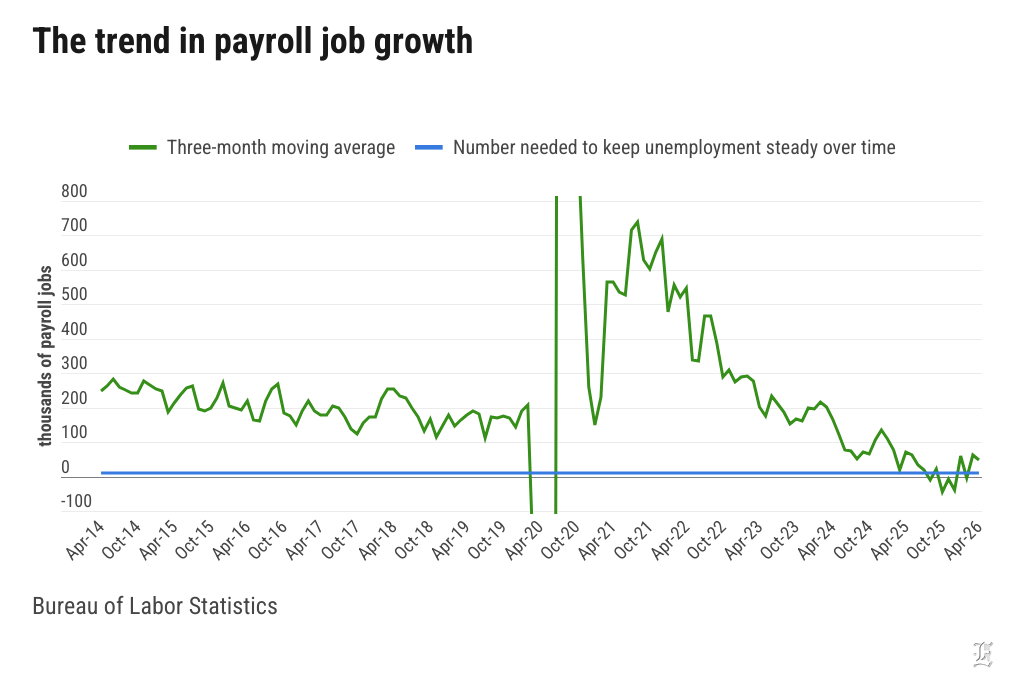
It is helpful to look not just at the most recent month, but the trend of job growth over the past few months. With downward revisions to the numbers for February and March, the three-month moving average of job gains was 48,000 in April.
Although that is fewer than has been the norm in recent years, it is more than enough to keep pace with population growth, and to keep unemployment trending down.
That’s in large part because the Trump administration’s crackdown on illegal immigration has slowed population growth. It is likely that only a few thousand jobs each month are needed to absorb new entrants into the workforce.
As a result, employment rates have remained healthy even as job growth has slowed in recent months.
Prime-age employment, meaning for those between the ages of 25-54, has held near all-time highs.
No signs of a recession
A recession would mean a fast-rising unemployment rate.
The unemployment rate, taken from the jobs report’s household survey, is still low by historical standards, although it has been drifting upward. It held steady at 4.3% in April.
Friday’s data suggests that the U.S. labor market is moving away from triggering one major recession indicator — namely, when the three-month moving average of the unemployment rate rises half a percentage point relative to its minimum point over the past year. This indicator, known as the Sahm Rule, had signaled the start of all post-war recessions.
The indicator had been triggered in mid-2024, but is not signaling a recession right now.
Federal government employment has dropped
One of the reasons that job growth has not been stronger is that the Trump administration has been cutting the federal workforce, which is a net positive for the economy in Trump officials’ eyes.
Federal government employment fell by 9,000 in April, adding to recent declines. It plunged in October thanks to the end of the “deferred resignation” promoted by the Trump administration at the end of September. Federal employment is now down about 345,000 since Trump came into office.
But manufacturing employment is down, too
Employment in manufacturing fell by 2,000 in April, adding to a downward trend.
The manufacturing sector is of particular interest because Trump has said that his tariffs will bring manufacturing to the U.S. from other countries. He’s imposed tariffs on China and trading partners around the world, and on steel, aluminum, autos, auto parts, and a number of other goods and services.
So far, though, the sector has lost 77,000 jobs during his time in office.
Leisure and hospitality job growth is off the pre-pandemic trend
The leisure and hospitality sector has, over the past year, exceeded the employment levels it reached in February 2020, right before restaurants and bars were forced to shut down across the country.
The sector added 14,000 jobs in April, and is now slightly above its pre-pandemic level of employment. It is well off the pre-pandemic pace of hiring.
Construction job growth has held up
Construction employment rose by 9,000 in April.
Economists are watching closely for any signs of slowing hiring in construction because the housing market took a massive hit over the past few years as mortgage rates have soared alongside the Fed’s rate hikes. The sector is also under pressure from Trump’s tariffs and his immigration overhauls.
