

Department of Health and Human Services officials announced Monday that they have curtailed the number of vaccines recommended to be given to children, modeling guidance on the Danish childhood vaccine schedule.
A person familiar with the change confirmed to the Washington Examiner that the Centers for Disease Control and Prevention‘s recommendations are effective immediately, cutting the number of immunizations children receive from 18 down to 11.
Recommending or requiring fewer childhood vaccines has been a longtime goal of various vaccine skeptics within the Trump administration, including HHS Secretary Robert F. Kennedy Jr., and Denmark’s childhood schedule is often cited as a gold-standard model to adopt for America’s children.
Denmark only recommends vaccines against 10 diseases in childhood compared to the United States’s 17, omitting vaccines for chickenpox, Hepatitis A, RSV, and Rotavirus, among others. Danish children also do not receive their first vaccine until three months of age, whereas the U.S. practice for decades has been to vaccinate starting at birth with the Hepatitis B vaccine.
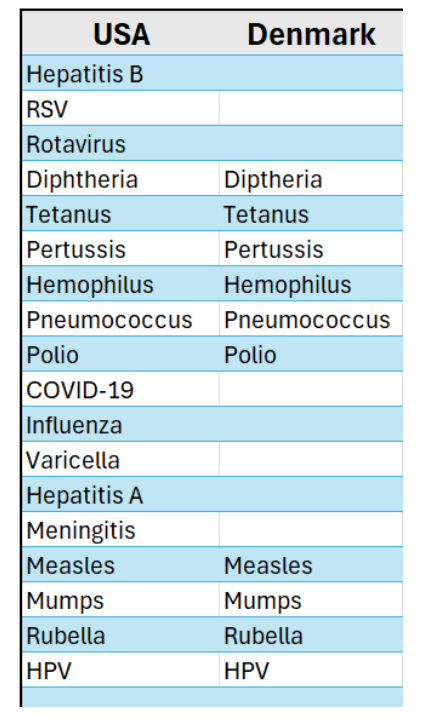
HHS was initially supposed to announce late last month an effort to cut the U.S. vaccine schedule down to size, following President Donald Trump’s executive memorandum instructing the agency to review the vaccine schedules of peer nations to direct future reforms.
Within hours of its announcement, though, the event was canceled, reportedly due to concerns that any policy shift of this size directly from the Centers for Disease Control and Prevention or HHS would violate the Administrative Procedures Act and leave the Trump administration vulnerable to protracted litigation.
Kennedy said in a press statement on Monday that the decision followed an “exhaustive review of the evidence” and implements a vaccine schedule based upon “international consensus while strengthening transparency and informed consent.”
Acting CDC Director and Deputy HHS Secretary Jim O’Neill said Monday that he signed a decision memorandum making the new schedule effective immediately. In an interview with radio show host Scott Jennings on Monday, O’Neill said he spoke with foreign health leaders, including his Danish counterpart, regarding their vaccine schedules in the lead-up to the announcement.
Some legal experts have speculated that massive changes to the childhood vaccine schedule would be susceptible to legal challenges unless they were first recommended through a vote by the Advisory Committee on Immunization Practices, an independent advisory panel to the CDC that plays a vital role in directing insurance coverage for vaccines.
Tracy Beth Høeg, acting director of the Food and Drug Administration’s Center for Drug Evaluation and Research, gave a lengthy presentation comparing the U.S. and Danish childhood vaccine models during the most recent ACIP meeting last month.
Høeg, a physician who has practiced medicine in both the U.S. and Denmark, said the Danish approach to infectious disease prevention relies upon a more holistic understanding of children’s health and well-being than that of the U.S.
Critics of cutting U.S. vaccines, however, are quick to highlight the major differences between Denmark and the U.S. that make the Danish disease risk profile more suitable for a minimal childhood vaccine schedule.
Denmark’s population is only 6 million, comparable to that of the state of Colorado or the metro Atlanta area, rather than the entire U.S. population of 340 million. The landmass of the U.S. is also roughly 300 times the size of Denmark, which has a similar land area to that of Maryland.
Opponents of implementing the Danish vaccine model also note that Denmark has a socialized medicine system that provides universal healthcare coverage, meaning that there are fewer gaps in both prenatal care and childhood health screenings.
Dr. Demetre Daskalakis, the former head of the CDC’s immunizations wing who resigned over the summer following clashes with Kennedy over vaccines, argued in a Washington Post op-ed last month that the U.S. disease burden is different in part because the U.S. healthcare system is more heterogeneous than Denmark’s single-payer framework.
“It has universal health care, national patient registries and a highly homogeneous population with low rates of vaccine-preventable diseases,” Daskalakis wrote of Denmark. “Its immunization program is designed for a system where every child is tracked, every parent has access to care and every gap is quickly closed.”
Removing any vaccines from the childhood vaccination schedule would effectively remove them from the Vaccines for Children Program, which provides no-cost immunizations to uninsured or Medicaid-enrolled and Native American children, Daskalakis wrote in his December 2025 op-ed.
Sen. Ron Wyden (D-OR), the top Democrat on the Senate Finance Committee, which has jurisdiction over HHS, said following the announcement that Kennedy is “hellbent on continuing his anti-vaccine crusade, making America sicker and enhancing children and other vulnerable people.
“Robert Kennedy, with Trump’s blessing, is leading the country down a tragic path where more children die from preventable disease,” Wyden said.
Sen. Bill Cassidy (R-LA), the chairman of the Health, Education, Labor, and Pensions Committee, denounced the decision via X, noting that the vaccine schedule is not a mandate but rather recommendations upon which states can create mandates or parents and pediatricians can make choices.
US LIKELY TO LOSE MEASLES ERADICATION STATUS IN 2026
“Changing the pediatric vaccine schedule based on no scientific input on safety risks and little transparency will cause unnecessary fear for patients and doctors, and will make America sicker,” Cassidy said.
Cassidy, a physician specializing in liver disease preventable by the Hepatitis B vaccine, has clashed publicly with Kennedy multiple times regarding vaccine policy.
