

Anti-abortion advocates are celebrating the 50th anniversary of the federal prohibition on taxpayer-funded abortions, even as they warn of a growing threat that Democrats will repeal the measure if they gain power.
More than 2.6 million children were born in the past five decades because of the Hyde Amendment, a restriction on abortion payments included in government funding bills for half a century, according to the Charlotte Lozier Institute, an anti-abortion think tank.
Stay informed.Stay ahead.
Join Washington Examiner for unlimited access to the news, analysis, and commentary that matter most.
Already a member? Log in
Named after the late Illinois Republican congressman Henry Hyde, who introduced the measure that was enacted 50 years ago Wednesday, the Hyde Amendment prohibits taxpayer funding for abortions in federally funded health insurance programs except in cases of rape, incest, or to save the life of the mother.
But Republicans who spoke with the Washington Examiner ahead of the anniversary are concerned for the future of the Hyde Amendment, particularly if Democrats win the House, Senate, and presidency, and if Senate rules are changed to allow for simple majorities to pass legislation.
Anti-abortion Democrats and Republicans in the 1970s and 1980s came together each year to block federal abortion coverage in Medicaid, the partially federally funded health insurance program for low-income Americans. But the bipartisan consensus on the Hyde Amendment cracked in 2010 under the weight of passing Obamacare, which effectively brought an end to the small coalition of anti-abortion Democrats in Congress.
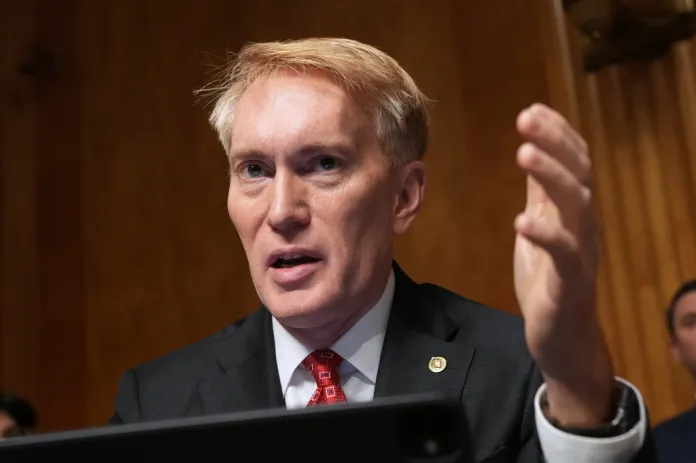
Sen. James Lankford (R-OK), Vice Chairman of the Senate Republican Conference, told the Washington Examiner that he fears that liberal Democrats would strategically target the Hyde Amendment if they win a governing trifecta in 2028.
“Now, Democrats are committed to finding every way they can to increase the number of abortions in America, including having federal taxpayers pay for elective abortions,” Lankford said. “So a very different Democrat Party perspective from just 10 years ago — certainly from 50 years ago when the Hyde Amendment came into place.”
Biden’s attempt to end Hyde thwarted by Senate rules
Democrats sought to remove Hyde amendment language from appropriations bills when they won the House, Senate, and presidency in 2020, but the Senate’s filibuster rule, which requiring a 60-vote majority to pass legislation, stood in the way.
Former President Joe Biden had been a longtime supporter of the Hyde Amendment, consistently opposing taxpayer-funded abortions during his 36 years in the Senate. But during his campaign for president in 2020, Biden switched sides.
The Democrat-majority House passed the health agency appropriations bill without Hyde protections, but enough anti-abortion Republicans blocked the measure from reaching the filibuster-proof threshold to pass the Senate.
Rep. Chris Smith (R-NJ), a stalwart anti-abortion advocate in the House, said he and his colleagues in the lower chamber were grateful that enough anti-abortion senators prevented the bills from passing without Hyde language.
“Thank God we had a Senate that said, ‘You know, forget it. You’re not going to get these bills,’” Smith said. “People always knock the Senate. Well, they stood up tall then and made sure that Hyde and everything else went back into the law.”
Since then, an increasing number of Republicans have called for the end of the filibuster rule under pressure from President Donald Trump. But anti-abortion Republicans consider it a bulwark protecting the Hyde Amendment each year.
Lankford, a supporter of the filibuster, said he believes Democrats “absolutely would” target the Hyde Amendment in the future if either party decided to change the rules in the Senate to only require simple majorities.
“If the filibuster went away — and whether that is Republicans unwisely throwing away the filibuster or Democrats unwisely throwing it away — I do think one of the first things that they would get rid of would be the Hyde Amendment,” Lankford said.
Democrats renew promise to end Hyde Amendment
Democrats stepped up their efforts to scrap the Hyde Amendment after the Supreme Court overturned Roe v. Wade in 2022, which allowed states to restrict abortions early in pregnancy.
Sen. Patty Murray (D-WA) told the Washington Examiner in a statement that she has introduced legislation “to put an end to the Hyde Amendment,” which she says has become a necessity for women’s health since Roe was overturned.
“I will keep pushing for that — abortion care should always be accessible and covered, no matter where you get health care or what type of insurance you have,” Murray said. “Right now, all over this country American women are living through the devastating and deadly consequences of the post-Roe health care crisis.”
House Reproductive Freedom Caucus co-chairs Reps. Diana DeGette (D-CO) and Ayanna Pressley (D-MA) told the Washington Examiner the anti-abortion measure is “nothing more than a dangerous, racist, and classist abortion ban.”
“In Congress, as in the American public, there is historic and growing support for ending the Hyde Amendment once and for all,” the congresswomen said in a statement. “The government should never have the right to use health insurance coverage as a targeted weapon, should never deliberately strip certain people of the freedom to make their own medical decisions.”
Democrats on the shortlist for the presidential nomination in 2028 also have demonstrated their support for taxpayer-funded abortions by opposing the Hyde Amendment.
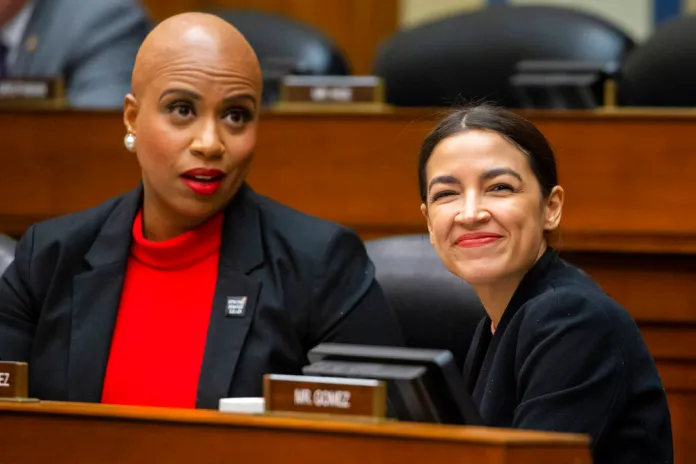
Rep. Alexandria Ocasio-Cortez (D-NY), a 2028 Democrat frontrunner, introduced a measure with Pressley and others in 2020 to permanently repeal the Hyde Amendment, calling it an “inhumane policy” that “disproportionately denies the right of choice to low-income women and women of color.”
Former Vice President Kamala Harris, during her time in the Senate, similarly sponsored legislation that would permanently prohibit the inclusion of Hyde Amendment language in appropriations bills. In the Biden administration, Harris also led a nationwide tour meant to “fight back against extremist attacks” on abortion following the Dobbs decision and made abortion rights a central feature of her 2024 presidential campaign.
Sens. Mark Kelly (D-AZ) and Cory Booker (D-NJ), two other potential candidates in the 2028 Democratic primary, have also expressed support for ending Hyde Amendment prohibitions on abortion funding.
Dwindling opposition to taxpayer-funded abortion
Although those who oppose taxpayer-funded abortion are still in the majority, their numbers have declined over the past decade, signaling a problem on the horizon for the anti-abortion movement.
A thin majority of 54% of Americans opposed using tax dollars for abortion, according to a January 2026 poll conducted by Marist University and the Catholic group the Knights of Columbus. But that is a 14 percentage point decline since November 2015.
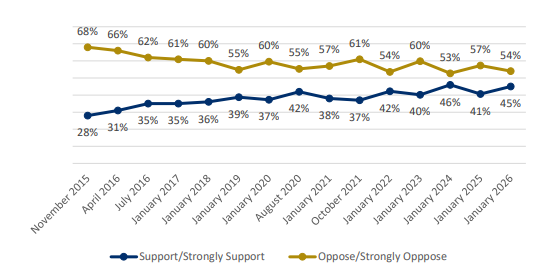
Meanwhile, support for legal abortion has risen. Since 2012, the share of Americans who say abortion should be legal in all or most circumstances at least through six months of pregnancy has risen 12 percentage points, from 20% to 42%.
The poll also found 16% of those who identified as “pro-life” and 18% of Republicans in 2026 supported using taxpayer dollars for abortion, while nearly 40% of respondents who identified as “pro-choice” opposed tax-funded abortions.
In a separate poll conducted in the immediate aftermath of overturning Roe in 2022 by the left-leaning group Data for Progress, 50% of respondents expressed support for federal funding for states to provide abortions to in-state residents and out-of-state visitors.
Former congresswoman Marilyn Musgrave, who served in the House with Henry Hyde in the early 2000s, told the Washington Examiner the Hyde Amendment depends upon voters choosing candidates that will defend it each year in the budget-making process.
ABORTION PILL MAKERS SHIRK OVERSIGHT RESPONSIBILITY WHILE MAKING MILLIONS, SENATE GOP FINDS
Musgrave, who is now the head of government affairs at Susan B. Anthony Pro-Life America, said the Hyde amendment “has to be fought for every year.”
“And so for the next 50 years, we have to have elected representatives that will stand for the common sense view that Hyde protections are what the American people want,” Musgrave said.
