

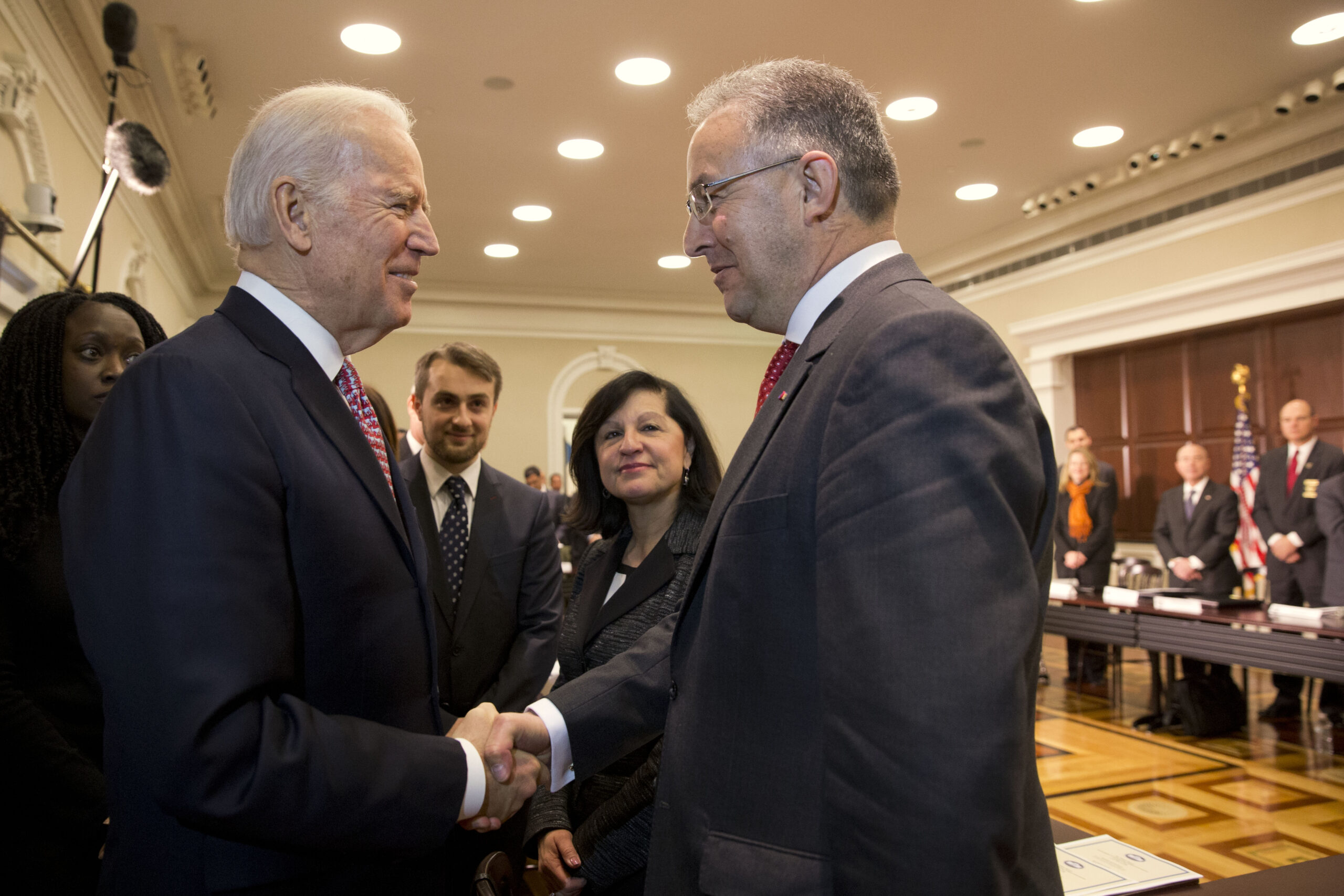
Vice President Joe Biden opened the three-day White House conference on countering violent extremism by arguing that America’s long history of assimilating immigrants could help prevent terrorist attacks on U.S. soil similar to the recent spate of assaults in Europe.
“I am not suggesting that America has all of the answers here — we are just a lot more experienced,” he said in lengthy remarks before the beginning of a roundtable on community initiatives for countering extremism at the Eisenhower Executive Office Building.
Recommended Stories


“We are a nation of immigrants, and our strength is that we are a melting pot,” he added, later noting that the U.S. wants to learn from Europe’s efforts to counter violent extremism as well.
The roundtable, taking place Tuesday afternoon, includes leaders from Los Angeles, Boston and Minneapolis-St. Paul, home to pilot programs for community efforts to counter extremism. They were joined by Ahmed Aboutaleb, the mayor of Rotterdam, the Netherlands, and Hans Bonte, the mayor of Vilvoorde, Belgium.
“I know from my discussions in Belgium, all of Europe is trying to figure this out,” Biden said, referring to his trip to Belgium in early February before the Munich Security Conference on global security challenges. “There has been a significant amount of immigration into Europe from all over the world — it is a newer phenomenon.”
The Justice Department last fall launched a new series of pilot programs in Boston, Los Angeles and Minneapolis-St. Paul to bring together community representatives, public safety officials and religious leaders in a community-led effort to counter extremism.
“The pilot cities have each developed a framework to implement whole-of-community approaches for prevention and intervention. Representatives will discuss their programs and lessons learned during the summit, with the intent to then take their frameworks nationwide,” a senior administration official told reporters.
The Minneapolis-St. Paul area is a hotbed for Islamic radicalization. The area has one of the highest concentrations of Somali immigrants in the country, and since 2007, more than 20 Somali-Americans have traveled back to Somalia and joined the terrorist group al-Shabaab.
“There’s a very strong effort that’s been going on for years, led by the U.S. attorney’s office and [the Department of Homeland Security] to really reach out to that community to try to blunt the recruitment efforts that are going on there,” a senior administration officials told reporters Monday.
“What we’re really looking for are communities to take the lessons to heart and to build ways that prevent and intervene before individuals radicalize [into] violence,” the official added.
Civil rights groups such as the Brennan Center for Justice at New York University are wary of community outreach programs aimed at combating violent extremism.
The center says the groups unfairly target Muslim groups and contribute to a greater culture of Islamophobia.
The group also argues that the U.S. government, specifically the FBI, has used counter-extremism programs in Minnesota to “spy on” the Somali Muslim community.
“With the recent increase in [countering violent extremism]-related programming, does this mean there will be increased surveillance of Muslim communities as well?” the group asked Tuesday in a release.
After the weekend shooting in Copenhagen, Denmark, on a free-speech gathering and terrorist attacks in Paris and a foiled plot on law enforcement in Belgium, Obama administration officials said the community outreach efforts are both urgent and essential.
“Events in Australia, Canada and most recently in France, Belgium and Denmark underscore the significance of the challenges we face in countering violent extremism,” said Alejandro Mayorkas, deputy secretary of homeland security, said in opening remarks at the summit.
