

A whistleblower complaint filed late last month accuses Customs and Border Protection Commissioner Rodney Scott of abusing his authority to order investigations of direct subordinates and to target a senior Border Patrol official with whom he had clashed internally.
A career CBP employee in the commissioner’s office with firsthand knowledge of internal tensions filed the five-page complaint to the Department of Homeland Security’s inspector general on Feb. 25. The complaint outlined what three sources within the Department of Homeland Security described to the Washington Examiner as Scott lashing out over “personal or political vendettas” against his subordinates.
One CBP official resigned last month over the “deep-seated culture of division, corruption, and mandatory fealty to Commissioner Scott,” according to the complaint.
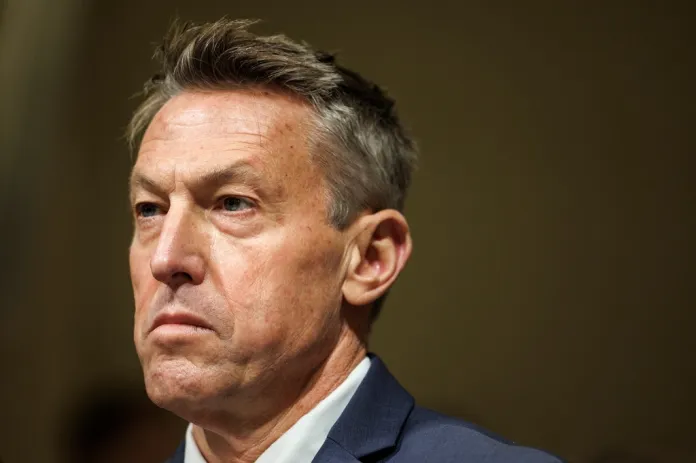
Although news of the complaint comes after DHS Secretary Kristi Noem’s abrupt ouster by President Donald Trump last week, its filing predates her removal by more than a week.
A source familiar with the matter told the Washington Examiner on Monday the complaint would be reviewed by the DHS Office of the Inspector General. White House spokeswoman Abigail Jackson did not comment on the substance of the complaint but said Scott “has done an excellent job implementing the President’s agenda to secure the Southern Border and put America First.”
“Under President Trump’s leadership, Commissioner Scott has worked to totally secure the border and intercept deadly narcotics before they reach American communities, among other critical actions that benefit the American people on a daily basis,” she said.
Scott, Lewandowski clashed for months
Scott had clashed with DHS leadership for months before the whistleblower complaint was filed, sources told the Washington Examiner. Noem’s senior adviser, Corey Lewandowski, had particularly sharp disagreements with Scott, a veteran Border Patrol official of more than 30 years, over how CBP should advance Trump’s immigration agenda.
Several of Scott’s trusted deputies were reassigned by DHS leadership, and he was forced to fire other officials he wanted to keep, the sources said. Noem and Lewandowski replaced some of Scott’s deputies with their hand-picked officials, causing friction at CBP.
Scott’s allies viewed the moves by Noem and Lewandowski as part of a deliberate effort to push Scott out of the administration.
CBP under fire for alleged Greg Bovino ‘perjury trap’
The complaint accuses Scott of assuming “de facto” control over CBP’s Office of Professional Responsibility, the agency’s internal affairs office, to investigate subordinates he viewed as political adversaries in an attempt to “consolidate power” inside the agency “by cutting out the Deputy Commissioner and others.”
Those subordinates he targeted for OPR investigation included his own deputy commissioner, chief of staff, deputy chief of staff, and one senior adviser, who were placed in his office by DHS headquarters after Noem fired his previous slate of top subordinates around late December.
Although Scott oversees OPR directly, the complaint alleges he created an “ethical conundrum” and “weaponized” his role by holding up paperwork for the promotion of the office’s assistant commissioner, who resigned after he pressed her to open the four investigations.
Among the complaint’s most serious allegations is that Scott sought to manufacture a “perjury trap” against Border Patrol’s El Centro, California, Chief Gregory Bovino after an Obama-appointed judge required Bovino to provide daily depositions during a federal lawsuit in Chicago.
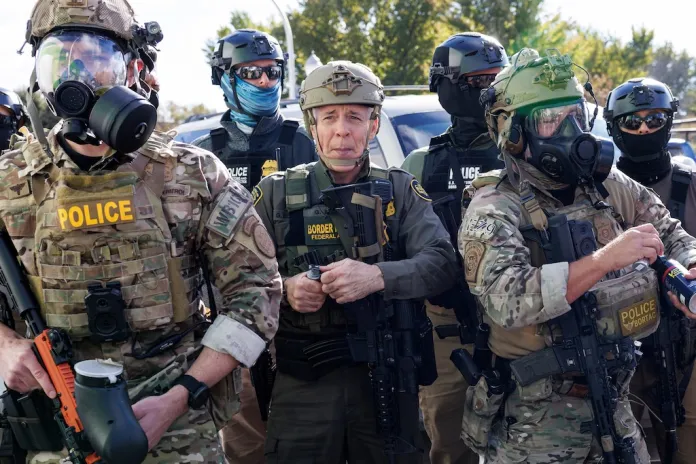
The lawsuit, Chicago Headline Club v. Noem, was filed Oct. 6 by a coalition of nonprofit groups that was challenging Border Patrol’s immigration enforcement tactics in the Windy City. U.S. District Judge Sara Ellis, an Obama appointee, oversaw the case and quickly ruled against DHS. According to the whistleblower complaint, the alleged “perjury trap” set by Scott stems from Bovino’s testimony about Ellis’s Oct. 17 temporary restraining order requiring uniformed Border Patrol agents to wear body cameras while on duty, among other requirements for agents during the immigration enforcement operation known as Midway Blitz.
Bovino testified that neither he nor anyone else on his team had violated the court’s order. Court records show Bovino offered a sworn declaration in November that he complied with the TRO on Oct. 30 when he received a body camera.
Shortly before Bovino was scheduled to testify again, however, OPR issued a letter of reprimand to a member of Bovino’s security detail alleging a violation of the order, according to the complaint. The letter of reprimand alleged that Bovino’s security detail failed to comply with body-worn camera requirements during enforcement operations, a senior DHS official told the Washington Examiner.
That official said the letter of reprimand was flawed because the TRO exempted nonuniformed officers from the body-camera requirement, and Bovino’s security detail was plain clothes, meaning its members do not dress in Border Patrol uniforms.
The whistleblower complaint accuses Scott of pressuring OPR to draft the reprimand letter, alleging that Bovino’s security detail had failed to comply with the restraining order, which, if true, would have made Bovino’s sworn declaration inaccurate and exposed him to scrutiny for perjury.
“The idea was that the court would rely on OPR’s internal assessment as prima facie evidence that Bovino was in contempt,” the senior DHS official said.
Bovino was ultimately cleared of any possible perjury violations after the agency’s general counsel determined the restraining order had not been violated, and the letter of reprimand, which was never published, was rescinded.
However, Bovino still faced scrutiny from the judge in Chicago, who determined he was lying when he testified he was hit in the head by a rock before deploying teargas at a Chicago protest. CBP has also opened an investigation into whether he made disparaging remarks about the Jewish faith when criticizing the U.S. Attorney for Minnesota.
Scott directly sought internal watchdog investigation, emails show
The whistleblower urged the DHS inspector general to focus its review on an email thread labeled “Discussion” that took place between Scott and OPR officials between Jan. 30 and Feb. 4, in which, according to the complaint, Scott allegedly made requests for investigations against his four subordinates. The whistleblower also said Scott discussed the investigations via encrypted messages on Signal.
A Washington Examiner review of the emails revealed OPR opened a preliminary inquiry into Bovino during preparation with agency counsel for his most recent testimony before Congress on Feb. 10. “We did not have an open case and have subsequently opened one,” an OPR official wrote in a Feb. 4 email summarizing the situation.
The Washington Examiner was unable to make contact with officials currently working in CBP’s OPR. A representative for Scott declined to comment on the record on the allegations about his correspondence with OPR or the other allegations in the complaint.
Four of commissioner’s subordinates targeted for investigation
The proposed OPR inquiries into four of Scott’s senior subordinates came after personnel reassignments ordered by DHS leadership under Noem, but Scott’s supposed “paranoia” over the late-December removal of his previous team made him believe his new subordinates were “conspiring to make him quit,” according to the whistleblower complaint.
Emails reviewed by the Washington Examiner show OPR officials were reluctant to proceed without specific allegations of misconduct, describing the information behind the proposed investigations as “second or third hand.”
The dispute contributed to the Feb. 6 resignation of Jennifer Barreras-Rawls, the assistant commissioner overseeing CBP’s OPR, less than three weeks after she began the role in mid-January, over what the complaint describes as her refusal to fulfill Scott’s request for investigations without a written order.
“Barreras-Rawls did not feel that she had the support she needed from Commissioner Scott in
addressing the deep-seated culture of division, corruption, and mandatory fealty to Commissioner
Scott,” according to the whistleblower complaint.
Scott later blocked an external organizational review of OPR on Feb. 18, according to the whistleblower complaint. Drafting of the complaint began Feb. 22, and the complaint was submitted to the inspector general on Feb. 25, nearly a month after the Washington Examiner reported that Noem and adviser Corey Lewandowski had attempted to push Scott out amid disagreements over immigration enforcement strategy and deportation goals.
Sources said Scott first took issue with DHS leadership because he believed Lewandowski had worked beyond his 130-day cap as a special government employee at DHS, which he believed would render the instructions Lewandowski gave him unenforceable. Lewandowski has been in the role for a year, and all eight sources who spoke with the Washington Examiner about the internal tensions at CBP said he is very involved in daily operations.
The DHS has not specified how many days Lewandowski has worked. Scott was also concerned about Noem and Lewandowski’s approach to immigration enforcement. He had pushed back on proposals to have the Border Patrol help ICE with interior immigration enforcement because the two agencies have different missions, and he worried the optics could have a lasting, negative effect on the Border Patrol.
When pressed by the Washington Examiner, two DHS sources who spoke under the condition of anonymity said the complaint had no connection to Noem or Lewandowski.
Scott ‘did not want to put things in writing,’ complaint says
The whistleblower said Scott instructed Barreras-Rawls to open investigations without written complaints or formal allegations. After a career attorney warned that doing so would be improper without documented justification, Scott allegedly refused to put the directive in writing, according to the whistleblower.
“[Scott] said that he did not want to put things in writing because he had other ways to ‘get them,’” the complaint states.
A senior DHS official said the allegations raise serious concerns given the limits on a commissioner’s role in internal investigations.
NOEM AND LEWANDOWSKI WAGED CAMPAIGN TO OUST TRUMP’S BORDER LEADER: SOURCES
“CBP is perhaps the most powerful domestic agency in government,” the official said. “When that authority is used for personal or political vendettas, it becomes a serious national issue.”
Read the full complaint below:
CBP-Whistleblower-Complaint-Rodney-Scott-OPR.pdf by reportoftheday
