
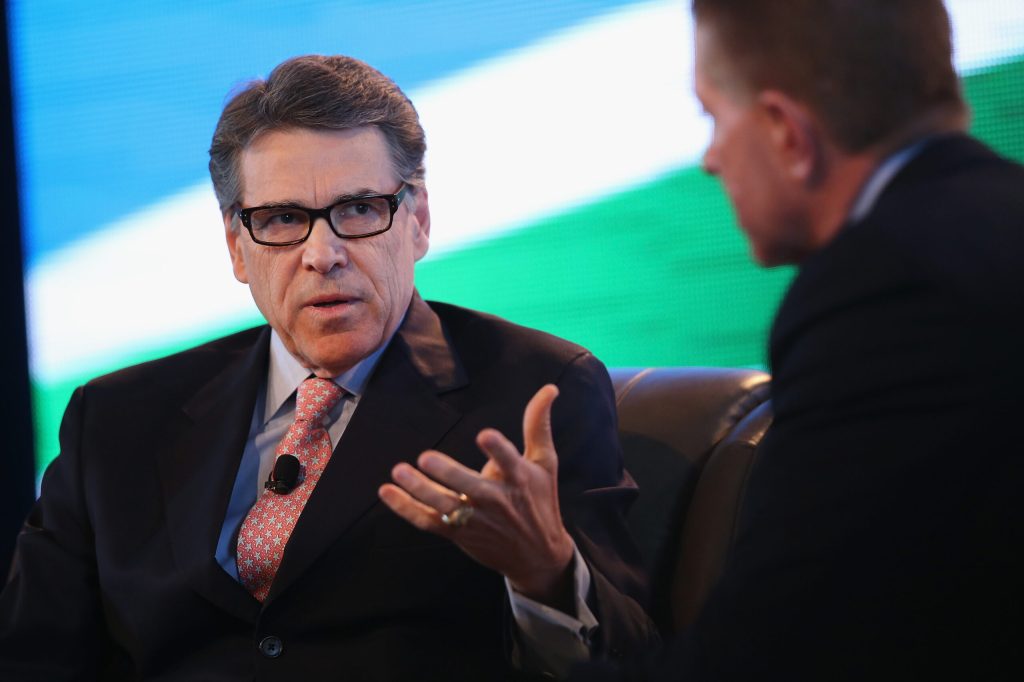
Rick Perry aims to revive his presidential ambitions at the spot of their undoing four years ago — the GOP primary debate stage.
The former Texas governor remains haunted by one word, “oops,” uttered during a 2011 debate. That episode and other shaky performances fueled perceptions that Perry was ill-prepared for the White House. Even now, Establishment GOP operatives second-guess his judgment, while grassroots Republicans wonder if he’s viable. The result is that Perry has entered the 2016 campaign as an invisible man rather than one of the GOP’s frontrunners.
Recommended Stories
Perry understands the criticism. That’s why he spent the intervening years traveling the world and studying up on complex domestic and foreign policy issues. His first chance to impress comes Aug. 15 in Cleveland, the date and site of the first debate of the 2016 Republican presidential primary.
“It’s no secret that mistakes were made last time around and we have a lot to overcome,” Jeff Miller, Perry’s top political advisor, told the Washington Examiner Monday during a telephone interview. “If the governor does decide to run, we will be prepared when the moment comes.”
The governor has scraped the bottom of most polls and been treated as somewhat of an afterthought as he’s moved toward a 2016 bid. He stood at 2.6 percent in the latest RealClearPolitics average of recent surveys. That’s unusual for a Republican with Perry’s public service history and political profile.
Perry is a military veteran who was elected Texas governor three times, serving a record 14 years. He is poised to make his second run for president in as many elections. Recent history suggests the GOP likes to nominate a primary runner-up from four years previous, as the party did with Sen. John McCain of Arizona in 2008 and former Massachusetts Gov. Mitt Romney in 2012.
Perry’s ability to travel along this well-worn path has been complicated by his own, self-inflicted wounds and the upcoming campaign’s expected deep field of heavyweights.
The 2016 primary ballot looks to be crowded with sitting and former governors, senators with national profiles and a few political newbies who have excited the GOP base. Perry must convince big GOP donors and influential conservative activists, not to mention rank and file primary voters, that he can win a general election. Republicans are thirsting for victory after being shut out against President Obama.
The 2016 field also offers GOP voters considerable choice. Republicans attracted to Perry’s conservative bravado but worried the governor’s shortcomings could back Sen. Ted Cruz of Texas. Those who appreciate his executive experience and government know-how but worry that Perry’s 2012 performance wasn’t a fluke could consider another former governor, like Jeb Bush of Florida or Wisconsin’s Scott Walker — the current frontrunner according to most polls. George Seay of Texas, a major Republican donor who backed Perry in 2012, is supporting Sen. Marco Rubio, R-Fla., in the 2016 race.
“He bombed last time, plain and simple,” an unaligned South Carolina GOP insider said. “Perry will need to make the case to [Republicans] that he has learned from his last campaign and won’t make the same mistakes.”
Perry entered the 2012 race late in the campaign, while recovering from back surgery and relying on painkillers. Supporters emphasize that he was physically and mentally unprepared for the rigors of a presidential campaign, and contrast that with now. Perry is in great shape and has spent two years turning himself into a learned expert on issues ranging from the intricacies of monetary policy to the internal politics of Middle Eastern Muslim nations.
Perry’s team argues that perhaps no candidate is prepared to compete with the governor on foreign policy, which is emerging as a major 2016 issue. His advisors are confident that Perry’s other assets — his governing record, retail politics skills and conservative bona fides — will boost him once GOP primary voters realize how prepared he is for the presidency this time around. For the moment, Perry’s supporters are happy to escape the scrutiny that comes with frontrunner status.
“You want to peak when the NCAA [college basketball] tournament is starting, not in mid February,” said Austin Barbour, a Republican operative advising Opportunity and Freedom PAC, a super PAC that backs Perry but is unaffiliated with his political operation.
At least a half dozen Republican strategists interviewed for this story, including party insiders based in the early primary states of Iowa, New Hampshire and South Carolina, confirmed that the Texan is getting a second look, albeit a skeptical one, among early state primary voters and Establishment donors who have yet to sign on to another campaign-in-waiting. They caution not to write Perry off prematurely, saying he has a lot going for him.
Perry’s broadly conservative message fires up GOP primary voters. On social, fiscal and national security matters, they tend to agree with him and take to his fighting spirit.
Perry is aggressively courting voters on the trail, one-on-one, in small and large groups, in the way that builds success over the long haul in the early primary states. Victory in these primary battlegrounds can propel a candidate to the nomination, and Perry’s attention and retail skill shouldn’t be underestimated. In 2012, former Sen. Rick Santorum came out of nowhere to win the Iowa caucuses after months of intense, under-the-radar campaigning there.
Perry’s governing record over 14 years in Texas has motivated Republican donors and other Establishment players to keep an eye on him as a possible go-to choice if other initial first-choice candidates fall short. By most accounts, the Lone Star State’s economic and fiscal performance was good during Perry’s tenure. Many Republicans lean toward nominating a governor with executive experience, and Perry brings more of this to the table than any other candidate considering a 2016 campaign.
“Perry is making a better impression than he did during the 2012 primary,” said a Republican operative with New Hampshire ties. “But he will have to work for it.”