

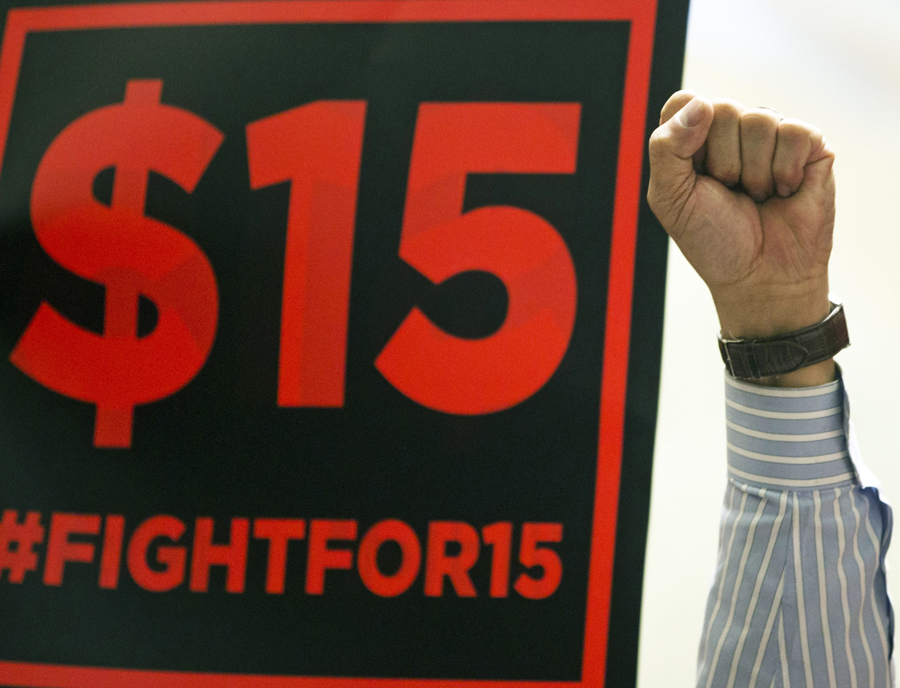
The New York Times on Wednesday pressured Hillary Clinton, who it has endorsed for the Democratic presidential nomination, to adopt the position to increase the federal minimum wage to $15 per hour, up from $7.25.
“Economic obstacles are not standing in the way of a $15 an hour minimum wage,” the Times said. “Misplaced caution and political timidity are.” The paper also said there is “no proof” that such a wage increase would be “too high for employers.”
Recommended Stories



The Times, however, has previously interviewed small-business owners who say an increase in their expenses would likely result in layoffs, and pay increases that go above the minimum wage in order to retain better employees.
In February 2014, the Times reported on Dolores Riley, a childcare business owner in New Jersey, who said a state minimum wage increase from $7.25 to $8.25 per hour “is likely to add $10,000 to $15,000 a year to payroll costs that already make up nearly 80 percent of her operating expenses.”
“I hope I don’t have to close,” Riley said then.
The same article also interviewed Charlene Conway, who owns a skating rink in Massachusetts and said a state increase in the minimum wage from $8 to $9 would likely force her to reduce her staff of 20 workers.
She said that a past increase in the minimum wage led her to raise the age of employees she hired from 14 to 16.
“What this does,” she was quoted, “is eliminate the opportunity for young people to get started in the work force.”
In September of 2014, the Times published a letter from Katrina Ryan in North Carolina, where she owns two cafes. Ryan described herself in her letter as “pretty liberal” and said that she offers her full-time staff health insurance and paid time off.
A minimum wage increase, she said, would mean “some things for my higher paid employees will have to go. There just isn’t more payroll in the budget.”
There are also economic studies that point to the negative impact of a dramatic minimum wage increase — in this case, the Times is calling for a 100 percent increase.
A study published by the National Bureau of Economic Research in 2006 found that “minimum wages reduce employment among low-skilled workers.”
Another 2013 study by Antony Davies, a Mercatus Center-affiliated senior scholar at George Mason University, concluded that increases in the minimum wage, at least in New Jersey, would “increase unemployment among workers without a high school education (by approximately two percentage points), increase unemployment among workers without high school diplomas in general (by approximately one percentage point), and have no effect on unemployment among college-educated workers.”
The Times call for a $15 federal minimum wage is also a sharp departure from the paper’s position in 1987. Back then, the Times said that the “right” minimum wage would be set at $0.
