
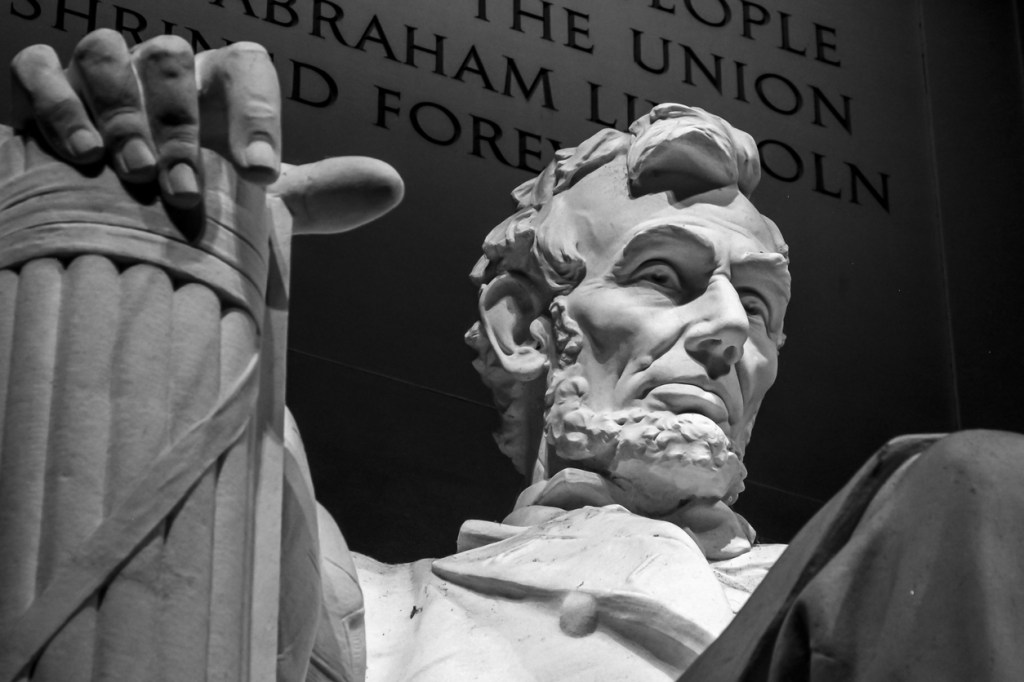
It goes without saying that Abraham Lincoln was one of America’s greatest presidents. The strengths he brought to the job included intelligence, inspired leadership, unmatched rhetorical power, and a steady hand in dire times. No political leader is perfect, of course. Lincoln made mistakes during his astonishing journey from a small log cabin near Hodgenville, Kentucky, to the White House. But his quest and determination to ensure that people from all walks of life had freedom, liberty, and the ability to pursue the American dream remains a constant source of inspiration and admiration.

“Generations have looked up to him as the man who not only preserved the Union,” another great president, Ronald Reagan, said on Lincoln Day on Feb. 12, 1984, “but helped us realize that true democracy is an evolving process.” Today, with various groups fighting over how to “strengthen democracy” or claiming that “democracy is on the ballot,” even as they cheapen the common understanding of what the word even means, it is more important than ever to look to history to understand this political concept. And here, the insights of the wise, self-educated, small-town Illinois lawyer about democracy can serve as a crucial guide. In his new book, Our Ancient Faith: Lincoln, Democracy, and the American Experiment, Allen C. Guelzo shines a new light on Lincoln’s powerful vision for true democracy.
Recommended Stories

Guelzo, a Princeton University historian, is one of the world’s foremost scholars on the 16th U.S. president and Civil War. He has authored 16 books, including Abraham Lincoln: Redeemer President and Lincoln and Douglas: The Debates That Defined America. A three-time recipient of the prestigious Lincoln Prize, he is often included in panel discussions and documentaries focusing on Lincoln’s life and career.
“The word democracy only occurs 137 times in the collected writings of Abraham Lincoln,” he points out. That’s not a significant tally for someone as prolific as Lincoln. Yet what Lincoln said about democracy stands out. “No other word described what he saw as the most natural, the most just, and the most enlightened form of human government,” Guelzo wrote. “Nothing, he said, could be ‘as clearly true as the truth of democracy.’ And nothing demonstrated that truth more clearly in Lincoln’s mind than the American democracy, which embodied ‘the greatest living principle of all democratic representative government.’”
Several themes from Lincoln’s body of work tie directly into the growth and development of democracy, which he once described as “my ancient faith.” In a chapter related to human liberty, Guelzo examines Lincoln’s important distinction between slavery and democracy. This was to illustrate what he believed “democracy was not, and that contrast hinged on the point of consent.” In other words, consent was a duality of “how sovereignty was exercised” and “what drew a line of separation between freedom and enslavement.” Slavery was forced upon black people, who were treated as inferiors and unequal in a country that was supposed to promote equality and equal opportunity. Lincoln correctly understood that consent “was exactly what was absent from the slave’s labor, either at its beginning or ending.” What made slavery wrong, to Lincoln, was then exactly what made it undemocratic: “The master not only governs the slave without his consent; but he governs him by a set of rules altogether different from those which he prescribes himself.”