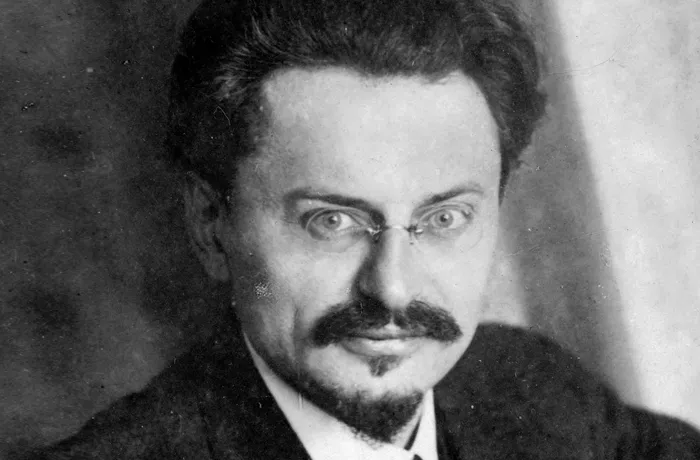
Trotsky’s fatal conceit

On Aug. 20, 1940, the Bolshevik firebrand Lev Bronstein, better known by his nom de plume, Leon Trotsky, was viciously attacked in the study of his home in Coyoacan, a quiet suburb of Mexico City. A fatal blow was delivered via ice axe to the top of his skull by an assassin working on behalf of the feared Soviet intelligence agency, the NKVD. He died the next day on the operating table of a nearby hospital with his wife, Natasha, by his side. Trotsky’s death was the final chapter of his long dissident struggle with the oppressive Soviet state that he’d been instrumental in establishing.

In his intoxicatingly good new book, The Death of Trotsky: The True Story of the Plot to Kill Stalin’s Greatest Enemy, Josh Ireland immerses us in the violent upheavals of the early 20th century, bringing the fraught geopolitics and murky intelligence world of the pre-World War II era to the heights of the finest espionage thrillers. In his exploration of the rivalry between Trotsky and Stalin, and the colorful life of NKVD agent Ramon Mercader, the Spanish communist who ultimately dealt the fatal blow, Ireland explains how Vladimir Lenin’s revolution ultimately evolved into the paranoid, totalitarian empire of Joseph Stalin.

Born in 1879 to impoverished Jews in what is now Ukraine, Trotsky was one of those remarkable figures in history who, while ascending far beyond what his weak early hand in life should have allowed, never quite became all that he could be. Part of this was due to his personality. While he repeatedly demonstrated the spellbinding charisma needed to win followers and obtain political power, he was also undermined by his blatant narcissism, indifference to those around him, and a rather grandiose image that was not entirely befitting of a class revolutionary. Another factor was Trotsky’s lack of skill at political games. Contrasted with his greatest rival, Stalin, who took the time to network with potential allies after party meetings and managed the drudgery of power with an unyielding enthusiasm, the more intellectual Trotsky wound up isolated. His widely anticipated appointment as Lenin’s successor never arrived. For the sake of optics, it likely did not help that he didn’t bother to attend his leader’s funeral.

The Death of Trotsky: The True Story of the Plot to Kill Stalin's Greatest Enemy 
Josh Ireland 
Dutton
$35, 384 pp.
The Death of Trotsky: The True Story of the Plot to Kill Stalin’s Greatest Enemy; By Josh Ireland; Dutton; $35, 384 pp.

Trotsky, “instinctively theatrical,” had entered the political arena when, at 25, he’d demonstrated a talent for public speaking in the throes of the 1905 revolution. The fallout from his emergence as a national political figure saw him banished to Siberia for the second time in his life. When, in 1917, he learned of the Bolshevik Revolution, Trotsky would rush back to the action from another spell of exile in New York.  

He was proven remarkably adept when, during the Russian Civil War, he took charge of the Red Army. Traversing the country by armored train, he inspected the front lines and held military tribunals sentencing cowards and deserters to death. “These Cains must be exterminated,” he said upon ordering the annihilation of peasant villages during one local rebellion. He accrued enough blood on his hands that when, as a tired old man in Mexican exile, he is cruelly felled by the stroke of an axe, one cannot help but feel a sense of karmic symmetry. He was, after all, a founder of the Cheka. With that said, there is also something disgusting about the long string of betrayals that brought about his death. Trotsky, as we learn, was a rather poor judge of character.

In 1927, Trotsky was expelled from the Communist Party, and, in 1929, he was again exiled. After various spells in Turkey, France, and Norway, and while Trotsky’s followers became “socialism’s lepers,” he was invited to Mexico by President Lazaro Cardenas. In Mexico City, Trotsky first decamped to the Blue House, where the artists Frida Kahlo and Diego Rivera held court. When the enormous, eccentric personalities of the Blue House eventually came to clash, Trotsky and his entourage relocated to another compound down the road. It was here that, in May of 1940, a gang of interlopers led by the muralist David Alfaro Siqueiros unleashed a violent, if farcical assault. After subduing the Mexican police guarding the compound, the gang opened fire on Trotsky’s bedroom and launched incendiary devices, perhaps intending to destroy the old man’s substantial archives (a serial writer and archivist, he was writing a highly sensitive biography of Stalin in his final years). Trotsky survived by hiding under his bed, which had been reinforced with a steel plate.

There is a strange inevitability to Trotsky’s demise, a comical sense of fate. Visitors were not often searched; basic security precautions were rarely taken. The NKVD file of Trotsky was 5 inches thick and filled with photographs taken from within his own home. This fact underscores one of the most perplexing aspects of the Trotsky case: the NKVD had enough agents in close enough proximity to the famous dissident for so many years that it becomes hard to believe they actually wanted him dead for all of that time. He was, after all, never quite in hiding, and his attempts to conceal himself during his forays into Mexico City merely consisted of his wearing a bandana. Trotsky’s exile drove an atmosphere of paranoia in the Soviet Union, which preempted Stalin’s great terror. His specter would prove politically useful to Stalin, who, in an effort to consolidate power, rendered even his most loyal supporters as conspirators and enemies.

Leon Trotsky, a Russian revolutionary and rival of Joseph Stalin, assassinated in 1940.
Leon Trotsky, a Russian revolutionary and rival of Joseph Stalin, assassinated in 1940. (Mandel Ngan/AFP via Getty Images)

“By 1938, so many officers had been recalled or liquidated that a number of NKVD residences ceased to function.” Ireland writes. “Hunting down enemies of the people had become a greater priority for the NKVD than, for instance, intelligence collection.”

In the basement of Moscow’s Lubyanka prison and elsewhere, victims of Stalin’s purges were interrogated, made to confess (sometimes they were rendered so weak from torture that a commissar would have to do so on their behalf), and dispatched by one bullet from a Tokarev pistol to the back of the head. The final page added to their lengthy files was the death record, signed by one of the consulting physicians present.

Ireland takes the well-trodden ground of his subject matter to produce a work that is not quite a triumph of historical scholarship, but a brisker and more enjoyable version of a story that has already been told many times over. Everything from the pacing to the illustrations of Trotsky’s life on the run makes for a compelling work that is genuinely hard to put down.

MAGAZINE: A CHARACTER LIKE HARRY REID 

In 1938, Trotsky’s son, Lev Sedov, was felled in Paris, from where he coordinated the Fourth International’s European activities, by a mysterious decline in his health. He died “in the grip of something that the doctors didn’t understand,” perhaps poison. This came after his group’s infiltration by a mysterious outsider, “Etienne,” who was spying on behalf of the NKVD. Despite the apprehensions of Sedov’s entourage, the spy was always protected by his victim.

Trotsky himself fell for the same trick. Mercader, who’d been recruited during his service with the Republicans during the Spanish Civil War, managed to seduce the sister of a Trotsky courtier while living in Paris. Operating under the name Frank Jacson, he decamped to Mexico, gradually gaining trust and access until the final, fatal moment. Ultimately, Trotsky was not brought down by a brilliant conspiracy, but by the same weakness that had dogged him throughout his political life: his fatal misjudgment of the people around him.

Carson Becker is an American writer.

Related Content