

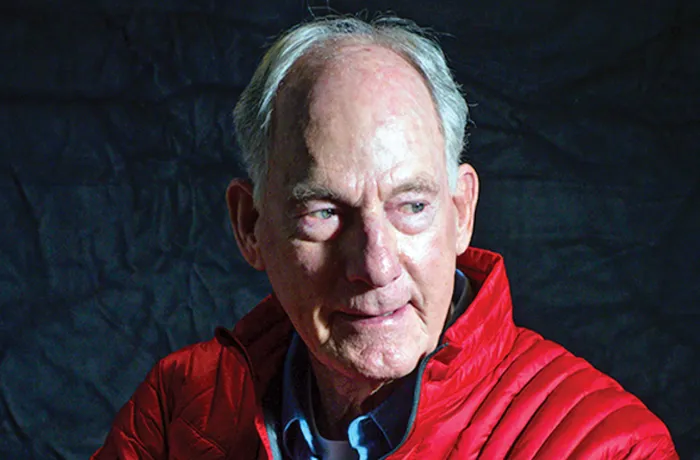
On May 1, 1963, at 1 p.m. local time, a 6-foot-5 Seattle outdoorsman — a shoe salesman, essentially, who had moonlighted as a mountain guide — planted an American flag in the snow at the top of the world. He had climbed through blizzard-force winds and minus-30-degree air, alongside a Sherpa named Nawang Gombu, and was running out of supplemental oxygen somewhere just below the summit. He pressed on anyway. Whatever lay ahead of him, at 29,029 feet, could not be worse than turning back.
Recommended Stories


James Warren Whittaker was born on Feb. 10, 1929, in Seattle, Washington, the son of a mother who, when her boys climbed trees or fences, never told them to be careful. This was, it turned out, a gift. Whittaker and his identical twin brother Lou took up climbing as Boy Scouts in the 1940s, learning the ropes, quite literally, from volunteer instructors willing, as Whittaker later said, “to welcome a stumbling teenager into their course and teach me about gravity.”
At 16, the brothers summited 7,965-foot Mount Olympus in Washington’s Olympic range. When they came down and reached the town of Port Angeles, they found cars honking and people celebrating — World War II had ended. It was a perfect metaphor for the kind of life that awaited Whittaker, one in which the exhilaration of the summit and the drama of the world below would always be in conversation.
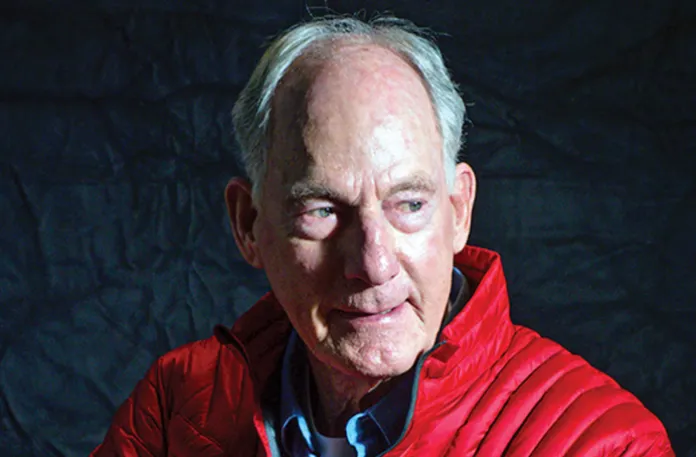
After graduating from Seattle University, Whittaker joined a small outdoor cooperative called Recreational Equipment, Inc., where he became the company’s first full-time employee on July 25, 1955. His career and REI’s would grow together in ways neither could have predicted. When filmmaker Norman Dyhrenfurth invited the Whittaker twins to join a 1963 American expedition to Everest, Jim’s expertise in outdoor equipment made him the expedition’s gear coordinator. Then Lou, on the eve of departure, backed out to open a sporting goods store in Tacoma. “I felt betrayed,” Jim later wrote in his memoir, “A Life on the Edge.” “It was a stunning blow.” But history could not wait for brotherly solidarity.
The American Mount Everest Expedition of 1963 assembled nearly 20 expert climbers to accomplish what no American had managed in the decade since Edmund Hillary and Tenzing Norgay first stood atop the world. Whittaker spent weeks above the clouds acclimatizing and establishing camps before his summit day arrived. He and Gombu, a nephew of the great Tenzing Norgay, set out in brutal conditions. The oxygen ran out. They went on. At 1 p.m. on May 1, Whittaker became the first American to stand on the summit of Mount Everest, with the whole curve of the earth visible around him.
The country went wild. President John F. Kennedy awarded Whittaker and the expedition the Hubbard Medal, the National Geographic Society’s highest honor. The once-shy, rangy climber was suddenly on magazine covers and in demand for speeches and good causes. Among those causes was a friendship with Robert F. Kennedy that became one of the defining relationships of Whittaker’s life.
In 1965, Whittaker guided RFK up a newly named 14,000-foot Canadian peak — Mount Kennedy, named for the fallen president — and the two men grew close. When Kennedy ran for president in 1968, Whittaker served as chairman of his Washington state campaign. When Kennedy was shot in Los Angeles, Whittaker flew immediately to the hospital. “Bobby Kennedy was one of the grittiest little guys you’ve ever seen,” the 6-foot-5 Whittaker later said. “It’s not how big you are, but how tight you are wound that counts.”
The mountains, meanwhile, kept calling. In 1978, Whittaker led the first successful American expedition up K2, the world’s second-highest peak, considered by many to be more technically demanding than Everest. Back at REI, he rose to chief executive, leading the cooperative from 1971 to 1979 and watching its membership grow from 250,000 to nearly a million. Then in 1990, at 60, he returned to Everest to lead the Earth Day 20 International Peace Climb, bringing together American, Soviet, and Chinese climbers to demonstrate what goodwill across the Cold War’s lingering fault lines could accomplish. Twenty climbers reached the summit, the most successful Everest expedition in history. The team also hauled two tons of trash off the mountain on the way down, because Whittaker was that kind of man.
He summited Mount Rainier more than 100 times. He led 10 disabled climbers up Rainier in 1981 and said afterward that, for them, “that was Mount Everest.” He sailed around the world with his family. He fought to preserve the wildness of wild places. “You’re in nature, participating in God’s creation,” he said. “It’s such a high, such a spiritual thing.” He understood what that meant because he had felt it over and over, at altitudes where most of us will never breathe.
Jim Whittaker died on April 7, 2026, at his home in Port Townsend, Washington, at the age of 97, in a bed with a sweeping view of the Olympic Mountains and Port Townsend Bay. The man who reached the top of the world once put it simply: “When you live on the edge, you can see a little farther.” Ninety-seven years would seem to be proof enough of that.
Daniel Ross Goodman is a Washington Examiner contributing writer and the Allen and Joan Bildner Visiting Scholar at Rutgers University. Find him on X @DanRossGoodman.
