

Our nation’s semiquincentennial is upon us. That’s historian-speak for July 4, 2026, the 250th anniversary of the signing of the Declaration of Independence. Beverly Gage, Pulitzer Prize-winning author and professor of U.S. history at Yale University, has used the occasion to do one of her favorite things: hit the road. The result is This Land Is Your Land: A Road Trip Through U.S. History, a 13-chapter book featuring 13 road trips Gage took in 2023 and 2024 in anticipation of America’s milestone birthday.
Recommended Stories


As Gage describes it, “Each chapter describes a road trip unto itself, a five-to-ten-day journey by car through some significant place — a city, a state, a region — where the key questions of American history intensified at a certain moment, and where Americans today are wrestling with how to understand and interpret what happened.”
In total, Gage visited 300 historic sites, museums, battlefields, parks, monuments, souvenir shops, and roadside attractions across the continental United States. “Many will be familiar: Independence Hall, the Alamo, Mount Rushmore,” writes Gage. “Others will be places and attractions you might never have heard of — the Eugene V. Debs House in Terre Haute, Indiana, or the historic black town of Mound Bayou, Mississippi — especially if you weren’t raised nearby.”
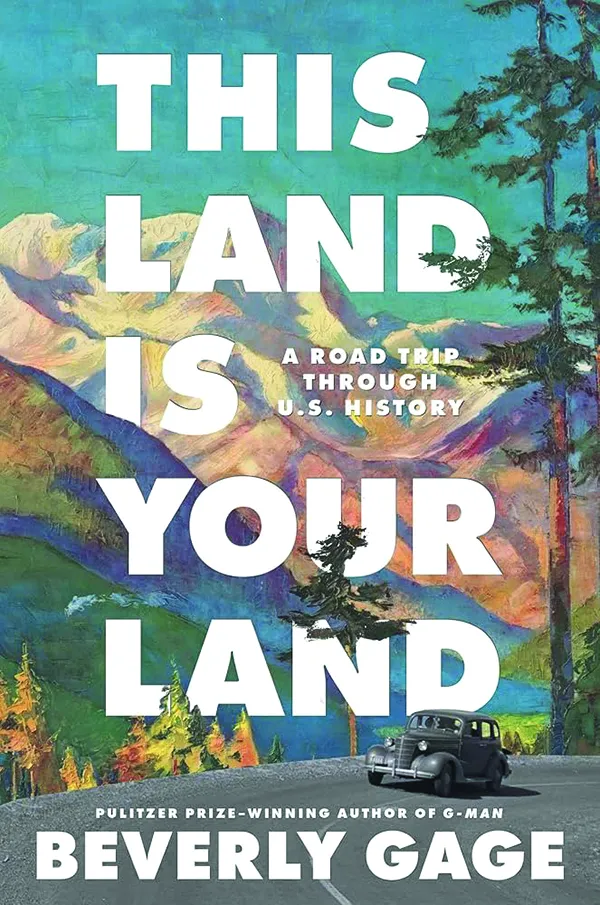
Simon & Schuster; 352 pp., $30.00
The journey begins, unsurprisingly, in revolutionary Philadelphia at Independence Hall and ends in mid-20th-century Southern California at the happiest place on Earth (yes, Disneyland). However, the book is arranged by chronological time periods, not by geography, so the journey is not a straight shot from the East to the West coast. As Gage puts it, there’s a lot of zigzagging in between. She covers a lot of ground, both literally and figuratively, but she strives to draw connections from place to place and from one moment in time to another so that her travelogue doesn’t feel disjointed.
From Philadelphia, Gage heads to the stately Virginia dwellings of our nation’s forefathers (Colonial Williamsburg, Mount Vernon, Monticello, and Montpelier), where the paradox of all paradoxes — slaveholders writing the playbook for freedom — is on full display. From there, it’s on to Nashville, Tennessee, the adopted hometown of President Andrew Jackson, and then to San Antonio, Texas, where staunch Jackson critic Davy Crockett made his home after losing his Tennessee congressional seat, only to die at the battle of the Alamo.
While in San Antonio, we get a glimpse into the Ralston Family Collections Center, what Gage calls the “new Alamo museum.” This state-of-the-art building houses the famous British musician Phil Collins’ Alamo collection. “Apparently he watched the Disney show about Crockett as a little kid, got inspired, and ended up amassing one of the world’s foremost Alamo artifact collections,” explains Gage. Who knew?
Next on the itinerary are upstate and central New York, where some of the most groundbreaking figures in American history made their homes — Frederick Douglass, Gerrit Smith, and Harriet Tubman, Elizabeth Cady Stanton, and Susan B. Anthony. This northern convergence of abolitionists, women’s rights activists, politicians, and reform-minded Christians from all walks of life made for the “stuff of legend” and “had as much impact on the America we live in today as anything that took place at Independence Hall or the Alamo,” writes Gage.
Gage then heads south again, this time to South Carolina. Her quick stop at Parris Island, just outside of Beaufort, brought back memories of attending my brother’s hard-earned boot camp graduation there in 2010. Outside of training U.S. Marines, I didn’t realize that this Lowcountry town played such a pivotal role in Civil War history. Once “a hotbed of secession,” Beaufort became the headquarters of the Reconstruction Era National Historical Park in 2017. The space honors the remarkable Robert Smalls, a former slave and war hero who bought the house that once belonged to his enslaver.
Gage’s account of her trip to Manzanar, California, where the first Japanese internment camp was established during World War II, is particularly memorable. “It’s one thing to know that 120,000 people of Japanese ancestry were sent off to internment camps in remote locations,” writes Gage. “It’s another to taste the dust in the air and feel the noonday sun bearing down.” In other words, you had to be there.
Some critics believe Gage focuses too heavily on the negative aspects of our nation’s history at the expense of more triumphant ones, but I didn’t see it that way. Sure, there are accounts of our nation’s darker moments of deep injustice (and even a dig or two at President Donald Trump’s policies), but it’s ultimately Gage’s journey, her chosen itinerary, her perspective as a teacher and student of history. Also, attempting to interpret events stretching across 250 years in as many pages is no small feat. You just can’t cover them all.
The personal travel anecdotes Gage shares, including the bumps in the road that we can all relate to — car troubles, GPS mishaps, canceled and delayed trips due to COVID-19 — give the book some levity in between the heavier history lessons. Gage travels solo for most of her adventures, but there are a couple of instances where she is joined by her adult son, Nick, and her beau (now husband), fellow historian John Fabian Witt. “Nick and I have been exploring American history together since he was a little kid,” explains Gage. “Around age four, he discovered that he could delay bedtime … by gazing sweetly into my eyes and saying, ‘Mama, just one more history fact?’ Unable to resist, I would launch into disquisitions on the Chinese Exclusion Act, Watergate, or the coming of the Civil War.” He joins his mother for the Texas and California legs of the journey. In addition, the first road trip Professors Witt and Gage took together as a couple — a visit to New Deal Detroit to explore Henry Ford’s old stomping grounds — occurred during the writing of the book. “Sometimes romance means nerding out in the Rust Belt,” says Gage.
The “nerding out” is what lends this book its charm. For example, while in the Cold War Southwest, Gage partakes in some “atomic tourism” in Los Alamos, New Mexico, and on the outskirts of Las Vegas, but she wants more. She declares, “I didn’t just want to learn about atomic history from afar. I wanted to spend the night in a nuclear missile silo.” She finds what she’s looking for in Roswell, New Mexico, a town best known as the site of an alleged UFO crash covered up by the government. And so she accomplishes her “Cold War mission” in what has got to be the most unique Airbnb in all the land.
I would call Gage’s road trips a success, and her book gave me a thought: Surveying our nation’s past is a lot like taking a road trip. It’s sometimes harrowing, oftentimes uncomfortable, but always memorable. I enjoyed being along for the ride.
Erin Montgomery is a writer living in Maryland.
