

The most remarkable thing about Joshua Kendall’s new biography of cartoonist Garry Trudeau is that it exists at all. The Doonesbury creator is notoriously reclusive. He has been called “the J.D. Salinger of comics.” In 1975, Time magazine told the then-27-year-old Trudeau that they wanted to do a cover feature on him. He agreed to an interview but threw up the night before and called it off. He has kept his silence, with a handful of exceptions, ever since.
Recommended Stories


Reticence comes naturally to WASPs. Trudeau is an “American aristocrat, descended from three generations of Yale-educated doctors,” Kendall writes. His earliest North American ancestor, Etienne Trudeau — whom he shares with Canadian prime ministers Pierre and Justin Trudeau, making them his distant cousins — arrived in Canada from France in 1659. His great-grandfather, Edward Livingston Trudeau, established America’s first tuberculosis sanitorium in the Adirondacks in 1884. His father carried the family tradition of medicine as the town doctor in the upstate New York village of Saranac Lake.
Garretson Beekman Trudeau, born 1948, attended St. Paul’s, the preppiest of prep schools, and then Yale University. He came to Yale at a pivotal time. Between 1966, when he arrived as a freshman, and 1973, when he left with a Master of Fine Arts in graphic design, Yale went from a finishing school for blue bloods to a campus for meritocrats, strivers, and political radicals.
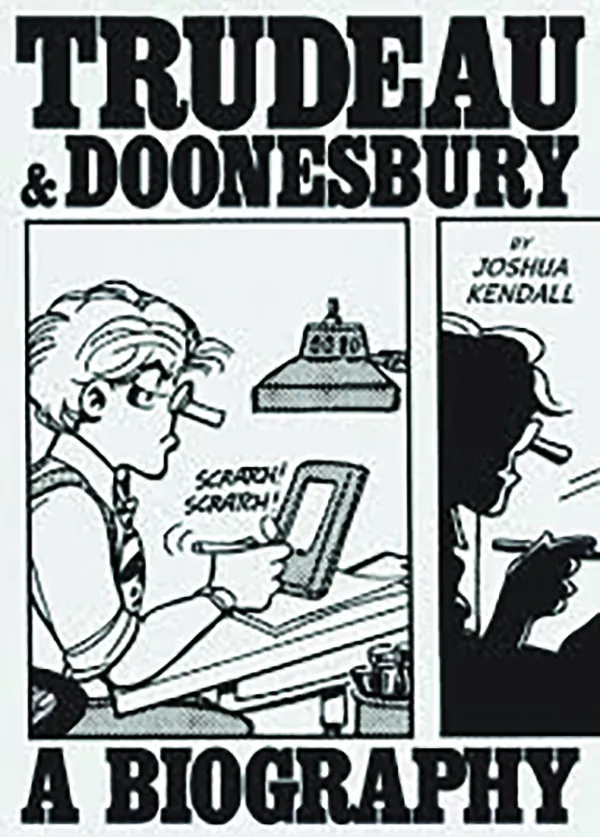
By Joshua Kendall; Abrams Press; 352 pp.; $35.00
The old guard was represented by George W. Bush, who was two years ahead of Trudeau in the same residential college. They crossed paths on the activities committee. Trudeau hated him. In 1967, Trudeau contributed to a Yale Daily News article about branding irons being used on pledges at Bush’s fraternity. Thirty years later, he reprinted a photo from that article in a strip about the Abu Ghraib scandal. “While you can’t draw a direct line between a 19-year-old’s fraternity activities and national policy,” Trudeau said in 2005, “this is part of a larger picture of this administration’s belief that the ends justify the means.”
The Yalies whom Trudeau liked came from the new breed. The Doonesbury character “Megaphone Mark” Slackmeyer is based in part on Mark Zanger, leader of the Yale chapter of Students for a Democratic Society. “I was committed to the anti-war cause,” Trudeau remembers, although “I found much of its leadership clownish.”
He launched his national career by selling himself as a cartoonist who could interpret the boomer generation for the rest of the country. “As you might have noticed, there has been an enormous amount of national attention focused on us students as of late,” he told his editor at the Universal Press Syndicate in 1970. Trudeau proposed a strip that would “develop topics like drugs, sex, and all the many issues such as the War, the Panthers, etc., that have all the students worked up. Strip wouldn’t be radical, emphasis still on humor and good taste.” His editor wrote back enthusiastically, and Doonesbury made its debut in 28 papers across the country on Oct. 26, 1970.
Just five years later, he won the Pulitzer Prize for editorial cartooning, the first comic strip artist to do so. The secret to his success was Watergate. He hammered the subject mercilessly and followed every twist and turn in the case. Six weeks had always been his lead time on each strip, but he had to cut it down to one week so that his topical dialogue would not be out of date by the time it was published.
People loved him, even his targets. John Ehrlichman wrote to request the original of a strip lampooning him. “Trudeau’s humor had a playful quality. It was creative – not malicious,” one Nixon speechwriter tells Kendall. An exception was Hunter S. Thompson, the model for the Doonesbury character Uncle Duke. “If I ever catch that little bastard, I’ll tear his lungs out,” Thompson grumbled. He wanted to sue Trudeau, but his lawyer told him he should be grateful: “The guy makes you out to be friendly and nice, basically. You’re not.”
The only people who really disliked Doonesbury were left-wing radicals who doubted whether Trudeau believed in anything. He obviously hated Republicans, but what was he for? “He had no specific political agenda,” Kendall admits. Friend and occasional collaborator Nicholas von Hoffman said, “Garry is not nearly as radical as people think he is,” hence why his strip “is basically gentle in nature.”
Feminism was one policy issue that got Trudeau’s blood moving. The character Joanie Caucus was a personification of women’s liberation. She first appeared in 1972 as a hitchhiker fleeing an abusive husband. Trudeau tussled with censors to depict Joanie having premarital sex with her boyfriend in 1976 — a strip that 15 papers refused to print — and later cohabiting with him. After the Joanie character graduated from law school in 1977, the Exxon Foundation launched a $100,000 scholarship fund, the Joanie Caucus Fellowship, for women over 30 to attend law school.
“The most controversial six-strip series of his career,” according to Kendall, was about a women’s issue: abortion. In 1984, the short film The Silent Scream brought the gruesome reality of abortion home to American viewers by showing real ultrasound footage of a 12-week-old fetus during an abortion. Trudeau retaliated with “Silent Scream II: The Prequel” about a 12-minute-old fetus named Timmy, represented by a dot. UPS refused to run the strips, so Trudeau gave them to The New Republic. “Please think of TNR the next time you’ve got something too tasteless to distribute through normal channels,” editor Michael Kinsley wrote him.
Trudeau had all the virtues and vices of the old WASP class. Moderation was one of those virtues. So was parsimony. He drank instant coffee all his life, until his wife exposed him to brewed coffee on their honeymoon in Paris. He was also just plain nice. A writer on Family Guy invited Trudeau and his sons to visit the show’s studio after Doonesbury gave them a shout-out in 2005. “Garry was very gracious, signing swag and asking questions of me and my fellow writers,” the staffer remembers. After that, series creator Seth MacFarlane “decided to remove a critique of Doonesbury that was slated to run in a future episode. We just couldn’t do it.”
The vice of the WASPs was snobbery, a quality that Trudeau also has in abundance. The reason Trudeau hated Nixon so much was not that they disagreed on policy but because the man was uncouth. The same with George W. Bush and his evangelical voters. In Trudeau’s eyes, they were simply vulgar.
No one’s vulgarity offended Trudeau more than Donald Trump’s. “If one had to designate a Patient Zero … for Trump Derangement Syndrome,” the Washington Times wrote in 2024, “that dubious distinction would have to go to” Garry Trudeau. He wrote his first strip about the mogul in 1987. His Trump material has since filled five anthologies, whose titles include Yuge!: 30 Years of Doonesbury on Trump and Day One Dictator: More Doonesbury in the Time of Trumpism.
REVIEW: LEGACY MEDIA IS A LEGEND IN HOLLYWOOD’S MIND
Trudeau admits that his Trump strips at this point are “muscle memory.” His strip, which since 2014 has only run on Sundays, has lost its freshness in its fifth decade. So why does Trudeau keep at it? Perhaps out of the ethic of service that he inherited from his WASP forebears. As annoying as his knee-jerk liberalism can be, there is something admirable in his commitment to his vocation.
Given his privacy, we rarely see Trudeau in his capacity as father of three, but those glimpses show him at his best. When his daughter, Rickie, got into Yale in 2002, she told him she felt she “snuck in” and “had an unfair advantage because of you.” In the best WASP spirit, he told her, “Rickie, it’s not about whether you have been given an advantage, because you have. The question is, what will you do with that advantage?”
Helen Andrews is the author of Boomers: The Men and Women Who Promised Freedom and Delivered Disaster.
