
House Minority Leader Hakeem Jeffries (D-NY) has bristled at questions about his leadership should Democrats retake the House in November.
But after a wave of insurgent primary wins from New York City to Colorado elevated left-wing challengers openly critical of the party establishment, and in some cases of Jeffries himself, the minority leader now faces the reality that he may need to win their support if he hopes to hold the gavel.
Recommended Stories
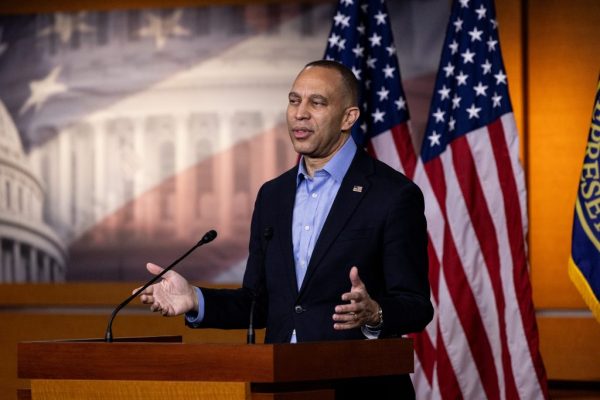

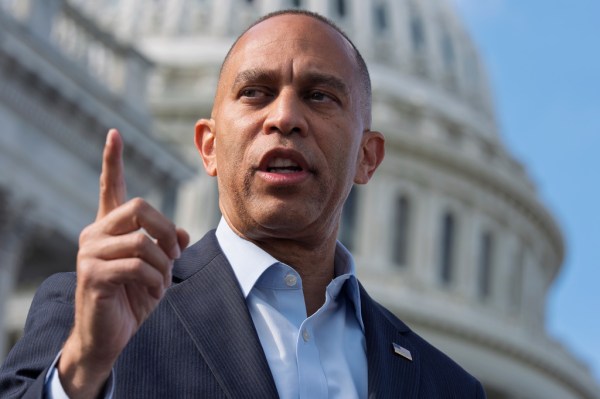
Jeffries, for his part, has brushed off questions over how he would govern a Democratic majority, telling reporters Tuesday: “I think I’ve stood as the Democratic nominee for speaker now a total of 20 times because of dysfunction on the other side of the aisle, and I haven’t lost a single Democratic vote yet.”
But the socialist wing of the Democratic Party is set to more than double its numbers after the November midterm elections. Already, some candidates backed by the Democratic Socialists of America, including Darializa Avila Chevalier and Claire Valdez of New York and Colorado’s Melat Kiros, have declined to commit to supporting Jeffries for speaker if Democrats hold the majority.
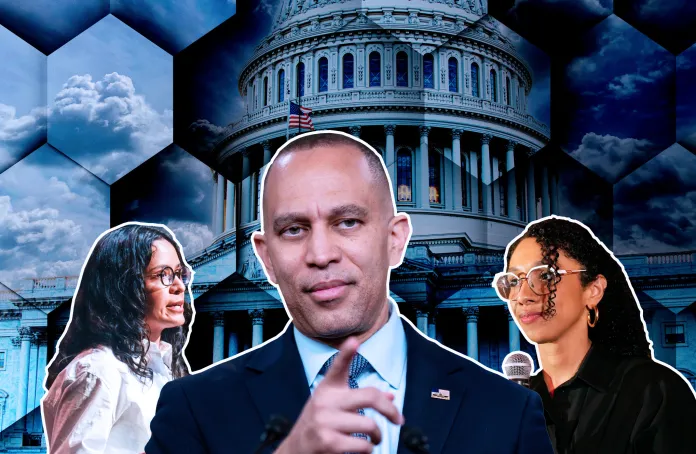
A primary threat to Jeffries in 2028 is not out of the question, either. A video from Valdez’s victory party showed her supporters chanting “you’re next!” when an image of Jeffries flashed on TV screens.
Jeffries narrowly escaped a primary challenger from socialist Chi Osse after New York City Mayor Zohran Mamdani intervened to block the effort. A spokesman for Osse declined to comment on whether he would consider primarying Jeffries in 2028.
Rank-and-file Democrats aren’t shy about admitting Jeffries will have a difficult job should Democrats hold the majority, but argue it would be a difficult feat regardless of who joins the caucus.
“He’s gonna have a hard job, no matter what,” Rep. Greg Landsman (D-OH) told the Washington Examiner. “Certainly doesn’t make it any easier. I think the key is to update the rules package so that we can govern, and that’s a decision that gets made after we win and before we start. You’ve got to set up the rules so that we can govern.”
The reality of governing is one House Speaker Mike Johnson (R-LA) faces daily from his own band of rebels, who have repeatedly sunk floor votes or otherwise withheld their support for party-line items until they are given concessions.
The House rules package, which is adopted at the start of each Congress, lays out how the chamber will operate. In 2023, under then-House Speaker Kevin McCarthy, Republicans passed a rules package that allowed just one lawmaker to offer a motion to vacate, a parliamentary procedure used to force a vote on ousting the speaker. McCarthy’s own party used the tactic to remove him from his leadership post after just eight months. At the start of 2025, Johnson raised the threshold so that nine members of the majority party are needed to offer a motion to vacate.
Rep. Becca Balint (D-VT) told the Washington Examiner that Jeffries’s job leading Democrats will be hard, saying, “Every time we have new people coming in, they bring their perspectives, their districts.” But Balint argued it’s up to new members to “figure out once they’re here how to be the most effective.”
“What I’m thinking about is each of those people coming in here, I don’t think any of them have legislative backgrounds, right?” Balint said. “Regardless of who you are, it’s a rude awakening. You come in, even those of us who have legislative experience — you’re one of 435, so you’ve got to figure out how to be effective.”
She continued, “I think they’re going to be figuring that out in real time, at the same time that hopefully Speaker Jeffries is going to be figuring out how to wrangle a caucus that is going to look different no matter what happens, so I think he is capable of doing that.”
Still, Balint said she does not believe Jeffries will face the same struggles Johnson has had during his tenure.
“I do not think we’re going to have a situation where you have progressive members coming in, acting more in the way that the Freedom Caucus acts right now,” the Vermont Democrat said. “I just don’t see it, because people want to get stuff done, whereas I see the Freedom Caucus at so many steps of the way have tried to interrupt the work here, as opposed to trying to actually produce a body of work.”
The House floor has been frozen for two weeks, as GOP hardliners have refused to support a procedural measure to advance leadership’s legislative agenda in favor of other conservative priorities, such as a voter ID bill known as the SAVE America Act or codifying President Donald Trump’s border policies.
Johnson holds a three-seat majority, giving him a razor-thin margin by which to pass any party-line item. Depending on how many seats Democrats win in November, Jeffries could struggle with the same headache.
Rep. Laura Gillen (D-NY) told the Washington Examiner after the New York primaries that “the way forward for the Democratic Party, and for both parties, actually, is to lead from the middle. I’m a capitalist, I’m not a socialist, and I think every socialist society generally collapses, and so I am not very happy about it.”
But for more progressive members, the prospect of the socialists joining their ranks should be welcomed. Rep. Pramila Jayapal (D-WA) told the Washington Examiner that “progressives make everything better.”
SUMMER LEE’S ALLIES EAGER TO SEE ‘SQUAD’ DEMOCRAT PRIMARY FETTERMAN IN 2028
Jayapal explained that every speaker, even former Speaker Nancy Pelosi (D-CA), has to win over new members to effectively lead the caucus.
“I think it’ll be exciting to have a new crop of really bold progressive populist people in the House who will remind us time and time again of what we need to be reminded of, which is we need to be bold,” Jayapal said. “That’s what people want — they want us to stand up for them, they want us to fight, not fold, and they want us to deliver.”