

Facts matter.
There are many pithy quotes on the subject.
Recommended Stories


“Facts are stubborn things,” future President John Adams argued in defense of British soldiers during the 1770 Boston Massacre trials. “Whatever may be our wishes, our inclinations, or the dictates of our passions, they cannot alter the state of facts and evidence.”
“Everyone is entitled to their own opinion, but not their own facts,” is widely attributed to the late Sen. Daniel Patrick Moynihan. But — just to be factually accurate — no one can cite a source for the claim that the New York Democrat allegedly said it.

And my personal favorite, “I don’t like facts. Facts can change. I like my opinion. It never changes, no matter the facts,” which I’m pretty sure was said by comedian Stephen Colbert, back when he had adopted the persona of a pompous right-wing pundit.
From my earliest days as an idealistic young reporter, I believed the highest form of journalism was to bring facts to bear on matters of importance. So that public policy could be debated and argued based on informed opinion.
I wouldn’t tell people what to think. I shouldn’t tell them how to think. But I could provide factual, credible information to inform their opinions and serve as an inoculation against demonstrably false narratives.
However, in 2001, my faith in the ability of facts to support corrective information was shattered in the aftermath of the Sept. 11 terrorist attack. When I saw the way millions — in fact, polls showed tens of millions — of Americans were persuaded by the early forms of social media to doubt what I witnessed firsthand.
They did not believe a commercial airliner, hijacked by Islamic terrorists, had crashed into the west side of the massive building. Killing all 64 innocents on board and 124 people on the ground.
I was in the Pentagon that day. I photographed wreckage with markings from an American Airlines 757, and the adjacent heliport covered with shards of aluminum from the plane’s fuselage.
As the false narratives grew, I set about using facts, reason, and a mountain of evidence that pointed in only one direction. And my personal experience was to try to debunk what I considered demonstrably false beliefs.
I wrote stories, I interviewed experts, and I engaged with self-proclaimed “9/11 Truthers” one-on-one.
And after 10 years of effort, I can confidently say I never changed a single person’s mind.
Not one.
There are myriad reasons humans can become impervious to corrective information. There are hundreds of books on behavioral sciences and the cognitive biases or thinking errors that lead us astray as we try to puzzle things out — confirmation bias, correlation-causation fallacies, the mistaken belief that common coincidences are rare.
But after waging a battle against irrational beliefs and false narratives for decades, I’ve come to two basic explanations.
1. People have a strong emotional attachment to their beliefs.
2. Very convincing arguments can be made for things that aren’t true.
Consider a hypothetical murder trial — a man is charged with killing his wife. Both the prosecution and the defense are armed with facts.
Lawyers can’t introduce evidence in a court of law if they can’t verify that it’s true.
The prosecution goes first and, using facts, paints for the jury a compelling picture of how the man murdered his wife, including motive, means, and opportunity.

It’s convincing, and if the trial stopped at that point, the jury would convict.
But then the defense, using the same facts — and maybe a few the prosecution left out — tells an equally compelling story about how an intruder broke in and committed the murder.
Both sides make good, factual arguments, but only one side is right.
Like in our hypothetical murder trial, we often can’t know if someone, even an expert, is right or just has a better argument.
Jurors consider the facts and weigh the evidence, but the truth may remain ambiguous. Juries get things wrong all the time.
Which, in a way, explains my first proposition: that once a strong belief has taken hold, especially if it in any way benefits the believer, no amount of facts, reason, or logic can dislodge it.
Here, we can consider the contemporary and now infamous case of the “Lincoln Memorial Reflecting Pool vandals.”
It would be a source of immense embarrassment were it to be the case that President Donald Trump’s resurfacing of the iconic landmark turned out to be a $14 million boondoggle. So, when someone told him that his pet beautification project was ruined by vandals, he was quick to embrace the explanation.
Unfortunately for him, because the prosecution of the alleged vandals would have to stand up in court, the Justice Department did a full and thorough investigation and was forced to conclude — as Mona Lisa Vito famously testified in the 1992 legal classic My Cousin Vinny — the government’s case does not “hold water.”
In the Hollywood version, as in real life, prosecutors admitted they were wrong, and charges against the unjustly accused were dropped.
In the 20-page submission to the court, U.S. Attorney for the District of Columbia Jeanine Pirro — a strong ally and close friend of Trump — requested the case be dismissed because all evidence pointed to a “rushed and botched installation” by the contractor for the damage to the pool’s lining, and none pointed to vandals.
Such was Trump’s emotional investment in the vanity project that he couldn’t accept it — the facts didn’t matter.
“I disagree 100% with Jeanine Pirro,” Trump posted on Truth Social. “I don’t know what she was thinking? To me, it was a pure case of VANDALISM … There may have been some contractor difficulty, but the major damage was caused by VANDALS!”
Trump has the world’s biggest megaphone, and he has learned to use it to bend reality to his wishes. And in the case of the Reflecting Pool, he continues to post discredited evidence to bolster his specious argument.
A recent New Yorker profile of Roy Cohn — Trump’s old mentor from his real estate days — recounts how Cohn taught Trump how to B.S. his way out of anything, by never backing down, never admitting he is wrong. “The lesson Trump took from Cohn was that the facts could always be drowned out by strident counterclaims.”
In today’s cacophonous social media ecosystem, the dueling narratives can be overwhelming.
We are trapped in a bizarre bazaar of half-baked ideas where facts are dismissed as opinions, and opinions are passed off as facts. What’s a thinking person to do?
Sorting fact from agitprop requires more than just intelligence and critical thinking skills. It requires an understanding of the unconscious biases we humans are subject to — after all, what are the odds that everything you believe is true?
Humility, curiosity, and wisdom are the tools, along with a finely-tuned B.S. detector.
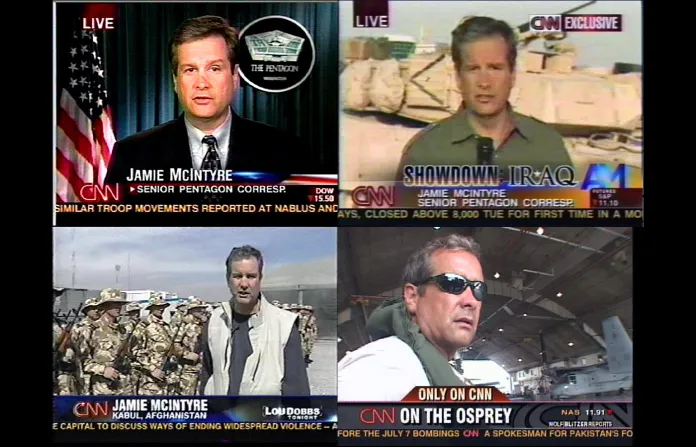
Jamie McIntyre (@jamiejmcintyre) is the Washington Examiner’s senior writer on national security. He is retiring to write a memoir of his childhood growing up in the 1960s.
