

There is a revealing scene in the new Spider-Man movie, Brand New Day, in which Yelena Belova (Florence Pugh) explains to Peter Parker that the Avengers handle the “big potatoes,” while Spider-Man deals with the “small potatoes.”
The distinction encapsulates what has always made Spider-Man appealing. He fights local crime and neighborhood disorder — muggings and robberies, compensating for the shortcomings of local law enforcement in the dense urban jungle of New York. He doesn’t fuss with the specter of nuclear war or fiddle with the space-time continuum.
Stay informed.Stay ahead.
Join Washington Examiner for unlimited access to the news, analysis, and commentary that matter most.
Already a member? Log in
The exchange also captures the malaise that has marred Marvel’s recent films: the studio’s reluctance to let an individual character sustain a stand-alone story. Even Brand New Day is crowded with Pugh’s rueful Russian accent, Mark Ruffalo’s Hulk, and Jon Bernthal’s Frank Castle, to name a few. Why can’t Spider-Man just be Spider-Man? The result often feels like a collection of future Marvel projects searching for a plot.
We pick up after No Way Home (2021), returning to a New York that only knows Spider-Man as an anonymous vigilante. Nobody has any memory of Peter Parker, including his former girlfriend, MJ (Zendaya), and best friend, Ned (Jacob Batalon).
The opening act cleverly uses social media to convey the passage of time. Instagram reels chronicle MJ and Ned’s journey through their years at the Massachusetts Institute of Technology, interlaced with Spider-Man’s crime-fighting escapades back home. While they graduate into adulthood, Peter isolates himself socially, fully embroiled in vigilantism, locking up criminals faster than Mayor Zohran Mamdani can release them back onto the streets.
Tom Holland is visibly comfortable in the role. Looking more muscular and assured than in previous films, he carries himself like a fully formed Spider-Man — no longer the overeager adolescent clamoring for Tony Stark’s approval. After thwarting a break-in at the Department of Damage Control, he mimics Columbo’s folksy candor: “Oh, and one more thing — what’s V-Max?”
Peter is also undergoing some form of spider puberty. He unexpectedly begins shooting webs through his wrists, as in the Tobey Maguire films, while experiencing changes to his senses and temperament. He must relearn how to be Spider-Man, something like driving a stick shift after becoming accustomed to an automatic.
The conceit gives physical form to Peter’s instability. He has lost his identity, his friends, and his place in the world; now even his body has become unfamiliar. The film links his mutation to Bruce Banner, though the Hulk’s inclusion soon becomes another excuse for an enormous set piece.
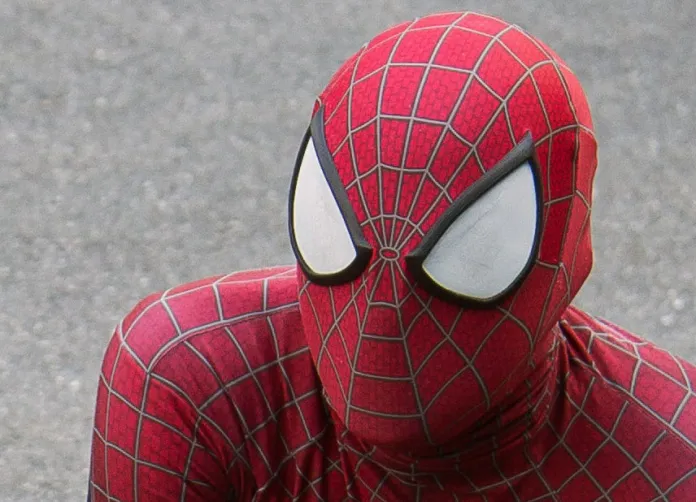
The Marvel addition that works best is Bernthal’s Frank, introduced in Daredevil before leading his own Punisher series. I had seen neither, but Brand New Day makes a persuasive case for correcting that oversight. His streetwise, Jersey-accented banter with Spider-Man produces the film’s liveliest scenes.
Despite the hardships he has endured, Peter retains his arguably naive faith in restraint and redemption. Frank, by contrast, subscribes to a “shoot first, ask questions later” philosophy. Their infectious chemistry is best captured when Spider-Man finds himself facing an enraged Hulk and Frank arrives to help. “What are you doing here? This is way above your pay grade!” Peter exclaims. Frank’s response is characteristically practical, reaching for a .50-caliber sniper rifle.
Meanwhile, the Department of Damage Control has evolved into a shadowy federal bureau led by the cool and collected Bill Metzger (Tramell Tillman). It presents itself as a benevolent institution created to seize dangerous technologies and powers from the villains Spider-Man apprehends, ostensibly for public use — it is the sort of assurance that vindicates Ronald Reagan’s suspicion that the most frightening words in the English language begin with, “I’m from the government.”
Through Damage Control, the film introduces Jean Grey (Sadie Sink of Stranger Things). Jean telepathically infiltrates the agency through the bodies of people she controls, attempts to free villains such as the Scorpion, and spends much of the first act operating without a clear motive. Under Mamdani’s criminal justice system, she might have saved herself the trouble and waited another week for him to reappear on the street.
Damage Control nevertheless extends the film’s small-potatoes thesis. Spider-Man’s ethos resides in the minute acts of heroism people perform for one another — the obligations and sacrifices that keep society afloat. Brand New Day gives that ethos a libertarian tint. Damage Control claims institutional authority while exploiting the powers it confiscates. Spider-Man, an unauthorized private citizen in a leotard, performs the work the bureaucracy has corrupted. Had Ayn Rand possessed a greater flair for accessible entertainment, she might have invented Spider-Man.
CHRISTOPHER NOLAN HAD THE MUSES ON HIS SIDE
The film’s narrative discipline begins to fray around Peter’s attempt to find his way back into MJ’s life, which occupies too much of the runtime. The premise that Peter remembers an entire relationship that, from MJ’s perspective, never occurred contains genuine tragic potential. The Spider-Man romance has traditionally drawn some of its appeal from the fantasy of the awkward science prodigy winning the affection of the more glamorous, socially assured Mary Jane. That dynamic is less pronounced in the Holland films, where Peter and MJ are essentially kindred outsiders. Here, however, Peter is trying to recreate an intimacy that only he remembers, and the subplot feels like a different film in both tone and subject. Director Destin Cretton devotes too much time to this effort while simultaneously juggling Peter’s mutation, Damage Control, the Hulk, the Punisher, and Jean.
Though it retains some superhero bloat, Brand New Day appreciably sheds Marvel’s multiverse mania for a story more intimately connected to New York and its people. With each successive film, Marvel keeps raising the stakes and reaching for bigger potatoes. Brand New Day is at its best when it remembers the small ones.
Harry Khachatrian (@Harry1T6) is a film critic for the Washington Examiner. He is a software engineer, holds a master’s degree from the University of Toronto, and writes about wine at BetweenBottles.com.