

“The problem with socialism,” Margaret Thatcher once said, “is that you eventually run out of other people’s money.”
The British Prime Minister’s famous quip captured an underlying truth: Socialism makes people poorer. By seeking to redistribute wealth rather than create it, socialist economies weaken the incentives and entrepreneurship that drive prosperity. Indeed, decades of economic research show that countries with greater economic freedom and stronger private property rights are wealthier than those built around central planning and state ownership.
Recommended Stories


Yet recent events in Nicaragua are a reminder that empty shelves and lower living standards are not the only problems with socialism. Earlier this week, Nicaragua’s longtime socialist leader, Daniel Ortega, announced that the country would abandon democratic elections.
Considering his intellectual influences, the result is no surprise.
Ortega, the son of a shoemaker, first came to power in 1979 after dropping out of law school to join the Sandinista National Liberation Front, a socialist revolutionary movement. He became an unapologetic disciple not just of Karl Marx but also of Vladimir Lenin, the Bolshevik revolutionary who brought terror as well as revolution to Russia.
“I admire Marx, I respect Marx, as I also admire and respect Lenin,” Ortega told the Los Angeles Times in the 1980s.
Like the Bolsheviks, Ortega had little hesitation about expropriating private property, helping himself to the luxurious mansion of a wealthy banker. Throughout the 1980s, Ortega implemented a familiar socialist playbook: nationalizing industries, redistributing wealth, and radically reallocating land, all while enjoying the spoils of what capitalists had built.
President Ronald Reagan famously dismissed Ortega as a “dictator in designer glasses.” Yet many argued Ortega was a reformer disinterested in personal power.
“He’s a man totally dedicated to the cause,” one diplomat told the Los Angeles Times in 1986, “and his life is given up to that cause. He’s not power-hungry for himself, for his own personal benefit.”
Yet the results of Ortega’s socialist policies were undeniably bleak.
In 1980, when the Sandinista government began implementing its reforms, Nicaragua’s per capita GDP was $659 (in current U.S. dollars), according to World Bank data. By the time he was voted out of office in 1990, it had fallen to $242.50.
This dismal economic performance, a 60% decline in per capita GDP, is no doubt why Ortega spent the next 16 years out of political power, losing elections in 1995 and 2001.
During this time, however, the former revolutionary underwent a transformation. Ortega abandoned the revolutionary Marxist slogans and the olive green uniforms. Instead, he spoke of unity and reconciliation, of aid to the poor and healthcare. He even became a “social conservative.”
Ortega’s pivot from Marxist revolutionary to “democratic socialist” paid off.
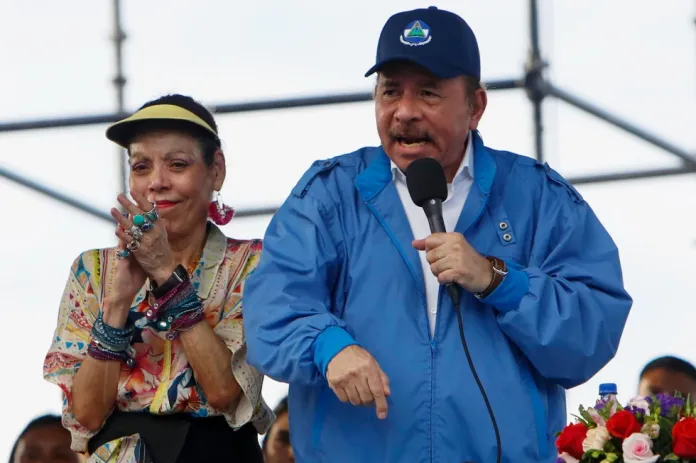
He returned to power in 2007 and was re-elected in 2011 after changing the constitution to overstay his term limit.
If Ortega’s first act illustrated socialism’s central failure — it makes people poor — his political rebirth revealed another: Socialism’s tendency toward authoritarianism.
In 2017, Ortega was sworn in a third time as president, with his wife serving as vice president. From there, things only got worse. In the spring of 2018, attempts to reform the country’s pension system were met with riots, followed by a brutal crackdown by Ortega’s forces. Hundreds were killed, including many university students.
In the aftermath, Ortega abandoned even the pretense of political freedom. His 2021 reelection, his fourth consecutive electoral victory, was denounced by international leaders as a sham after his government imprisoned or barred opposition candidates. A 2024 United Nations report noted the government continues “to persecute not only those who express dissenting opinions” but anyone “who does not fall directly under their control.”
Nicaragua’s descent fits a familiar pattern. The great socialist experiments of the 20th century confirmed that Marx’s economic vision was a recipe for poverty. After Castro took power, Cuba’s economy stagnated. Vietnam became the poorest country in the world after Saigon fell and its socialist blueprint was implemented. By the 1980s, reformers in the Soviet empire marveled at the abundance of an ordinary U.S. grocery store.
Yet socialism doesn’t just make people poorer. It’s also a recipe for tyranny, because it’s an economic system that concentrates power in the state.
Ortega will go down in history as yet another socialist leader who rose to power claiming to serve the proletariat, yet failed the power test. And Nicaragua’s sad plight is a reminder of Nobel laureate economist Milton Friedman’s warning: Economic freedom is a necessary ingredient of political freedom.
THE DSA JUST DECLARED WAR ON THE CONSTITUTION
As America experiences its own revival of socialist ideas, Nicaragua provides yet another reminder that adding “democratic” to socialism does not render it benign.
Designer glasses may change socialism’s appearance, but not its deadly consequences.