Restoring America

Conservative values, National renewal

Menu

Republicans are falling for the data center panic

Published August 18, 2026 6:00am ET


In July, Gov. Kathy Hochul (D-NY) signed an executive order establishing the nation’s first moratorium on the construction of hyperscale data centers.

Hochul said that while New York had always been a leader in national innovation, the development of data centers threatened “to hike up utility bills, deplete our natural resources, and create uncertainty for New Yorkers.”

In some ways, the order came as little surprise. New York has had a long history of regulatory overreach, including strict regulations on showerheads and faucets, as well as bans on natural-gas stoves, furnaces, and boilers.

Yet it’s not just New Yorkers who have a beef with data centers.

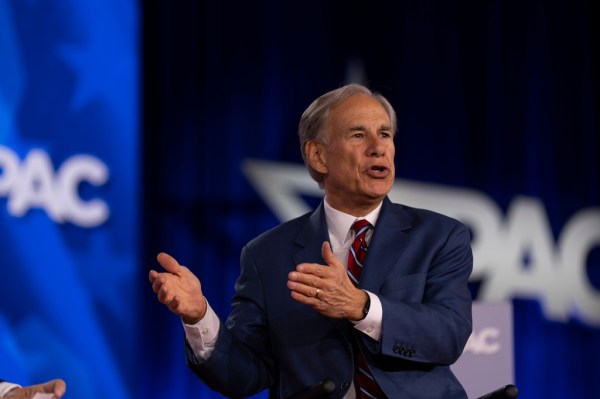
Earlier this month, facing growing public fears about data centers, Gov. Greg Abbott (R-TX) announced a moratorium on the approval of new data center projects pending fresh audits by regulatory agencies of the projects’ possible impact on the Lone Star State’s electric grid.

The moratorium reflects a bipartisan wariness toward data centers that challenges typical political paradigms. Texas is not California or New York. It is a right-leaning state, filled with conservatives who, in the words of the Washington Post, “love free markets, the energy industry, development and small government.” The Washington Post interviewed one such conservative, a three-time Trump voter and self-described lifelong conservative, who detailed her concerns over data centers.

“We are the people who built this community, and we intend to pass it down to our children,” Nikki Meador, 43, told the newspaper. “We deserve protection, not to be sacrificed for outside investment. Industrialization is irreversible.”

Meador’s concerns highlight both a growing protectionist streak in the GOP and a broader problem facing data centers. Many people oppose data centers, but many have a difficult time saying precisely why they oppose them. Ask people, and you’ll get all sorts of responses. Some will cite high water or electricity usage, while others say they are too loud.

None of these concerns is illegitimate per se. But each is more complicated than opponents acknowledge.

It’s true that data centers use plenty of water — 17 billion gallons in 2023, to be precise. But so do, to pick two economic sectors, golf courses and almond farming. When you crunch the numbers, you’ll find that golf courses use roughly 30 times as much water as data centers. Almond farming uses roughly 100 times as much. These numbers change if you account for indirect water consumption associated with data centers, but their water consumption still falls well below that of almond farming and golf courses.

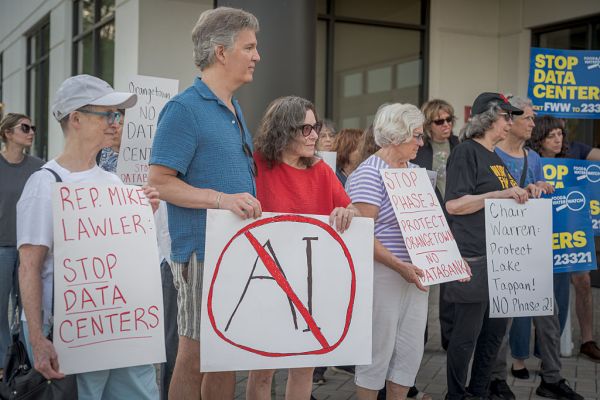
Clockwise from top left: anti-data center sentiment in St. Paul, Minnesota; Bastrop, Texas; Nescopeck, Pennsylvania; and Westfield, Massachusetts. (opposite, clockwise from top left: Michael Siluk/UCG/Universal Images Group/Getty; Paul Weaver/SOPA Images/LightRocket/Getty; Aaron E. Martinez/Austin American-Statesman/Getty Images; Danielle Parhizkaran/Boston Globe/Getty)

One of the most common concerns surrounding data centers is that they drive up electricity prices. Ask anyone, and they’ll tell you it’s true — even though several studies show this isn’t the case. In fact, a recent paper found that data center growth from 2015 to 2024 actually caused average electricity prices to “fall modestly.”

“Despite prevailing sentiment,” the authors noted, “the finding is consistent with economic reasoning: existing large power system fixed costs, economies of scale in transmission and distribution, and declining unit costs for generation imply that durable demand growth lowers average prices.”

A more recent concern over data centers is that they make a lot of noise. Well, so do airports. This isn’t to minimize noise pollution, which is a real and valid concern. But the U.S. economic system has a robust legal framework for addressing negative externalities.

Data centers are like any other industry: They come with economic benefits and economic costs. This is the reality of trade-offs, which brings me back to the GOP.

Republicans say they want to “revive U.S. industry” and attract “outside investment.” Yet these are precisely what a growing chorus of Republican faithful are now hostile to, at least when it comes to data centers. This was always the danger, if an overlooked one, of embracing economic populism.

For years, it was primarily the Left that wanted to ignore trade-offs and simply ban things they didn’t like — from plastic straws to gas stoves to gasoline-powered cars. True, banning data centers might be popular. But by placing political success over sound economics, the GOP stands to emulate its political counterparts, who long championed harmful but popular policies such as rent control and minimum-wage laws.

To be fair, Texas is just one state. And there’s fortunately not yet any real momentum for a national moratorium on data centers. Yet the bipartisan hostility toward data centers is deeply troubling.

RIGHT-WING X FALLS FOR VACCINE MISCARRIAGE HORROR STORY

Data centers are hardly the first target of a modern moral panic. From fears of population growth to the garbage crisis of the 1980s, and from plastic and DDT to acid rain and ozone depletion, Americans have experienced many.

But Republicans and Democrats alike should beware: If Americans succumb to the latest moral panic and decide bans on data centers are sound economic policy, politicians chasing votes could do serious harm to the U.S. economy.