

Do secretaries of state with no political ambition give sunset speeches in the most jaw-dropping settings imaginable, stirring the soul to defend civilization?
That’s the question all of Washington is asking itself today.
Stay informed.Stay ahead.
Join Washington Examiner for unlimited access to the news, analysis, and commentary that matter most.
Already a member? Log in
Marco Rubio’s speech Wednesday from the Pnyx, the hill where ancient Athenians held their democratic assembly, with the Parthenon lit behind him, turned heads among political observers not only for the striking scenery, but for its clarity of purpose and its sense of historical ambition.
Rubio said, “Here, in Athens, we found the first full realization of all the essential traits that would come to define the West: fierce individuality and relentless ambition; daring exploration and invention; a yearning for discovery, for adventure, risk, and glory; an insatiable curiosity about the world and the principles by which it operates; a hunger to know the mysteries of nature and grasp the secrets of the cosmos.”
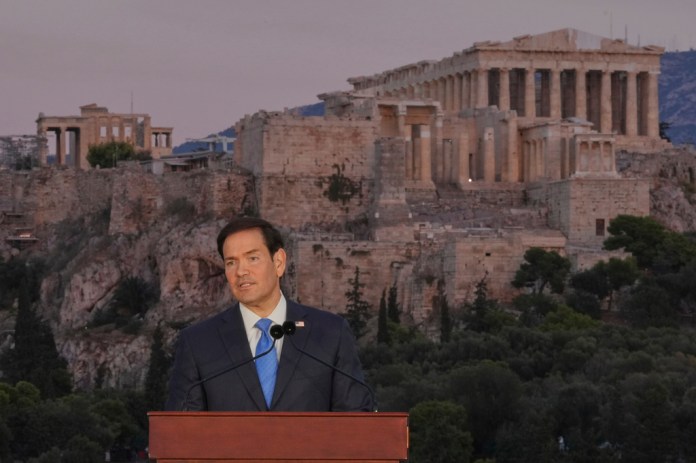
For Rubio, the West finds itself at an inflection point, where it can either recover the confidence that built the Parthenon or resign itself, in his words, to “a future of atrophy, and servitude, and decline.”
Of course, this may not be a soft launch of a 2028 campaign. Rubio has repeatedly insisted he will not challenge Vice President JD Vance for the nomination should Vance run — and it appears Vance already is. This may simply have been a masterfully staged and executed speech that, for a day, united the warring factions on the Right and charted a path to victory not only for the Republican Party, but for Western civilization itself, as the armies of communism and Islamism march closer to the gates.
Whatever it was, it stopped the news cycle in its tracks — the pictures alone were enough. That’s the kind of juice most presidential hopefuls spend millions trying to manufacture. Rubio still says he isn’t running, but it’s safe to say he’d be formidable should he choose to.
As many have noted, there appears to be less policy daylight between Vance and Rubio than is commonly thought. Rubio’s Acropolis speech embraced nationalism as unapologetically as anything Vance has said, lamenting that “‘nationalism’ became a dirty word” and declaring that the United States has chosen “the unapologetic pursuit of national power.”
And Rubio’s favored economic solutions of late all carry an unmistakable populist edge, the kind that puts domestic industry ahead of the old free-trade consensus. Like Vance, Rubio has made the case for an economics of the common good, most notably in a 2019 speech on “common-good capitalism” that drew heavily on Rerum Novarum, the papal encyclical issued by Pope Leo XIII in 1891 that laid the foundation for modern Roman Catholic social teaching.
The true contrast between the two, should a contest take shape, would be aesthetic. Rubio never deviates from his presentation as the classical statesman, favoring lyricism and the long arc of history.
Vance is a creature of the moment, mixing it up online and most energized when he’s picking a fight, as when he told a Lakeland, Florida, rally this month that Democratic Senate candidate Angie Nixon should “get the hell out of here” for calling herself a socialist.
RUBIO’S RALLYING CRY FOR THE WEST
Rubio soars where Vance brawls.
And for a party looking to consolidate its gains among minority and working-class voters, the messenger may ultimately matter just as much as the message.