
Firebirds are laughing all way to postseason
In a recent blowout win by the University of the District of Columbia, a player from Mercy College made a sensational dunk over the Firebirds’ Ziad Ashmawy and in the process accidentally kicked the sophomore in the groin, sending him to the floor in pain.
Recommended Stories

Afterward, UDC assistant coach Tony Iati told Ashmawy, the most intense and emotional Firebird, that ESPN had called requesting use of the footage for its “Top 10 plays,” and he had agreed. As they made the long bus trip home from Dobbs Ferry, N.Y., UDC players, one by one, were let in on the joke, leaving Ashmawy the last to know, and wonder how long it would take his embarrassing moment to make it on YouTube.
It’s times like these when UDC coach Jeff Ruland — a former NBA All-Star and coach of three NCAA tournament teams at Iona — realizes how much fun it is to be part of a team, regardless of the level.
“Being with these guys, it’s probably been the best year of my career,” Ruland said.
How did Ruland end up at lowly UDC, a Division II program crippled by probation, which hasn’t been relevant since winning a national championship 30 years ago?
The combination of an attractive salary (approaching $200,000) and geography (his youngest daughter is a senior at Loyola University in Baltimore), attracted Ruland to the oddly situated school in Northwest Washington located next to a Metro stop and overlooked by a strip of embassies.
In his first year, the Firebirds went 1-20 and finished some games with four players on the floor. But two seasons later, UDC is ranked No. 18, was 22-3 entering Saturday’s game at C.W. Post, and is a lock to make the NCAA Division II tournament.
Ruland has assembled a talented and eclectic cast that includes former Division I guards Nigel Munson (Virginia Tech), Dishawn Bradshaw (Maryland Eastern Shore) and Brandon Herbert (Binghamton), and a trio of international players — Ashmawy (Egypt), Florent Pontens (France) and Brandon Ennis (Canada).
“Coach Jeff, he’s an All-Star. When he said they were building something, I believed,” Ashmawy said. “He makes it fun. When I make a dunk in practice, he called me the Egyptian riding the carpet.”
The puzzling career of Munson, a 25-year-old who was a brilliant high school player at DeMatha, mirrors that of Ruland. The 6-2 point guard spent an unhappy season at Virginia Tech before leaving and working for two years. He arrived through an association with UDC assistant coach Terrell Stokes, a former Maryland point guard.
Munson enrolled at UDC in 2009, but a broken arm ruined his sophomore season. Academics sidelined him for the first semester of his junior year. But when he joined the 0-8 team in December, his effect was immediate. UDC went 11-7 the rest of the way.
This year, Munson has been the pulse of the Firebirds’ up-tempo offense, averaging 19.9 points and 6.8 assists a game and has renewed hope of a pro career.
“I know this is definitely a different route, going D-II. I probably won’t get drafted into the league, but I’m gonna keep working,” Munson said. “I definitely plan on playing basketball, whether it’s on the highest level or overseas.”
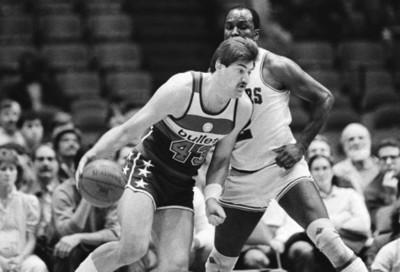
Ruland’s career has literally been all over the map. He was an All-American at Iona but had to prove himself at F.C. Barcelona (Spain) before getting his shot with the Washington Bullets. The 6-10 Ruland quickly established himself as one of the best power forwards in the game before brittle feet and knees derailed his career.
Ruland had two stints as an assistant with the Philadelphia 76ers, one with the Albuquerque Thunderbirds of the NBA Development League, and a nine-year run as coach at Iona.
A season removed from an NCAA tournament appearance, Ruland was unexpectedly fired by Iona after a free fall to 2-28 in 2006-07, learning of his departure via email while on a cruise. Ruland asserts that his relationship with an African-American woman, now his fianc?e, hastened his departure.
Ruland’s off-the-court life has been full of bumps. His alcoholic father died when he was 9. His mother, a bar owner, then married his father’s best friend. Eleven years ago, Ruland split with his wife when he and his daughters couldn’t convince her to seek treatment for alcoholism. Maureen Ruland remained close with her family and got sober but later was diagnosed with leukemia and died of a massive heart attack while undergoing chemotherapy.
Through it all, Ruland has retained a dry, if sometimes politically incorrect, sense of humor, endearing him to his players. Asked what he would be doing if he wasn’t a coach, Ruland says: “I have no idea. Maybe serial killer.”