

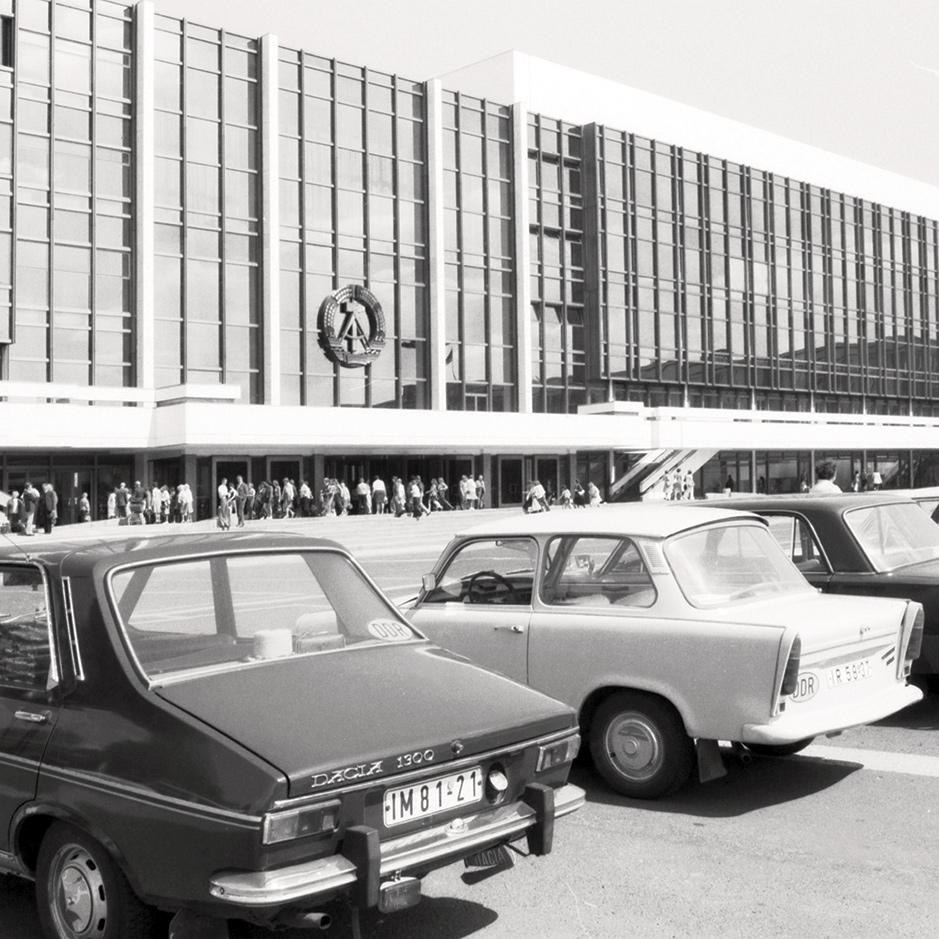
In his concluding chapter, Owen Hatherley cites a passage from Alexander Herzen’s From the Other Shore (1851), which argued that ideals and aspirations, as they float around in our minds, don’t tend to take the same shape when they metamorphose into the material world. Herzen, a political theorist of 19th-century Russia, wholly distrusted the idea that human suffering and appalling cruelty were justifiable actions worth taking to bring about a utopian future.
The Bolsheviks stood at the opposite side of this ideological spectrum. When grabbing power from the provisional government in Russia in 1917, they believed a Communist revolution—perhaps the most ambitious experiment in social engineering ever witnessed in human history—could deliver a world where social justice would arrive in abundance, camaraderie of fellow man would be the norm, and intellectual/artistic ideas would flow as naturally as water amongst the peasant classes, who would eventually overthrow the bourgeois and create a classless society.
Stay informed.Stay ahead.
Join Washington Examiner for unlimited access to the news, analysis, and commentary that matter most.
Already a member? Log in
Unfortunately, the opposite happened: Free speech was curtailed, state terror and murder intensified, and anyone with notions of individual liberty was likely to be imprisoned for life or executed. By 1921, a new autocracy had replaced the old czarist regime, and Lenin stated—without irony in his The Importance of Gold Now and After the Complete Victory of Socialism—that when the Bolsheviks overthrew capitalism on a global scale, gold would be used “for the purpose of building public lavatories in the streets of some of the largest cities in the world.” Three years later, Leon Trotsky declared in Literature and Revolution that communist “life in the future will not be monotonous.”
Owen Hatherley continually fixates on this distinctive, idiosyncratic tic of Bolshevism: the transformation of infrastructure into an epic narrative where the so-called scientific laws of history would prevail. Communism always dwelt on the notion that mythology and symbolism were just as important as events in the real world. So it’s hardly surprising that buildings and monuments in the Soviet Union were purposely built by a totalitarian regime that always reminded its subjects that they were working towards a utopian future, where posterity would flourish and prosper.
If it took millions of deaths for this idea to be achieved—well, that was a sacrifice the Bolsheviks were more than willing to make. Futurism and a very distinctive vision of modernity, which sought to disown the past and look towards an imagined paradise, became intrinsic to the physical, intellectual, economic, and architectural structures of Soviet communism.
Landscapes of Communism seeks to understand how life in the Soviet states operated culturally, socially, and politically by asking the following question: What do Communist buildings tell us about Communist societies?
It also asks: What sort of cities did Communist governments construct? Was it all as gray and miserable as the buildings, at first glance, suggest? And if not, what kind of interesting legacies did Soviet communism leave behind?
Some of the places Hatherley visits include public libraries throughout the Soviet bloc; art-house cinemas and milk bars in 1960s Poland, where surrealism almost became a standard decorative form; television towers in Moscow and Vilnius, which became monuments of modern mass media; the brutalist apartment complexes of Nicolae Ceausescu’s Romania, where society more closely resembled North Korea than Russia; and the metro stations of Moscow, which Hatherley believes are the one specimen of Soviet architecture and public infrastructure superior to anything built in the West.
Hatherley’s prose style is a strange hybrid: He mixes an informal first-person diary tone with highbrow political and historical analysis. Sometimes, however, this doesn’t work so well, and his writing descends into casual journalese. But this is only a minor problem in an engaging work from an erudite writer who knows his modern European history.
In 1997, as a teenager, I took my first trip across the region, by train. It was a glorious time to visit the former Soviet empire: The countries had only recently emerged from the rusted barriers of the Iron Curtain, and as Hatherley suggests, you really do need to visit a country, and interact with its people, before you can start making pertinent observations about its society, cultural practices, and social norms. In the West, in particular, we’ve become accustomed to viewing the history of Communist societies through simple soundbites and clichéd images: brutalist tower blocks, the gulags, jokes about substandard Soviet cars.
Of course, there is truth in these stereotypes: The spatial hierarchies of High Stalinism or Ceausescu’s Romania were fully as grotesque and obscene as they appear at first glance.
But the immense housing estates built by successive Soviet governments were (so Hatherley argues) the embodiment of egalitarian living—as were the theaters, squares, public canteens, and cinemas constructed throughout Eastern Europe during the Soviet era. He has the sense, as a socialist and grandson of British Communists, not to romanticize these totalitarian-Communist regimes. But traveling through the former Soviet states, with a degree of empathy and historical objectivity, the author puts these grotesque architectural remains in a balanced, consistent, and illuminating perspective.
J. P. O’Malley is a writer in London.
