
Something is off in the most recent jobs data, raising questions about whether the U.S. economy is faltering.
Job growth has weakened in the past two months, with two straight job reports falling short of expectations and raising doubts about the strength of the economy.
Recommended Stories



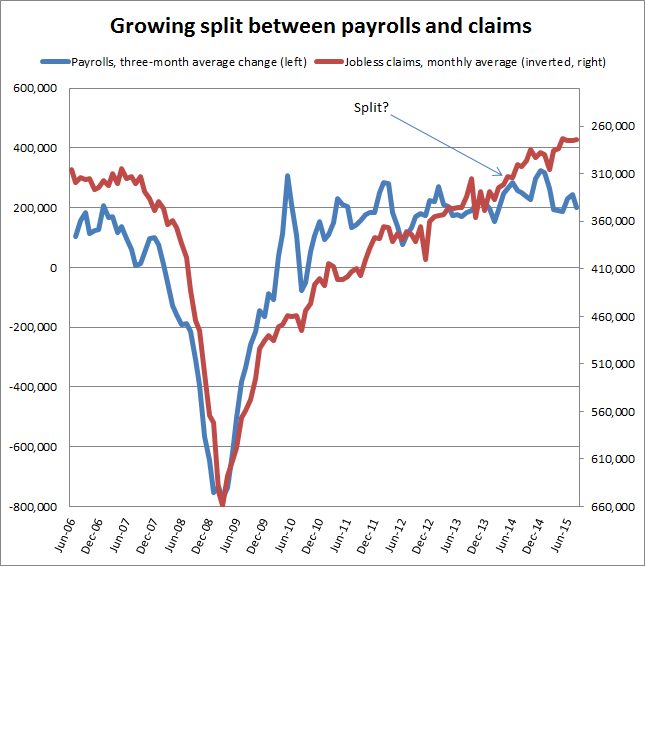
At the same time, more frequently updated indicators, especially jobless claims and taxes withheld from paychecks, have shown no such degradation.
Which indicator is “correct” — the jobs reports or the more frequent data — could be the clue as to whether the U.S. economy is still recovering.
The September jobs report showed just 142,000 new payroll jobs in the month and revealed that the gains in August were revised down to 136,000. “It was definitely weaker,” Federal Reserve Bank of New York President William Dudley said Friday in an interview with CNBC.
By comparison, job gains averaged 260,000 monthly throughout 2014. Yet initial claims for unemployment benefits, which are filed at the state level and then reported by the Department of Labor each week, have remained near their lowest levels since the dot-com bubble.
Just 263,000 first-time claims for unemployment insurance were filed the week ending Oct. 3, the Labor Department reported Thursday, and the four-week moving average was just 267,500, well below the levels throughout the recession that have led to drops in unemployment. Furthermore, receipts from paycheck tax withholdings have continued to grow at a healthy 5 percent annual rate.
“Withheld income tax receipts and initial jobless claims are two of our favorite indicators,” Joseph LaVorgna, economist for Deutsche Bank wrote in a research note, noting that both indicators, unlike the jobs report numbers, are not subject to large revisions. “Both series continue to point to sturdy domestic demand and steady hiring.”
The Federal Reserve, currently weighing a decision whether to raise interest rates and begin tightening monetary policy this year, will have to weigh the conflicting signals coming from jobless claims and tax receipts vs. net job gains, and determine whether the recent weak jobs reports reflects normal volatility or something worse.
One possibility for the Fed to consider is that fewer people are claiming unemployment benefits they are entitled to as the unemployment rate grinds lower and the economy picks up.
Economists at Goldman Sachs noted Thursday that unemployment insurance claims have continued to fall even as layoffs, as measured in other government surveys, have more or less leveled off in recent years.
Jobless claims, they suggest, thus might be less predictive of people getting laid off than during the worst of the recession. As a result, they calculate, the recent levels of jobless claims predict payroll employment growth of 160,000 to 200,000 jobs — not far from the numbers in the past few jobs reports.” We think this is a more realistic signal to take from the current level of jobless claims,” they write.