

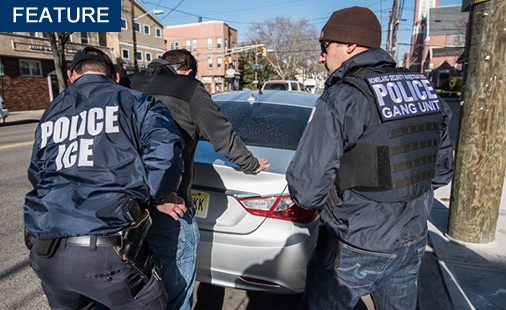
The Biden administration moved Thursday to further limit arrests and removals of people illegally residing in the United States.
Homeland Security Secretary Alejandro Mayorkas announced a plan that will prevent Immigration and Customs Enforcement’s Enforcement and Removal Operations officers from targeting an additional number of the millions of illegal immigrants in the country. Instead, ICE officers will begin conducting a “case-by-case assessment of whether an individual poses a threat” before making an arrest.
Recommended Stories



“The fact an individual is a removable noncitizen will not alone be the basis of an enforcement action against them,” the DHS said in a statement issued Thursday afternoon. “The Department’s personnel are to use their discretion and focus the Department’s enforcement resources in a more targeted way.”
The plan supersedes temporary measures that were imposed in February, which required ICE officers to obtain permission if arresting anyone who did not pose a risk to national security or border security or who is a convict or known gang member.
The new guidelines limit arrests to those three categories, but they will also require officers to carry out an analysis of the person they wish to target, likely restricting arrests of people it said in February were “public safety” threats. The review is intended to avoid taking into consideration a noncitizen’s race, religion, gender, sexual orientation or gender identity, national origin, political associations, or exercise of First Amendment rights.
“For the first time, they explicitly guard against the use of immigration enforcement as a tool of retaliation for a noncitizen’s assertion of legal rights, such as the right to exercise workplace or tenant rights,” Mayorkas said in a statement. “The guidelines make clear that immigration enforcement authority shall not be used as an instrument of unscrupulous employers seeking to exploit their employees’ immigration status.”
“In exercising this discretion, we are guided by the knowledge that there are individuals in our country who have been here for generations and contributed to our country’s well-being, including those who have been on the frontline in the battle against COVID, lead congregations of faith, and teach our children. As we strive to provide them with a path to status, we will not work in conflict by spending resources seeking to remove those who do not pose a threat and, in fact, make our Nation stronger,” he said.
The new criteria, dubbed the Guidelines for the Enforcement of Civil Immigration Law, will be implemented Nov. 29.
ICE officers are tasked by Congress with enforcing U.S. immigration laws, including the removal of people not permitted to be in the country, though the final decision is made by a federal immigration judge.
In February, ICE’s interim leader, Tae Johnson, informed officers that immigrants who commit less severe crimes would not be a priority for arrest.
Because more than 11 million people residing in the U.S. are illegally present, ICE has had to prioritize for years who it will attempt to arrest, typically focusing on people with criminal backgrounds, but sometimes officers encounter illegal immigrants without convictions or charges filed and arrest them.
ICE officers were instructed seven months ago to obtain permission from superiors before taking anyone into custody. The only exceptions where officers had not needed approval were when arresting people who had engaged in or were suspected of terrorism or espionage, who illegally crossed the land border on or after Nov. 1, 2020, and those convicted of, not just arrested or charged with, an aggravated felony, as well as those involved in criminal gangs or transnational criminal organizations, such as MS-13.
Under former President Donald Trump, ICE officers were told to focus efforts on any illegal immigrant, including those arrested after driving under the influence or charged with other less violent crimes. Since February, ICE officers have had to go through an internal approval process by management before going into communities and arresting specific immigrants if they do not meet the three criteria.
ICE arrests have dropped significantly over the past decade. Nearly 300,000 people were arrested during fiscal year 2009, compared to 143,000 in 2019.
CLICK HERE TO READ MORE FROM THE WASHINGTON EXAMINER
ICE has approximately 6,000 officers who carry out immigration enforcement.
