

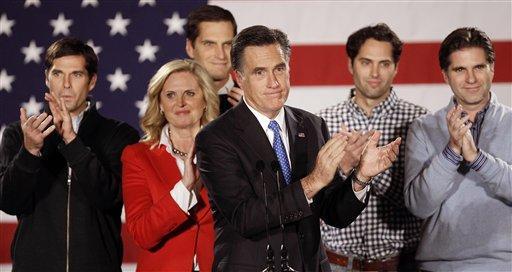
DES MOINES — For months Mitt Romney worked to lower expectations for his performance in the Iowa caucuses. Then, just a few weeks ago, despite his best efforts, those expectations began to creep up after Romney, who mostly stayed away from Iowa during the summer and fall, saw the possibility of success and began to return here, engaging with voters he had previously ignored. By the time Romney began a Christmas-week rush of campaigning across the state, he had managed to raise everyone’s expectations — including his own.
In the last days before the caucuses, the campaign buzzed with confidence as Romney’s experts foresaw an increased caucus turnout that would push him to victory. A few days before the voting, word got out that Romney, rather than flying to New Hampshire on caucus night, would instead stay in Des Moines — a sure sign Romney sensed an opportunity to give a victory speech. Aides worked overtime on that very speech. On caucus night, it was written and ready to go — but the voters did not cooperate.
At the moment Romney planned to claim victory, he was instead watching returns that showed out-of-nowhere rival Rick Santorum ahead by a few votes. The two candidates’ totals went back and forth until Santorum, still ahead, finally emerged at his suburban Des Moines headquarters to deliver what most observers would call his best speech of the campaign, claiming moral, if not outright numerical, victory. And it began with a head-on challenge to Romney: “Game on.”
Moments after Santorum finished, Romney took the stage in a small ballroom at the Hotel Fort Des Moines. The victory speech had been put aside, and Romney instead delivered the same stump talk he had been giving across Iowa for the last several days.
Aides tried to downplay Romney’s abrupt change. The undelivered speech was just “a variation” of Romney’s standard speech, top aide Stuart Stevens explained — nothing really new. Why the change? “It was late,” Stevens said. “It just seemed like a moment to be informal.”
The night grew much later; it was not until 1:34 a.m. local time that Iowa Republican Party chairman Matt Strawn announced the official vote tallies. Romney finally got the victory he had come to expect, but it was unimaginably close: Romney received 30,015 votes to Santorum’s 30,007 — an eight-vote margin of victory.
“We didn’t want to pay for a landslide,” Stevens joked, echoing John F. Kennedy’s famous quip from the 1960 election. “We maybe shaved it a little close.”
Santorum could reasonably claim a moral victory because he had started so far behind and labored in obscurity for so long. But Romney won the actual victory, even if it was by just eight votes. And Romney did it far more easily than Santorum, attending a total of 38 campaign events in a mere 19 days in Iowa while Santorum attended more than 350 campaign events in 105 days in the state. If the caucuses were determined by bang-for-the-buck, Romney would have won in a walk.
In the end, Romney escaped humiliation, and he did it at far less cost than in 2007-2008, when he gave Iowa everything he had in his first run for the GOP nomination. “If you look back four years ago, we had 52 paid staff in Iowa, and this time around, we have five paid staff,” top Romney adviser Eric Fehrnstrom said a few hours before Tuesday night’s results came in. “In terms of advertising, we spent $10 million in the run-up to the caucuses four years ago, and we’ve spent a fraction of that this time. And in terms of the candidate’s own appearances in Iowa, he was here 100 days or so four years ago, and this time we’re at about 15 days.” [It was actually a few more, but that doesn’t change Fehrnstrom’s point.]
So Romney avoided what would have been an embarrassing loss after his decision to go all-in in Iowa. But what now? He’s heavily favored to win in New Hampshire, but he’s likely to face a reconfigured field that will give his rivals the opportunity to pick up more support in the quest for a candidate to go up against Romney one-on-one. Iowa insiders predict that Rick Perry and Michele Bachmann, who received ten and five percent of the Iowa vote, respectively, will be out of the race within 48 hours. Nationally, Bachmann and Perry are at a combined 12 percent in the polls — support that will go to some other candidate or candidates, but not to Romney. That will make Romney’s job 12 points harder.
The Iowa race ended far differently than Romney had originally foreseen. For a while he stayed away from the state for fear of suffering a humiliating loss. Then he moved into Iowa in hopes of winning and thereby dealing a devastating early blow to his rivals. Nothing turned out quite the way it was expected to, but in the end, Romney managed to get away with his life.
