

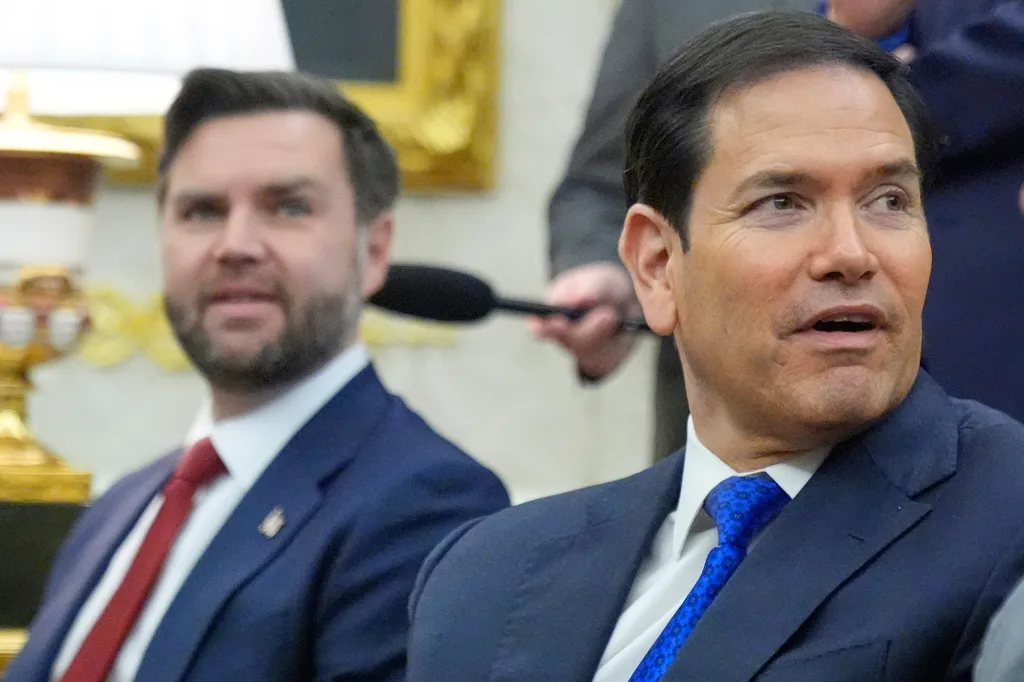
THE JD-MARCO 2028 QUESTION POPS UP AGAIN. We’re in the midst of another round of speculation about the 2028 Republican presidential race. What does it mean?
A year ago, talk about the contest focused on one person only: Vice President JD Vance. He was a zillion points ahead in the polls and had been (pretty much) declared the heir apparent by President Donald Trump. Today, Vance is still way ahead in the polls — up 30 points over Secretary of State Marco Rubio in the RealClearPolitics average. But the last week has seen a Rubio media boomlet which, along with some indications of rethinking on the part of the president, has at the very least added a little more uncertainty to the situation.
Stay informed.Stay ahead.
Join Washington Examiner for unlimited access to the news, analysis, and commentary that matter most.
Already a member? Log in
In the past several days, some in the press have enthused over Rubio’s performance as a fill-in White House briefer, as well as his meeting with Pope Leo XIV and his latest updates on the Iran war. “Rock star,” said the New York Post of Rubio’s time sitting in for White House press secretary Karoline Leavitt, who is on maternity leave. “Rubio’s Stint in the White House Briefing Room Sparks 2028 Chatter,” said the Wall Street Journal.
Meanwhile, on the same day Rubio met the press, Vance, with a good deal less media attention, made his first trip to Iowa as vice president. The purpose was to hold a rally for Republican Rep. Zach Nunn, but, like all such events at this time in the season, it did double duty as a midterm cheerleading session and a showcase for presidential ambitions.
Vance’s reception was a bit tougher than the one Rubio got from the Beltway press corps in Washington — “JD Vance campaigns with Zach Nunn in Iowa as Iran war rattles economy,” was the headline of the Des Moines Register.
Comparing the two events — Rubio in the briefing room and Vance in Iowa — sheds some light on how each man is handling the most complex and difficult issue before him today, which is the war in Iran. Granted, they were decidedly different events. A press briefing is a press briefing and can be consumed by the minutiae of the moment. A campaign speech is a statement directly to voters — in the case of Iowa, to voters who have been deeply affected, in a life-and-death way, by the war.
Rubio began his White House presentation by refining the administration’s reasons for war. He began with Epic Fury — until recently, that was what the whole war was called — but that is now finished, Rubio said. “The operation is over,” he told reporters. “We’re done with that stage of it, OK?”
Now, Rubio said, the war has morphed into a battle over the Strait of Hormuz and the ships and crews that are currently stranded in the Persian Gulf. The U.S. has begun “Project Freedom,” Rubio explained, and its goal is “to rescue almost 23,000 civilians from 87 different countries that are trapped inside the Gulf and left for dead in the Persian Gulf by this Iranian regime.”
Almost as soon as Rubio announced it, the Trump administration shelved “Project Freedom.” It was another example of the shifting ground any top official must negotiate as he discusses the war in public.
When asked about Iran’s nuclear ambitions, which was the original reason for going to war, Rubio was clear on the U.S. goal but unclear on where things stand now. He said that Iran no longer has the capacity to use missiles and other measures to shield its nuclear program. But he could not say what is happening on the question of Iran’s nuclear materials. “Well, that’s one of the topics that needs to be discussed,” he said. “The object of this diplomacy is to come up with some level of understanding about what are the topics that they’re agreed to negotiate on.”
That’s not particularly encouraging. But overall, Rubio’s was a polished, inside Washington performance. He threw in a few quips and old rap lyrics that seemed to dazzle some observers, and the political world responded encouragingly.
Despite the difficulties of dealing with the Iranian situation, as secretary of state, Rubio has shown a command of issues and a clarity of vision that has turned a lot of heads in the last year. People knew Rubio was smart and able, even as he was clearly unhappy as a senator. They knew he wanted to be president, and that he ran a nervous and overly-scripted campaign that was crushed by the Trump juggernaut in 2016. But they didn’t know he would do this well in one of the two or three most important posts in the second Trump administration.
As for Vance, a stump speech for a local congressman is not the place for policy explication. Much of the vice president’s speech was political boilerplate: “This is not a normal political environment,” Vance said. “This is a contest between a party that wants to take all of your money and give it to illegal aliens and a contest between gentlemen like Zach Nunn who fight every single day for you.”
But Vance had to deal with the war. The first thing he had to do was acknowledge that the war has made fuel and fertilizer prices rise. He did that even as he tied it to his support of more ethanol, in the form of a gasoline-ethanol mix known as E15. (Some things never change.) “We’re fighting for E15,” Vance said. “We also know that a lot of our farmers are struggling with high fertilizer prices. I’m aware of that. As the president of the United States has said, we got a little blip in the Middle East. We got to take care of some business on the foreign policy side.”
Vance also knew he could not refer to the war only as a “blip,” and certainly not in Iowa. The first six Americans to die in the Iran war were Army Reserve soldiers based at the 103rd Sustainment Command in Des Moines. Two of them were originally from Iowa. Vance described meeting two Iowa Gold Star families at the airport when he arrived. “I didn’t plan to, to see them, but they were here,” Vance said. “One of them told me … that their son’s birthday was today.”
It had been a heart-wrenching moment. Vance, who served in the Marine Corps from 2003 to 2007, with one deployment to Iraq, used the moment to describe the depth of the family’s sacrifice. With emotion in his voice, Vance mentioned his six-year-old son and said, “What would I say if this beautiful six-year-old boy got older and decided like his dad … and like so many of you here, decided to put on the uniform of his country?” Vance asked. “And I thought to myself, on the one hand, I’d be so proud of him. But on the other hand, I’d be so terrified that what happened to those two families would happen to this boy.”
Vance broadened the topic to discuss the effort Americans must make to live up to the sacrifice of those families who have lost members in military service. In all, it was a very human moment. By a terrible fluke, a disproportionate number of them have been linked to Iowa. Vance did not go to Iowa to recognize that fact, but he ended up doing so, because war is a life-and-death issue that can’t be avoided.
So Vance and Rubio had two very different Tuesdays. No, you can’t draw any great contrasts between the two men based on single events in their packed daily schedules. But you can see that charming the White House press corps and touching voters at a troubled time are two very different things.
