

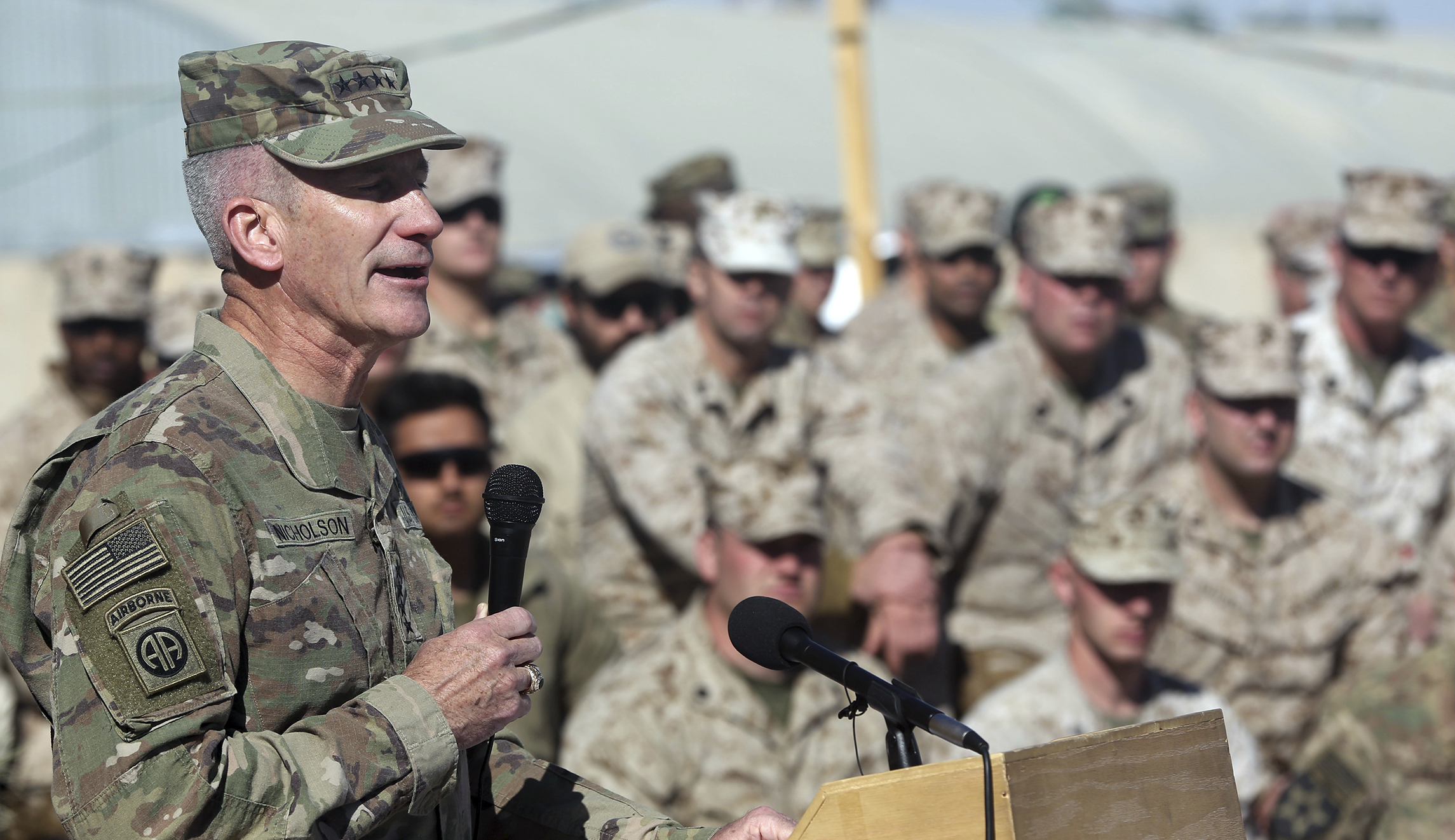
The new U.S. strategy for Afghanistan, announced one year ago by President Trump, is working despite the lack of clear military advances by the Afghan government, the outgoing U.S. commander said Wednesday.
Acknowledging that little ground has changed hands in the past year, Gen. John Nicholson told reporters in a briefing from Kabul that military pressure on the Taliban has nevertheless produced progress toward reconciliation, which is the ultimate goal of the strategy.
Recommended Stories


“I think we are seeing the strategy is fundamentally working in advancement toward reconciliation, even though it may not be playing out the way we anticipated,” said Nicholson, whose two-year-plus tour as top U.S. and NATO commander in Afghanistan ends next month.
In explaining the recent deadly attacks by the Taliban, U.S. commanders have called the current phase of the war “talking and fighting.” Nicholson said critics who cite the lack of military progress are missing the bigger picture of the growing social and religious pressure toward peace.
“Yes, it is a bit of an impasse, but despite that we’re seeing progress toward reconciliation,” Nicholson said. “So, what I would say is focus on the talking part of this … given that the traditional metrics of fighting are not explaining why the Taliban are willing to talk now.”
Those traditional metrics include the percentage of the Afghan population living in areas under government control or influence, which has not changed significantly in the last quarter, according the latest Lead Inspector General’s report issued on the eve of the one-year anniversary of Trump’s announcement of a revamped strategy.
“The Afghan government made no significant progress” on that front, notes the IG report, citing statistics from Operation Resolute Support. “As of May 2018, 65 percent of Afghans lived in areas under government control or influence, 12 percent lived in areas under Taliban control or influence, and 23 percent lived in contested areas.”
But Nicholson cited a number of political developments that he said were a direct result of Trump’s course correction from a plan to withdraw U.S. troops, to an indefinite commitment to stay as long as it takes to convince the Taliban they cannot win.
Within six months of Trump’s August 2017 announcement, Nicholson argued, there were two peace offers on the table: An open letter from the Taliban to the American people, and an offer from Afghan President Ashraf Ghani.
He also cited the first-ever cease-fire with the Taliban in June, which he said “unleashed the Afghan people’s desire for peace and an end to violence on a national and unprecedented scale.
“We have an unprecedented opportunity, a window of opportunity for peace right now, so President Ghani is working to take advantage of it. He offered a second cease-fire on August 19th,” Nicholson said.
So far, the Taliban have not responded to the offer.
Nicholson called this month’s high profile Taliban attacks an “attempt to increase their leverage in the negotiation and to maintain their cohesion,” and argued that the four-day siege of the provincial capital of Ghazni was another Taliban failure.
“This was not a military victory by any stretch. They were driven out of the city, and it was done in about four days,” Nicholson said, noting they suffered higher casualties than they inflicted.
The attack failed to achieve any military objective other than to terrorize the population and kill 150 innocent civilians, he said.
“The Taliban pulled people from their cars and summarily executed them. And when they failed to take any of their objectives, such as the prison, the airfield, the governor’s palace, they invaded people’s homes, burned markets and placed IEDs on the roads, disrupted electrical and phone service,” he said.
As he prepares to turn over command of the Afghanistan mission to Lt. Gen. Scott Austin next month, Nicholson, who has been criticized for his rosy prediction last year that the U.S. had “turned a corner” in Afghanistan, urged people to “expand the aperture” and look at the progress toward reconciliation.
“If we get a peace process initiated, then I think we are seeing the payoff for all these many years of war,” he said.
