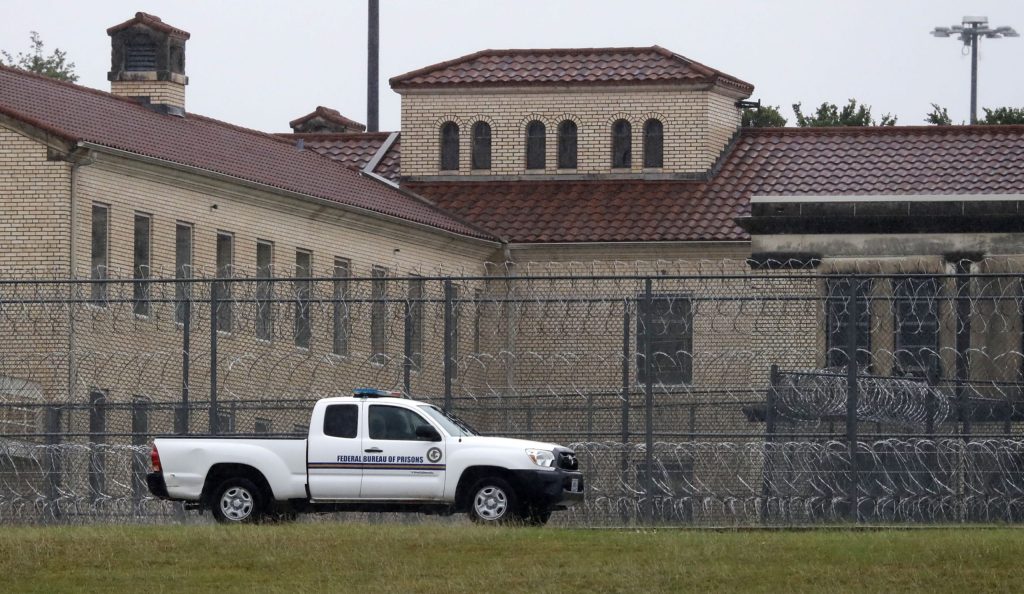
When I was arrested in 2011 on federal threat charges, I was denied bail pending trial and sent to a maximum security “detention center” run by U.S. marshals.
Nothing prepares you for the loss of liberty — the things you are subjected to, the fear, sorrow, and suffering you are about to experience.
Recommended Stories

For example, I remember when an earthquake hit, and the staff all abandoned the building, potentially leaving us all to die. Another time, a fire raged, and we were left locked in our cells with no way out.
Early on in my incarceration, my wife sent me “De Profundis,” the famous letter by Oscar Wilde. The Latin title, “from the depths,” references the first words of Psalm 130. It was written by Wilde during his imprisonment in 1897 for gross indecency — essentially for homosexuality. He wrote it for his lover, Lord Alfred Douglas, but it was never sent. Initially, he had titled it “In Prison and in Chains.”
Wilde was released in 1897 after serving two years of hard labor. He died in 1900 at the age of 46.
“De Profundis” is a personal journey of reflection, regret, and understanding that every single prisoner encounters in his journey. For Wilde, who was a well-known playwright and held in high regard in high society, it was a mighty fall. He laments and remembers some of his decisions that led to his demise, justly or not. He thinks of his parents and the shame he now knows was brought to their name. Wilde beautifully testifies to the pain and suffering of prisoners, past and present:
“Suffering is one very long moment. We cannot divide it by seasons. For us there is only one season, the season of sorrow. The very sun and moon taken from us. Outside, the day may be blue and gold, but the light that creeps down through the thickly-muffled glass of the small iron-barred window beneath which one sits is grey and niggard. It is always twilight in one’s cell, as it is always twilight in one’s heart.”
Each member of American society hopefully now, to some degree, can relate to the loss of freedom because of a killer disease, COVID-19. The jailor, in this instance, is not man but a pandemic. Obviously, being locked up in your home is not the same as being locked up in prison, but the powerlessness is there. Still, people are looking for guidance, leadership, and purpose. Society is appreciating the humanity of healthcare workers who care for us and hoping and praying for scientists to save us with a vaccine. As society tries and looks ahead with hope to normalcy in the near future, a prisoner has no such hope. His or hers is a life’s sentence. Ninenty-five percent will simply exchange one prison for another.
Prison is all about routine and structure. The individual has no say in when he eats, sleeps, or showers. There are different classifications of prisons, designed for different threat levels and the prison time left of inmates. There are various times in prison when routine is disrupted and there is a lockdown. Still, the hope is it is temporary and routine can get back to normal. It’s all the hope a prisoner has left.
With COVID-19, however, a prisoner serving two years for fraud has potentially the same sentence as the prisoner on death row for murder. The slight relief a prisoner may have is a plea for compassionate release. Usually, a prisoner who still has some money and can afford a motion to the sentencing court has the greatest chance for such relief. The indigent inmate, unaware of new laws and lacking representation, is usually left without recourse.
If there is a hearing, the judge, a person who decides sentences in the first place, must now play God and decide to reverse himself. In the current situation, this can become a decision about who lives and dies. This is too much authority for another human being outside of a doctor’s, nurse’s, or EMT’s efforts to save a life.
Wilde wrote in “De Profundis,” “Where there is sorrow, there is Holy ground.” What Wilde learned in his time was that in suffering, sorrow, pain, and seemingly hopelessness was indeed a different kind of hope — humility:
“Had anyone told me of it, I would have rejected it. Had it been brought to me, I would have refused it. One can not acquire it, except by surrendering everything that one has. It is only when one has lost all things, that one knows that one possesses it.”
Suffering is not meaningless. The reminder of mortality from time to time is indeed “a gift from God.” During these times of challenges to our very species, it is with hope that as much as we celebrate heroes of society and how precious and fragile life is, that we also think about the lowest rung of us, the poor, the prisoners who have no champion. Those with authority and power must understand that the decision to take away someone’s liberty has enormous consequences, not all of which are predictable. It should be a last resort, not part of a business or profit model.
Before his death, Wilde wrote a poem about his time in prison titled The Ballad of Reading Gaol. He wrote it about a man who had killed his wife and was hanged at the age of 30. The sight of seeing the man hanged affected Wilde and gave him thoughts about his time in prison and what life would possibly be when released. Wilde had a huge transformation that perhaps everyone in prison does. Martin Luther King Jr. called prison “all the essentials of life, without any of life’s beauties.” Wilde’s essay and poem are as relevant today as 100 years ago. As society has lost some of its freedoms over the last 60 days, hopefully it will give greater understanding to what liberty and freedom actually mean:
“A prison wall was round us both,
Two outcast men were we:
The world had thrust us from its heart,
And God from out His care:
And the iron gin that waits for Sin
Had caught us in its snare.
“At six o’clock we cleaned our cells,
At seven all was still,
But the sough and swing of a mighty wing
The prison seemed to fill,
For the Lord of Death with icy breath
Had entered in to kill.”
Vincent McCrudden, a former trader on Wall Street, served two years in federal prison.