
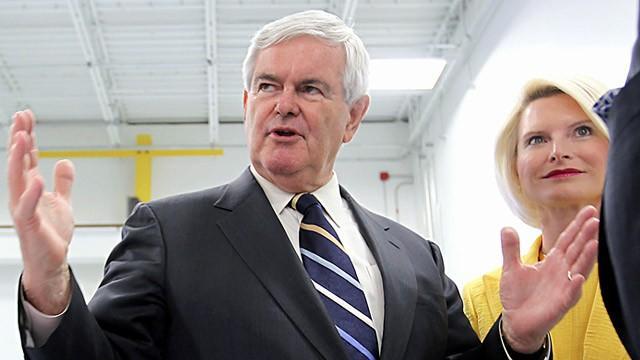
NASHUA, NH — Just as in Iowa, Newt Gingrich’s popularity has plunged here in New Hampshire. The former House speaker, who hit 24 percent in a Rasmussen survey in late November, is languishing at eight percent in the latest Rasmussen Granite State poll.
In the next primary state, South Carolina, Gingrich hit 42 percent in an NBC News poll in early December. Now, he is at 18 percent in a new Rasmussen survey.
The conventional wisdom holds that Gingrich fell as a result of highly effective attack ads aired in Iowa by rival Ron Paul and a super PAC working on behalf of Mitt Romney. Certainly those ads, which focused on issues like Gingrich’s paid work for Freddie Mac and his global-warming partnership with Nancy Pelosi, did some damage. But talks with voters here in New Hampshire and with politicos in South Carolina suggest the ads are not what killed Gingrich. It was Gingrich’s reaction to the ads.
Voters who once supported Gingrich but have now turned away from him say that his hot-tempered response to the ads, rather than the ads themselves, simply turned them off. “He’s got a temper,” said one Tea Party member at a Nashua coffeehouse Saturday morning. “I don’t want a guy with a temper with his finger on the button.” Other voters said Gingrich’s ill-tempered complaints about the ads distracted them from the former speaker’s message about jobs, the economy, and American renewal.
In South Carolina, Gingrich’s decision to call Romney a liar did not sit well with many Republicans, including those who don’t support Romney. “I think people saw him calling Romney a liar as just un-presidential,” says one well-connected South Carolina political figure. “It just looked unpresidential.”
As a political tactic, the brilliance of the Paul and Romney ads was that they provoked Gingrich to anger — and into hurting himself. That allowed Romney supporters to follow up by accusing Gingrich of being in a state of perpetual anger, and therefore unfit for the presidency. “He’s always angry,” former New Hampshire Gov. John Sununu, a Romney supporter, said Friday. “There’s nothing new about that…This is the old Gingrich. There was a new Gingrich for about 11 microseconds, and now you’re back to the old Gingrich.”
Gingrich has also been hurt by a long gap between Republican debates. Gingrich rose to prominence in the GOP race because of his consistently impressive performances in debates — and by his decision to focus his attacks on Barack Obama and not on his fellow candidates. But until Saturday night’s face-off in Manchester, there has not been a debate since the Fox News session in Sioux City, Iowa on December 15. That’s a long time for a candidate to go without being able to showcase his strength. During that time, Gingrich has fallen steadily in the polls.
Voters here and in South Carolina still have great respect for Gingrich and what he has accomplished in his career; no rival can match him. And voters wish some other candidate had Gingrich’s debating talent; one Tea Party member said he would like to see a candidate with Romney’s business acumen, Gingrich’s debating skills, and Rick Santorum’s integrity. But for many voters, in New Hampshire, South Carolina, and across the country, temperament is a threshold issue. If a voter determines that a candidate is too hot-headed, or in some way does not possess the proper temperament to be president, it ultimately doesn’t matter what else that candidate does; he won’t win the voter’s support. And that is what has happened to Gingrich in the aftermath of the Iowa attack ads.
