Trump’s ‘most favored nation’ policy threatens US competitiveness with China

Congressional enactment of the “most favored nation” drug pricing policy urged by President Donald Trump in his State of the Union message would gravely harm American innovation, competitiveness, and national security in the emerging pharmaceutical technology race with China by crippling the market incentive system that has reliably propelled U.S. global leadership in this vital sector for decades.

MFN policies are price-control schemes that establish caps on the costs of prescription drugs sold in the United States based on the lowest prices pharmaceutical companies charge for these medicines in other developed countries. Despite convincing evidence of the harmful economic consequences of such price controls, American politicians have demonstrated increasing interest in this type of dysfunctional market intervention over the past several years.
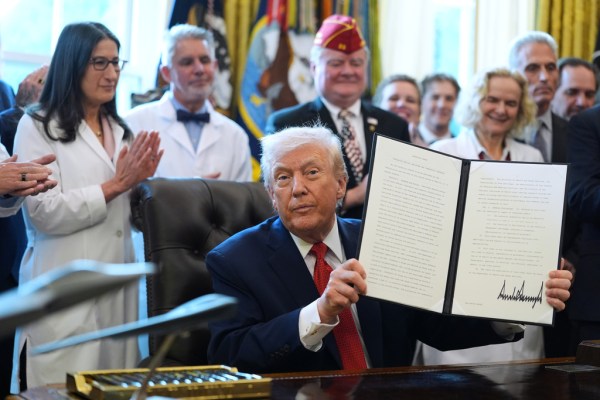
The two most recent examples of this tendency are the MFN proposals advanced by the administration and introduced in Congress last spring. These plans are successors to two earlier initiatives from the first Trump administration and are similar in concept to the Elijah E. Cummings Lower Drug Costs Now Act passed by House Democrats in 2019, and the price-setting provisions of former President Joe Biden’s Inflation Reduction Act of 2022.

TRUMP ADMINISTRATION URGED TO TAKE ON CHINA’S ‘PHARMA DEATH GRIP’

Voluminous evidence confirms that implementing MFN price controls will reduce investment in research, development, and discovery of beneficial new drugs. Extensive economic literature suggests that R&D spending will be suppressed by 1.5% on average for every 1% that pharmaceutical industry revenues are reduced by price controls, with some estimates pegging the suppressive effect as high as 5%. Economists at the Becker Friedman Institute for Economics at the University of Chicago have estimated that the MFN price control bill passed by the U.S. House in 2019 would have reduced pharmaceutical R&D spending by 45% or $1.5 trillion and resulted in 254 fewer new drug approvals during 2021-2039 had it become law. Several other studies have confirmed the negative effects the House Democrats’ 2019 bill and the IRA would have on innovation.

Initial analyses of the most recent MFN proposals are forecasting the same damaging effects on pharmaceutical investment and innovation. One evaluation from the Vital Transformations consultancy found that the provisions of the May 2025 executive order will cause the loss of up to $2.4 trillion in pharmaceutical industry earnings that drive investment in new cures, eliminate virtually all venture capital funding in the sector, and reduce new patents by 48% from 2025-2034.

The U.S. can ill afford a self-damaging unforced error, such as adopting MFN drug pricing, at a time when China’s strategic prioritization, investment, and competitiveness in the pharmaceutical sector are ascending so alarmingly. The Chinese Communist Party has designated the industry for accelerated development in its “Made in China 2025” plan, which seeks to achieve global dominance in critical industries by mid-century. The CCP pursues these goals through a panoply of aggressive mercantilist industrial policies, including central planning, subsidies, support of state-owned enterprises, theft of intellectual property, forced technology transfers, acquisitions of Western companies by Chinese companies, and discriminatory treatment of foreign investment, among others.

These state-led initiatives have produced impressive results for the CCP and are positioning China to credibly rival U.S. leadership in pharmaceuticals. China outpaced the U.S., Europe, and Japan by securing approvals for 256 new drugs during the early 2020s, including 87 in 2023 alone. China was also producing close to a third of the innovative molecules licensed by large drug companies by 2024. Furthermore, Beijing has increased its share of clinical trials from 1% of the world total in 2009 to 30% in 2024, while the U.S. share declined from 39% to 35%.

RESTORING AMERICA: COMPETITION IS THE REAL CURE FOR HIGH DRUG PRICES

The intersection of China’s aggressive economic nationalism with America’s misguided MFN price controls threatens U.S. national security on multiple fronts. Most fundamentally, the deterioration of the U.S. innovation and manufacturing environments resulting from the imposition of MFN pricing risks further increasing America’s already problematic dependence on Chinese production and supply chains for critical ingredients. These intensified vulnerabilities will undermine the ability of the U.S. to respond effectively to future pandemics or the use of weaponized biotechnologies by terrorists or hostile state actors.

However understandable American frustrations with high drug costs and unfavorable international price differentials may be, congressional codification of MFN pricing is not a suitable remedy. Congress and the president should instead focus on solutions that address root causes without jeopardizing their innovation ecosystem, economic independence, and national security, such as taking a hard line in international trade negotiations to press other developed countries to increase the prices they pay for innovative medicines.

William J. Murphy is a former Army officer and professor of social science at the New England Institute of Technology, where he teaches courses on national security and economics. 

Related Content