

The video of Kallie Keeler, a high school sophomore wrestling in an all-girls tournament last December, is just 22 seconds long. But it might demonstrate the 54-year history and purpose of Title IX as much as any lengthy lawsuit filing.
Recommended Stories


Taken by Kallie’s mother, Stephanie, video footage shows the 16-year-old wrestling an opponent who appears to be female. Halfway through the short match, Kallie looks at her mother, her face grimacing with pain and frustration. She mouths something, but it’s hard to decipher what. Moments later, Kallie lets herself be pinned to end the match. Kallie ran to her mom in tears.
“[D]uring the match, the male athlete sexually assaulted [Kallie], shoving his fingers through her spandex clothing, digitally penetrating her vagina, and holding the position for several seconds,” reads the explosive complaint that Alliance Defending Freedom filed on Kallie’s behalf against the Washington Interscholastic Activities Association in June.
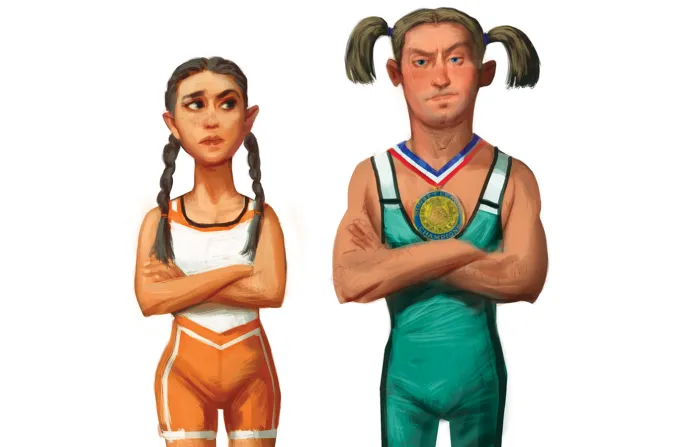
Kallie and Stephanie later learned from a coach on another team that her opponent was actually male and had been allowed to wrestle in the all-girls tournament without Kallie’s knowledge or consent. When the assault was reported, nothing happened for nearly two months.
Like many other females at the center of similar ADF lawsuits, Kallie learned firsthand what can happen when organizations, policies, or laws allow males to compete against females. Her lawsuit intertwines three delicate topics that have become a flashpoint on the forefront of law, culture, and politics: parental rights, sexual assault risks, and male athletes competing against females in all-female arenas.
Jonathan Scruggs, senior counsel and vice president of litigation strategy at ADF, told the Washington Examiner that, like with many of their cases on this topic, their clients and parents are asking for common sense to be applied to athletics.
“[D]on’t allow men in women’s sports in Washington,” Scruggs said. “This violates Title IX and what happened to Kallie illustrates that not only did she wrestle and lose to a male. She was sexually harassed during the wrestling match publicly in front of everybody.”
Supreme Court protects women, finally
As a mother of daughters and a former athlete myself, I found what happened to Kallie especially disturbing, if not discouraging, particularly in light of recent wins on this very subject.
On June 30, the Supreme Court upheld West Virginia and Idaho laws protecting female athletes from being forced to compete against males. In West Virginia v. B.P.J. and Little v. Hecox, the Supreme Court ruled unanimously that Title IX does not prevent states or schools from separating athletic teams by biological sex and 6-3 that the Equal Protection Clause of the 14th Amendment allows states to protect female athletes through sex-specific sports.
The Supreme Court’s majority opinion will be studied for years to come for many reasons, not the least of which is that both Justices Brett Kavanaugh and Clarence Thomas finally articulated, via sound legal analysis, the common-sense position.

“Men and boys with gender dysphoria are not women or girls, even if they believe that they are,” Thomas wrote in his concurring opinion. “Sex is an immutable ‘biological’ characteristic; it is binary; and ‘man’ and ‘woman,’ ‘boy’ and ‘girl,’ are the terms that correspond to adults and children of each sex. To use language to obscure reality — to show ‘indifference regarding the truth’— is to lie to the public and cease to treat our fellow citizens “as equal[s].”
Kavanaugh wrote the majority ruling. Tucked within the legal reasoning and historical references, was a logical, thoughtful paragraph only a coach of girls’ sports, as the justice has been, could write.
“What is the harm in allowing an additional athlete to compete in women’s or girls’ sports? That sentiment, though understandable, misunderstands the nature and reality of sports. Sports are highly competitive and generally zero-sum. At almost every turn, someone wins and someone loses. Every athlete who makes a team takes a roster spot from another athlete. Every player who earns playing time reduces the playing time of a teammate. Every player who makes the starting lineup sidelines another who remains on the bench. Every competitor who wins a race or competition deprives another athlete of that victory, or medal, or prize. Every team that wins because of an added player means that another team has lost because of that added player. Every player who makes all-conference beats out another player who does not. Every student who earns an athletic scholarship takes that opportunity away from another student. And so on.”
Surely Kallie, and so many women and girls adversely affected by these policies, can attest to these truths firsthand.
Still fighting for fairness and safety in sports
The legacy media took a different view of the ruling. “Trans Sports Bans Upheld By Supreme Court: What These Shameful Rulings Mean for Wisconsin,” the ACLU of Wisconsin wrote in a headline. “Supreme Court Weaponizes Constitution Against Transgender Athletes,” wrote Alliance for Justice.
It would seem that in the media, women are not fighting for fairness, privacy, or safety as much as they are demoralizing male or transgender athletes.
However, headlines don’t change reality, as much as they might try to obfuscate it. The Supreme Court’s ruling has already had an effect on at least one similar lawsuit. Two male athletes in New Hampshire dismissed their lawsuit to challenge that state’s law that protects girls’ sports after the most recent decision.
While 27 states have laws that protect women’s sports, 23 don’t. The next frontier will be to determine another vital question: Must these remaining states pass laws that protect women’s sports?
Blue states may be the last to act
In Scruggs’s opinion, girls like Kallie are still subject to harrowing experiences like the one she went through last December because in many Democratic-run states, there are no laws or policies protecting females in sports. Scruggs believes many “blue” states are “just captured by ideology and thinking that there’s no difference between boys and girls.”
Kallie’s lawsuit asks questions beyond just whether or not there are biological differences between men and women, but perhaps even more probing: Do females have a right to know if they’re facing a male in a sport? What about the parents of these same athletes?
Scruggs explained that the athlete at the center of the West Virginia v. B.P.J. case is a prime example of why Kallie and girls like her must be heard. It’s not just about athletic advantage due to sex differences, but there are safety and privacy concerns as well. “How many women have to lose their dignity and opportunities before people wake up?” he asked.
“B.P.J. beat 470 different girls, 1400 different times, and also sexually harassed a person,” Scruggs told the Washington Examiner. “That’s one reason again that we separate sports by sex, right? We don’t generally allow men to hang out with women or shower with men, or to be in this kind of close grappling situation with a female, precisely because we recognize and acknowledge men and girls, men and females are different. And we should respect those differences.”
Kallie has the support of the majority of Americans. Gallup and NBC News have consistently found that around 65% to 75% of U.S. adults believe sports participation should be restricted to biological sex.
But that hasn’t changed the way some Democrat-run states view this issue. ADF’s original lawsuit aimed at protecting females in sports, Soule v. Connecticut Association of Schools, started in 2019 and is still ongoing. In Connecticut, there are no laws that protect women and girls in sports, but there are anti-discrimination laws that allow males to compete on female athletic teams.
In 2019, a group of brave female athletes — Selina Soule, Alanna Smith, Chelsea Mitchell, and Ashley Nicoletti — were unable to compete and win in their sport thanks to the Connecticut Interscholastic Athletic Conference’s policy that allows males who identify as female to compete in girls’ athletic events.
During her high school track and field career, Soule earned 10 conference titles, five state titles, and broke five school records. During a Protect Women’s Sports Rally in Washington, D.C. earlier this year, Soule, now 23, said, “For my entire high school track career, I competed against one male almost every single week, totaling dozens of races — races lost to the male athletes. Between the two of them, they won over 15 women’s state championships and broke over 17 meet and state records — records no girl will be able to achieve.”
Soule was forced to start speaking out at 16 because “none of the officials in Connecticut stood up for us.” Soule, like Kallie, is proof that policies in blue states that favor male athletes competing in female sports do so at the risk of robbing females of what they’ve earned, or worse, harming them emotionally or physically. Kallie’s case has just begun; if it’s anything like Soule’s experience, it could be a long time before she sees justice.
MORE TRANSGENDER CASES LOOM ON THE HORIZON FOR THE SUPREME COURT
Even though the Supreme Court has upheld laws that protect females in sports, Scruggs can’t see the organization that allowed Kallie to compete against a male who allegedly assaulted her settling or backing down.
“We’ve always done this. From time immemorial,” Scruggs said. “We recognized that men and women are different. The ideological blinders that people put on to deny that is, I think, a little sad, but we live in a day and age now where you have to litigate and fight for reality, even if it means going to the U.S. Supreme Court — and we’re ready to do it.”
Nicole Russell is an opinion columnist for USA Today. She lives in Texas with her four children.
