Start with the week itself, in order.
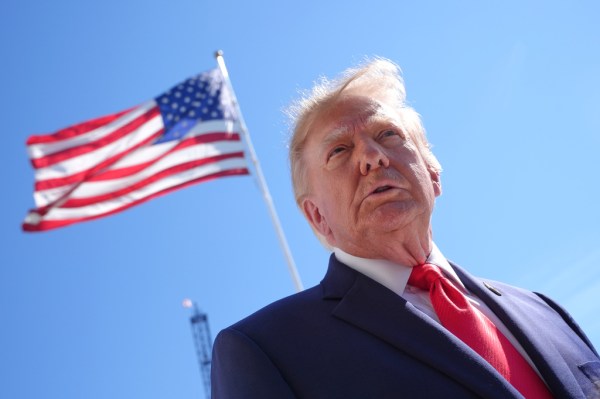
On Aug. 14, at a police training center in Garden City, New York, President Donald Trump told a room of law enforcement officers that once Iran is finished, “pretty soon I’ll be declaring the Hormuz Strait a territory of the United States.” He added the sentence that was not a joke: “We have the blockade. No ships get through unless we want them to.” Then he asked Americans to accept a higher price at the pump as the cost of keeping a very evil country from a nuclear weapon.
Recommended Stories
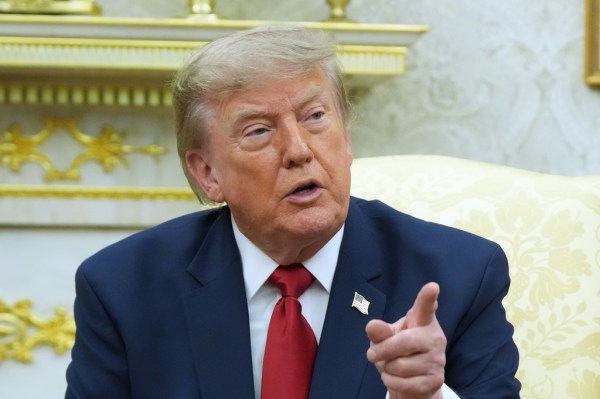
On the fifteenth, he posted a photograph of himself standing beside Kim Jong Un, with the note that the two of them get along great.
TRUMP’S HORMUZ TOLL LASTED 24 HOURS. THE PRECEDENT DOESN’T EXPIRE
On the sixteenth, Jared Kushner sat for roughly two hours in Cairo with Khalil al-Hayya, the man who became Hamas’s senior political leader in July, to talk about disarmament.
On the seventeenth, Trump posted a meme of Kim at a telephone, captioned “we cool, right,” and attached no words of his own. That same day, Kushner was in Jerusalem with Israeli Prime Minister Benjamin Netanyahu.
On the eighteenth came a graphic of the strait beneath a banner reading NEW U.S. TERRITORY. Hours earlier, Israeli aircraft had struck an air base in Idlib that a Turkish delegation had visited the day before — and it was the American envoy, Tom Barrack, who publicly named Israel as the author and called it an unnecessary escalation.
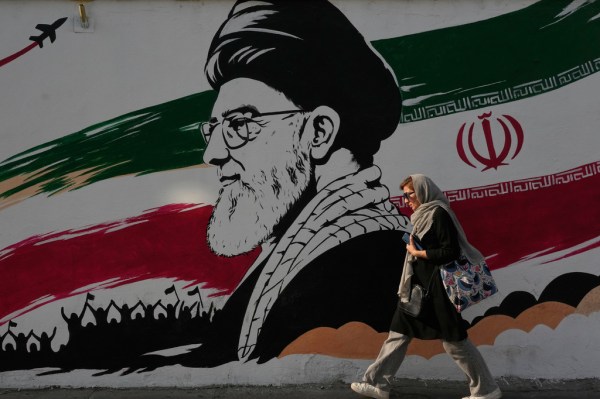
On the nineteenth, the president declared the June understanding with Tehran finished and announced what he called an economic D-Day: “the most crushing economic operation ever taken against any country,” in his words, with consequences promised for any nation whose banks, airports, ship registries, or front companies keep Iran afloat. You know who you are, he wrote.
Six days. Most of it was typing.
The method has a name
I have written before that these stretches are not hesitation but operational pauses — intervals in which the shooting stops and nothing else does. And I have called the wider method controlled chaos, which does not mean every event is scripted from one desk. It means the visible signal and the eventual result do not arrive in the order observers expect. One thing is thought, a second is said, a third is done, and a fourth result arrives.
The cost of sorting out which signal is real falls on whoever has to respond. That is not a side effect of the method. It is the product.
So sort them.
Who each signal was for
The blockade language and the economic D-Day were aimed at Tehran, and beyond Tehran at Beijing. More than 80% of Iran’s oil exports go to China. When Trump wrote “you know who you are,” the list he attached — oil smuggling, swap lines, cash transfers, exchange houses, ship registries, front companies — describes the machinery by which sanctioned crude reaches a buyer, and most of those buyers are Chinese. Not one item on that list is a weapon.
Moscow got its notice separately. On Aug. 7, the Senate passed the Lindsey O. Graham Sanctioning Russia and Iran Act, which would authorize tariffs of up to 100% on the largest buyers of Russian energy. Ukrainian drones have since stopped grain and crude loading at Novorossiysk, a port that moved Central Asian and Chinese cargo as well as Russian.
Pyongyang got two friendly posts inside three days, at the precise moment American pressure elsewhere was at maximum. Read that as sentiment if you like. Read it as a cheap way to keep one adversary quiet while the others are busy, and it reads better.
Ankara received the quietest signal of the week — and the sharpest. On Aug. 7, Turkey signed a mutual-defense pact in Mecca with Saudi Arabia and Pakistan, giving Ankara a new foothold across the Gulf. Eleven days later, Israeli jets struck a Syrian air base that a Turkish delegation had inspected the day before. Washington’s response was to name Israel in public and then open a trilateral deconfliction channel between Israel, Syria, and Turkey. Ankara kept its new standing. It also acquired an American chaperone.
And Hamas got Kushner in a room.
That last one deserves more attention than it received. Hamas did not send a spokesman; the president’s son-in-law sat with its most senior political figure, and the subject was disarmament. Organizations do not open that conversation while they still believe a patron is coming. Hezbollah has watched the Lebanese army begin locating its weapons. The Houthis declared a blockade of Saudi Arabia in July and have discovered that closing a sea lane is easier than surviving the response. What all three now share is the discovery that neither Tehran, nor Beijing, nor Moscow is in a position to shield them.
What it is worth, and to whom
Israel votes on Oct. 27. A prime minister facing that electorate has spent the month watching Iranians reach a contract, Hezbollah’s arsenal shrink, and a disarmament conversation open with Hamas. In the same week, Washington publicly rebuked him over Syria. Ankara read the strike its own way: Turkey’s communications directorate accused him of pursuing expansionist and destabilizing policies ahead of an Israeli election. The gains help him with one part of his coalition. Being accused by Ankara of confronting Turkey too hard, eleven weeks before a vote, does not obviously hurt him with another.
The United States votes on Nov. 3. And here the ledger is harder.
Gasoline on Aug. 14 averaged $4.08 a gallon, 29% above a year earlier. Two weeks before, Quinnipiac had the president’s approval at 32%, the lowest it has ever recorded for him. Forty-nine percent of voters said they were worse off financially than a year ago. Sixty percent opposed the military action against Iran; 66% said it had not been worth fighting.
Into that, at a rally for a Republican candidate for governor, Trump asked for more money at the pump.
Presidents do not do that. Presidents promise cheaper gasoline. They blame speculators, open the reserve, fly to Riyadh. This one did the reverse in public, on camera, 11 weeks out, and in the same breath claimed the chokepoint that sets the price.
Which is the question the week actually poses. Not whether he can annex a strait — he cannot — but what he believes he is buying with the eleven weeks, and whether the voters being asked to fund it have been told what the purchase is.
The part nobody prices
There is one more thing worth noticing about the method, and it is the reason it works.
Nobody can hedge against all of it at once. A Chinese refiner cannot tell whether the ship-registry warning is real. A Russian exporter cannot tell whether the tariff bill clears the House. Hamas cannot tell whether Kushner speaks for a settlement or for a deadline. And when the noise gets thin, there is always a forgotten file to reopen — Cuba, Greenland, a hemisphere away from wherever anyone is looking.
In June, Washington and Tehran actually reached a memorandum of understanding: the strait reopens, Iran reaffirms it will not build a weapon, the blockade lifts, sanctions drop. Sixty days to convert it into an agreement. The blockade eased. Then it came back.
So a deal to reopen Hormuz has existed once already. It did not survive. And in the months since, the United States has become the one large energy supplier nobody is shooting at, signing long-term contracts on the strength of a single fact: American cargo arrives.
Ask it plainly, because Trump nearly asked it himself on the fourteenth. Who benefits from reopening the strait, and who signs the contracts while it stays shut?
I spent my career in Georgia’s security services, and later in its parliament, representing a district on the line with the Russian-occupied territories. I learned there that the decisions that move a map are rarely the ones announced from a podium. They arrive as a customs schedule, a maintenance notice, an insurance condition — and by the time anyone names them as policy, the leverage has already moved.
What was unusual about this week is how much of it was said out loud.
The posts will be quoted for a while, because they are funny.
TRUMP IS DOING THE ONE THING CLINTON, BUSH, OBAMA, AND BIDEN REFUSED TO DO FOR UKRAINE
The gasoline line will not be quoted at all, because it is not.
That is usually the one to watch.
Emzari Gelashvili is a former senior official in Georgia’s state security, defense, and interior ministries, with a career in counterintelligence focused on Russian and Iranian intelligence operations. He served in the Georgian Parliament from 2008 to 2012.