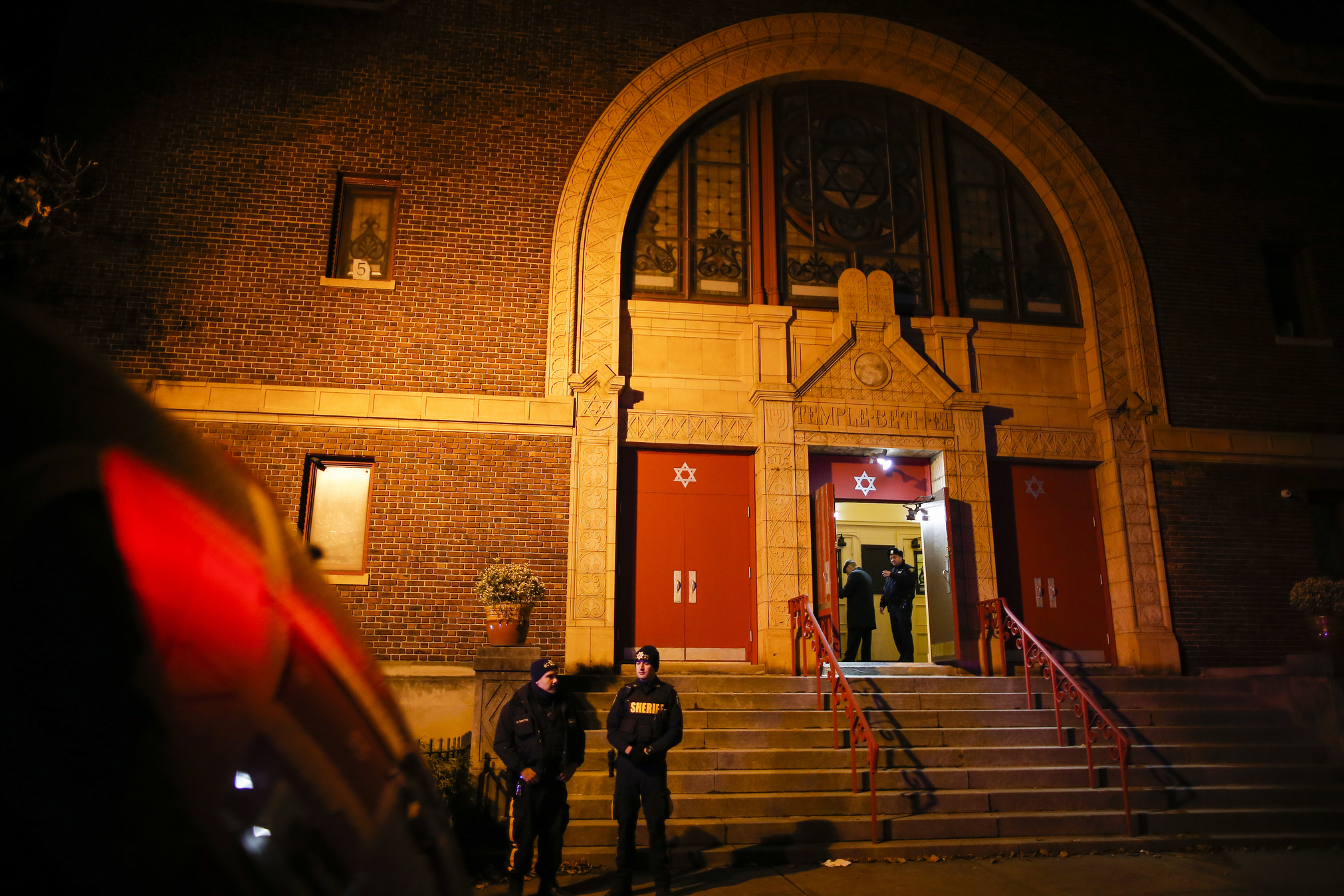
On Saturday night, a man stormed into a Hanukkah celebration at a rabbi’s house in Monsey, New York, slashing five Hasidic Jews with a machete. The Monsey attacks came during a week that saw nine incidents targeting Jews in the New York area during the holiday season and in the same month in which two assailants opened fire in a kosher grocery in Jersey City, New Jersey, killing three.
The New York-New Jersey area has the largest concentration of Jews outside Israel and has, until recently, been a place where these communities have felt safe. Yet in 2019, well before Jersey City and Monsey gained national headlines, the region was already seeing a huge spike in attacks on Jews, particularly members of the Orthodox community who are outwardly identifiable as Jewish. Jews have been routinely assaulted. They have been violently mugged. Within a week over the summer, a Hasidic Jew in his 60s was beaten with a brick while another was lacerated in the head when a group of youths threw a stone through the window of his truck. Just a day before the Monsey attack, in Brooklyn, a woman assaulted three Orthodox Jewish women, later telling cops, “Yes, I slapped them. I cursed them out. I said ‘F-U, Jews.’”
Recommended Stories
As anti-Semitism has seen a resurgence, news media and our political culture have reported it inadequately and confronted it hardly at all. Too often, the issue is talked about only when it can be used as a cudgel against one’s political enemies or when it confirms one’s preconceived notions about what fuels hate crimes. Otherwise, it is largely dismissed or ignored.
One of the unique aspects of anti-Semitism is that it cannot be treated as a monolithic form of prejudice. Anti-Semitism defies any party or ideology and is often contradictory. Hatred of Jews has endured for thousands of years, and, like a cancer, is constantly mutating. Jews are stereotyped as being weak, yet conspiracy theorists say they are pushy and all-powerful, controlling everything from geopolitics to the weather. White supremacists see them as a threat to European-descendant populations, but they are also accused of “hyper-whiteness” by those blaming them for urban gentrification. Jews are hated as socialists yet also because they are said to epitomize evil vulture capitalism. For centuries, Jews were persecuted, massacred, and chased out of countries on accusations that they undermined nations from within, and yet when Jews formed their own country, it has been treated as a global pariah. Israel’s efforts to defend itself have been used to justify a new wave of anti-Semitism that has spread like wildfire throughout Europe and on U.S. college campuses.
The recent trend of anti-Semitic attacks in the United States cannot be attributed to any one form of hatred or fit neatly into any narrative. The 2018 Pittsburgh shooter blamed Jewish groups for being behind migrant “invaders” while attacking President Trump for the “infestation” of Jews in the White House. In a manifesto, the shooter in an April Passover attack in Poway, California, wrote that Jews were “responsible for the meticulously planned genocide of the human race” while calling Trump a “Zionist, Jew-loving, anti-White, traitorous c—sucker.” Both of these assailants were white.
Yet an assailant in the Jersey City attack was a follower of the anti-Semitic Black Hebrew Israelite group. The suspect in the Hanukkah stabbings in Monsey, New York, who was also black, had a journal containing anti-Semitic rantings and had searched online for Jewish targets. The wave of attacks on Jews in Brooklyn in recent years has been predominantly carried out by nonwhite assailants.
Despite the complicated nature of anti-Semitism, Democrats have tried, lazily, to blame what’s happening on Trump or white supremacy. As news reports were still coming in after the Monsey attack, Rep. Eric Swalwell, who until recently presented himself as a suitable Democratic presidential nominee, declared that anti-Semitism was being “stoked” by Trump and tweeted out an op-ed he wrote recently blaming the president for rising anti-Semitism. After the Jersey City shooting, Rep. Rashida Tlaib tweeted, “White supremacy kills.” The Israel-boycotting member of Congress, who has peddled dual-loyalty smears and recently headlined an anti-Semitic conference, was forced to delete the tweet when she realized the attack was actually perpetrated by a follower of the Black Hebrew Israelites. Meanwhile, New York City Mayor Bill de Blasio, who has presided over the surge of anti-Semitic incidents, in June described anti-Semitism as an ideologically “right-wing movement.”
Making anti-Semitism about Trump or the “right-wing” reveals a lack of understanding or honesty about the nature of the problem, which guarantees that it will persist. If de Blasio weren’t spending the past few years acting as if Trump supporters and neo-Nazis were the only threat to Jewish populations, maybe he would have addressed the anti-Semitic beatings in his city.
His fecklessness is indicative of a broader tendency of partisans to ignore the forms of anti-Semitism that exist on their own side. For too long, liberals have allowed anti-Semitism to fester in their ranks as long as it gets laundered as mere criticism of Israel. That has allowed Tlaib and Rep. Ilhan Omar to bring anti-Semitic tropes into the halls of Congress with impunity.
Trump should be commended for his strong support for Israel and recent executive order combating anti-Semitism on college campuses, for which he was unfairly criticized. But he has also done his share to feed into anti-Semitic stereotypes, for instance, by saying Jews showed “great disloyalty” by voting for Democrats. He told a Jewish audience that they had to vote for him because of Democratic plans to confiscate wealth. He said, ”A lot of you are in the real estate business because I know you very well. You’re brutal killers, not nice people at all. But you have to vote for me, you have no choice.” Such rhetoric is unhelpful, even though it was intended as a compliment, and it shouldn’t be dismissed just because of statements that Omar or Tlaib made.
Anti-Semitism defies any easy solution. But to confront it, people need to start treating it as a problem independent of whether it can be used as a weapon against political enemies.
