

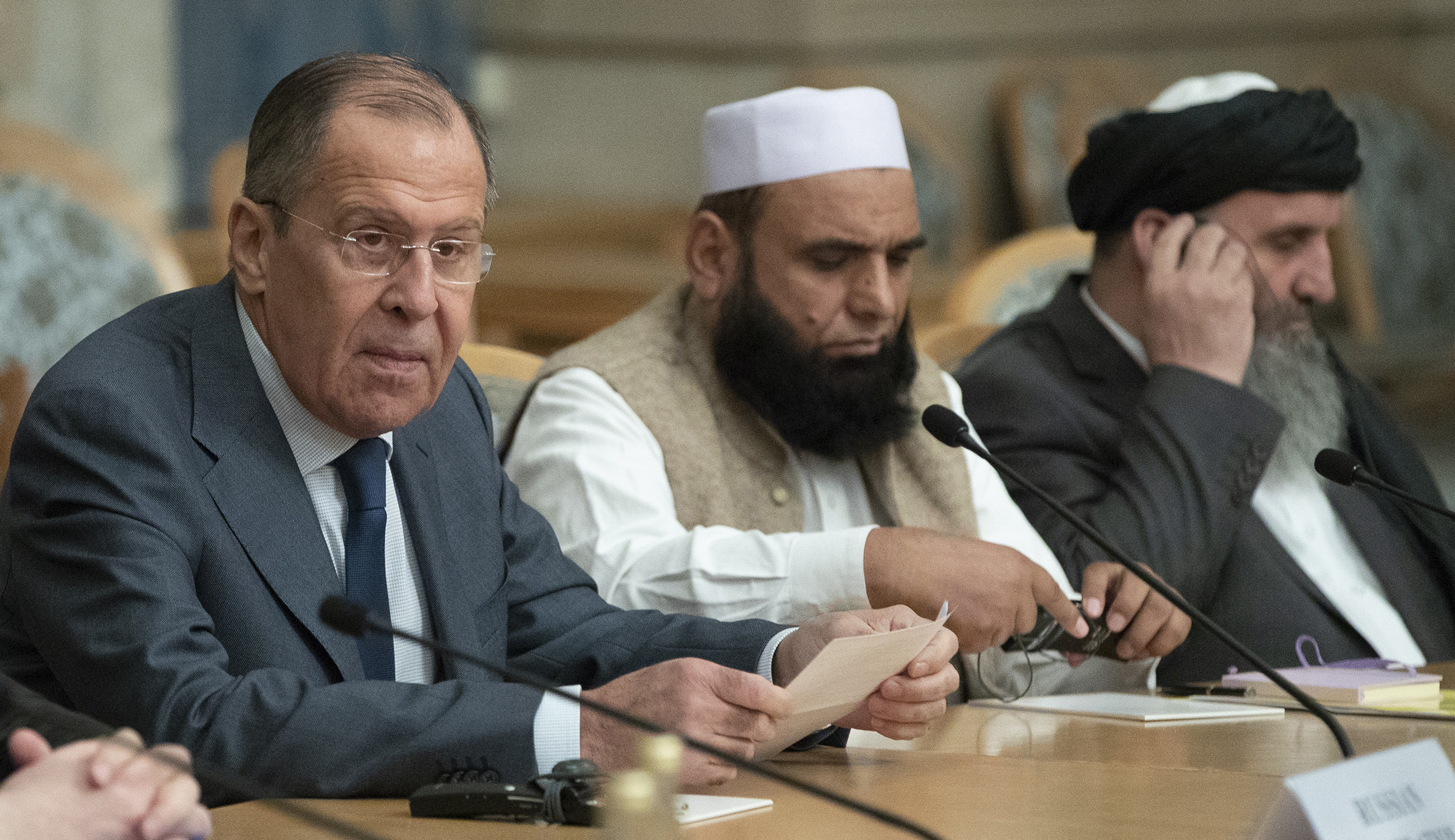
President Trump is taking an “egotistical approach” to negotiations to end the Afghanistan War, a top Russian official complained Monday.
“It is common knowledge that a dialogue between the Afghan government and the Taliban cannot be avoided,” Russian Foreign Minister Sergey Lavrov told reporters. “However, some countries, for example, the United States, have been trying to seize control of this dialogue so as to hold it behind closed doors.”
Recommended Stories


Lavrov offered that comment as a rebuke of the Trump administration’s announcement of a preliminary framework for an agreement with the Taliban that would result in the withdrawal of U.S. forces from the country. The top Russian diplomat has been trying to broker talks between the Taliban and the central government in Kabul through a loose organization known as the “Moscow format,” involving five regional power players, but a top U.S. diplomat has been negotiating one-on-one with the Taliban.
“By doing this, our American partners are keeping the regional countries, which care about Afghanistan’s future, in the dark about their plans,” Lavrov said. “Regrettably, the United States has done this not only in Afghanistan. This unilateral and egoistical approach to foreign policy initiatives is typical of the current foreign policy officials in the U.S. administration.”
The “Moscow format” also includes multiple nations that have tense relations with the United States. China and Iran are part of the group, in addition to Russia. Pakistan, a U.S. ally suspected of sheltering terrorists, also participates. India fills out the quintet, a country that has developed into the world’s largest democracy since gaining independence from the British Empire that the United States has been trying to cooperate with more closely.
“The Moscow format is unique because it brings together all countries that can influence different political forces in Afghanistan in one way or another,” Lavrov said.
U.S. officials have criticized Russia and Iran for “not helping at all” with the peace effort, and one top diplomat accused both of “propping up the terrorist networks” that seam the country.
“We call on Russia, Iran, and Pakistan to do more, and we call on places like India and China who could do more and have not gotten as involved as we think they could by — number one — saying to Pakistan: ‘You have a chance to come in with the international community and be [involved in] a positive effort,’” Kay Bailey Hutchison, the U.S. ambassador to NATO, said in April. “‘We need to rally all of the capabilities that we have to stop terrorism in Afghanistan, which is then exported to many other countries around there. We want to stop it for the Afghan people and for all of the countries that would be invaded by terrorists.’”
