

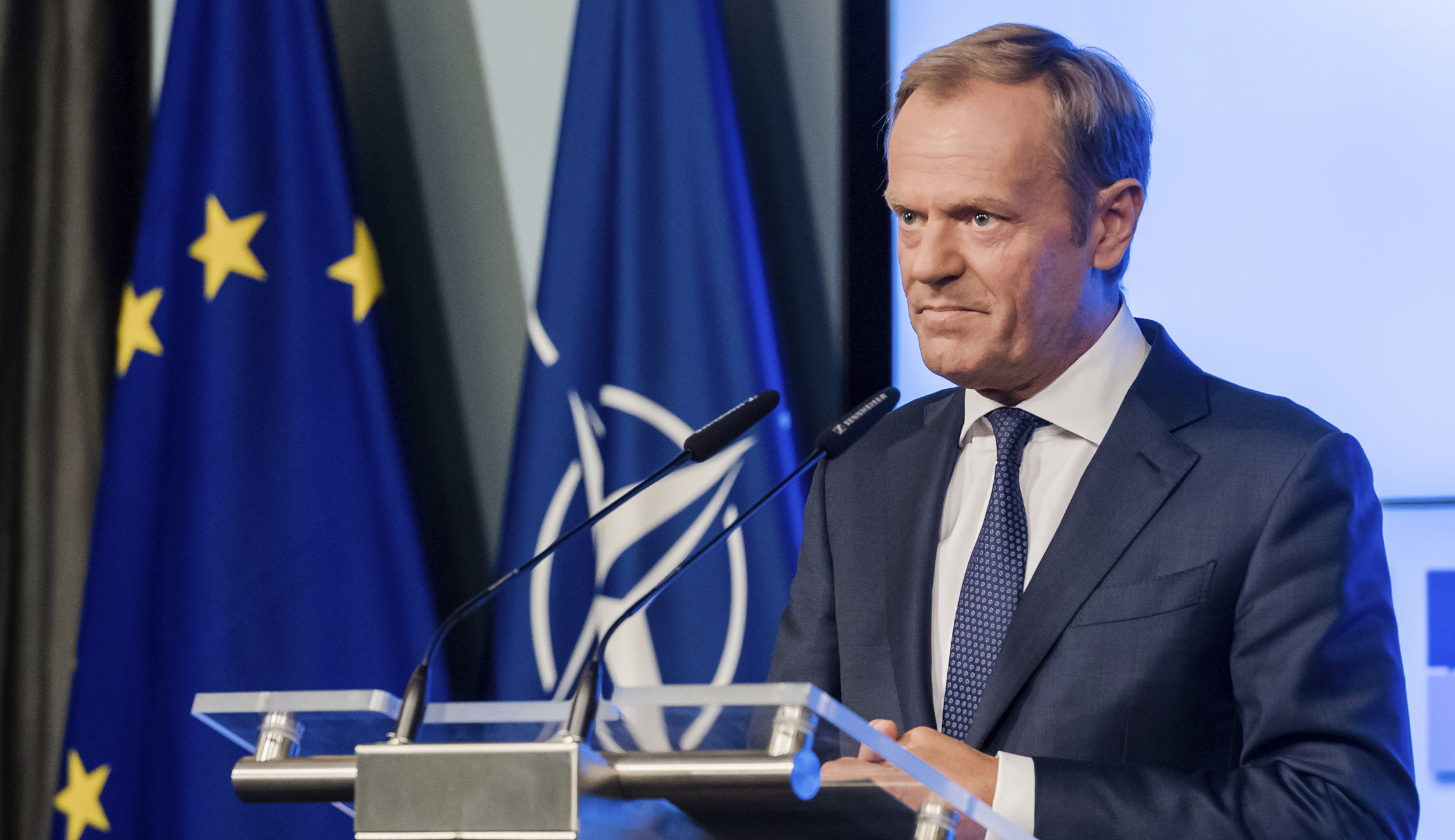
The leader of the European Council warned Tuesday that President Trump needs to treat his international allies better because he can’t afford to lose any of them.
“Dear President Trump: America does not have, and will not have a better ally than Europe,” European Council President Donald Tusk said Tuesday. “[D]ear America, appreciate your allies, after all you don’t have that many.”
Recommended Stories


Tusk sent that message as Trump was on the way to Brussels for a NATO summit, the first stop in a diplomatic tour that will include a stop in the United Kingdom and a one-on-one meeting with Russian President Vladimir Putin. Trump is expected to make cost-sharing a key focus of the NATO summit, and he has already complained on Twitter that Europe is not paying its fair share.
“The United States is spending far more on NATO than any other Country,” Trump tweeted. “This is not fair, nor is it acceptable. While these countries have been increasing their contributions since I took office, they must do much more. Germany is at 1%, the U.S. is at 4%, and NATO benefits Europe far more than it does the U.S.”
European allies hope to leave the meeting with a sense of “solidarity,” as Tusk put it after signing a declaration to enhance cooperation between NATO and the E.U.
“Today, Europeans spend on defense many times more than Russia, and as much as China,” Tusk said in response to Trump’s rebukes. “And I think you can have no doubt, Mr President, that this is an investment in common American and European defense and security. Which can’t be said with confidence about Russian or Chinese spending.”
U.S. allies are taking steps to bolster their effectiveness. Tusk and NATO Secretary General Jens Stoltenberg signed a declaration committing to cooperation in a number of areas, including cyberattacks and hybrid warfare — a response to Russia’s recent run of election interference and disinformation around the invasion of Ukraine. They also agreed to clear legal barriers that might impede the movement of NATO forces through E.U. member states that are not part of the military alliance.
“We … need to ensure the fullest possible involvement of non-E.U. Allies in our cooperation and avoid creating new barriers,” Stoltenberg said.
But they’ll have to do more to satisfy Trump, analysts predict.
“The U.S. goal will be to get a very public and political commitment from America’s European partners to spend more on defense,” the Heritage Foundation’s Luke Coffey, a former adviser to the United Kingdom’s secretary of state for defense, told the Washington Examiner. “For the Europeans, I think they’ll want a summit where there is alliance cohesion, where the alliance looks like it’s united against common threats, with a good strong summit communiqué . . . so not a repeat of the G7 debacle.”
Coffey was alluding to the recent meeting between Trump and the heads of six other major industrialized democracies in Canada, which was fraught with personal clashes and the president’s call for Russia’s re-admission to the trade bloc. Trump acknowledged Tuesday that Putin is a “competitor,” but he left Washington, D.C., prepared for a tussle with the European allies.
“So I have NATO, I have the U.K. — which is somewhat in turmoil,” Trump told reporters. “And I have Putin. Frankly, Putin may be the easiest of them all. Who would think? Who would think?”
Still, his call for a European spending increase found an echo on Tuesday. “Dear Europe, spend more on your defense, because everyone respects an ally that is well-prepared and equipped,” Tusk said.
