

European Commission President Donald Tusk does not understand the nature of NATO power.
Addressing President Trump in a speech on Tuesday, Tusk stated that “America does not have, and will not have a better ally than Europe. Today, Europeans spend on defense many times more than Russia, and as much as China. And I think you can have no doubt, Mr President, that this is an investment in common American and European defense and security.” Tusk then offered a particularly arrogant anti-American refrain: “Dear America, appreciate your allies, after all you don’t have that many.”
Recommended Stories


Tusk is patently wrong that the European Union is America’s best ally (the U.K., Australia, and Japan are all better), but his measure of Europe’s contribution to NATO is also delusional.
Yes, Tusk is correct that all E.U. states combined spend more on defense than Russia. But that is primarily a function not of greater E.U. capabilities, but of the higher salaries European service personnel receive compared to their Russian counterparts. Yet, the truest rebuke to Tusk’s contention is European military equipment budgets. As illustrated in the NATO chart below, many E.U. nations allocate less than the NATO target of 20 percent of total defense budget towards equipment purchases.
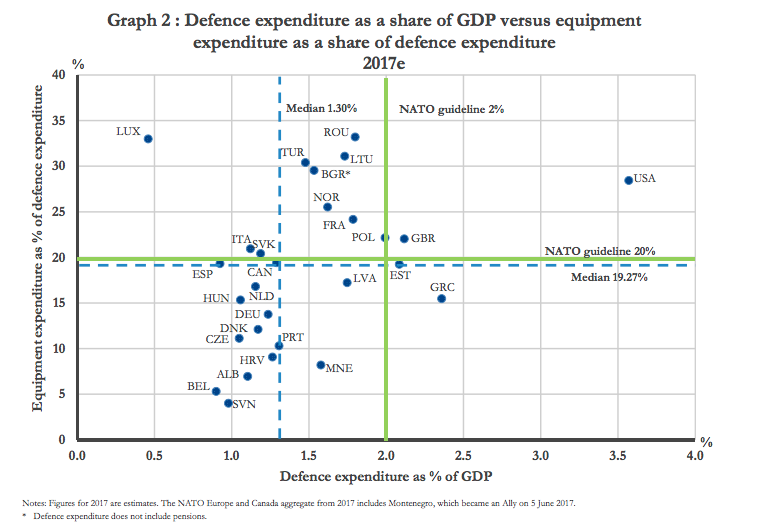
That chart shows, for example, that Germany spends just 14 percent of its total budget on equipment, and Belgium spends an insanely low 5 percent. That’s approximately $300 million — barely enough to buy rifles for its infantry units, let alone replace existing aircraft and spare parts. France deserves credit for its higher equipment budgeting.
The gaps speak to the exigent truth: When it comes to the most important measure of NATO credibility — the alliance’s military capability — the significant majority of E.U. states continue to free ride. They lack the tanks and artillery platforms to stop Russian armored columns, they lack the intelligence assets to monitor Russian troop movements and commands, they lack the cyber and signals units to disrupt Russian lines of communication, and they lack the air power to penetrate Russian air defense bubbles (central to Russian planning for war on the European continent). Together, they might just have the ability to contest Russia’s navy, but even that is questionable.
But it gets worse. Because as Tusk knows, the E.U. has become slavishly deferential to Russia, precisely the point of Russia’s energy blackmail strategy. German Chancellor Angela Merkel has put cheap energy ahead the stability of central and eastern Europe by endorsing the Nord Stream II pipeline.
Where does this leave us?
Well, with Tusk looking to better examples of collective defense. Britain’s choice to increase defense spending offers the best example here.
