Senate map shifts toward Democrats, but majority remains ‘a stretch goal’

Published April 14, 2026 9:57am ET | Updated April 14, 2026 9:57am ET


Democrats are gaining ground in the race for the Senate majority as a tougher national environment for Republicans reshapes key battlegrounds, but flipping the chamber remains a steep climb.

A new round of rating changes from the Cook Political Report is giving Democrats fresh optimism, with four races moving in their direction as President Donald Trump’s approval ratings slide and economic concerns persist.

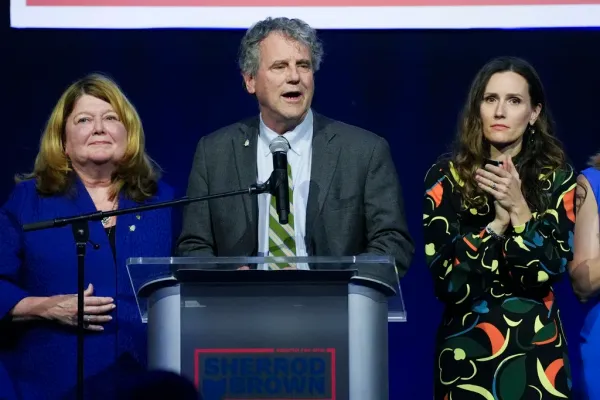
The nonpartisan political handicapper shifted the open-seat race in North Carolina, where former Democratic Gov. Roy Cooper is facing Republican National Committee Chairman Michael Whatley, into the “lean Democratic” column. In Georgia, Sen. Jon Ossoff’s (D-GA) reelection bid also moved to lean Democrat amid a crowded GOP primary featuring Reps. Mike Collins (R-GA) and Buddy Carter (R-GA), as well as former football coach Derek Dooley. Ohio, meanwhile, moved from lean Republican to toss-up, with former Democratic Sen. Sherrod Brown challenging appointed Sen. Jon Husted (R-OH) to finish out the term started by Vice President JD Vance.

The group also moved Nebraska’s Senate race from “solid Republican” to “likely Republican,” pointing to independent Dan Osborn’s continued strength after a surprisingly competitive 2024 run. Analysts still view the contest, however, as a difficult pickup opportunity against Sen. Pete Ricketts (R-NE).

“I think it is a reflection on what appears to be an increasingly poor environment for Republicans nationally,” said Chris Cooper, a political science professor at Western Carolina University.

Even as the map improves for Democrats, the path to a majority is still narrow. Republicans hold a 53-47 majority, meaning Democrats need a net gain of four seats while holding all of their own. To succeed, Democrats must win North Carolina and Ohio, hold Georgia, oust GOP Sen. Susan Collins in purple Maine, and score at least one additional upset in a Republican-leaning state.

The National Republican Senatorial Committee pushed back on the idea that the map is slipping away from the GOP.

“The 2026 Senate battleground is going to come down to a small number of very competitive races in true swing states that no one can take for granted, but Republicans remain favored to hold the Senate Majority and the NRSC has built our strategy, candidate recruitment, and resource deployment around winning exactly that kind of map,” said Joanna Rodriguez, NRSC communications director.

Privately, some Democratic operatives are more measured about what the new map actually means.

“Do I think we are in a better position today than we have been this year to take back the majority? Yes, but I still think it’s unlikely,” said a Democratic operative working on several Senate races and granted anonymity to speak candidly.

Ohio has quickly become a central battleground. The Senate Leadership Fund is investing $79 million, the most of any state, to defend the seat against Brown, who served in the Senate for 18 years before losing his reelection bid in 2024 to Republican Bernie Moreno. 

“I think there’s been enough polling out there to show that the races in Ohio have shifted dramatically,” said Ohio Democratic strategist Jeff Rusnak, who worked on Brown’s early campaigns. He argued that the contrast in the race is already taking shape, with Husted still introducing himself to voters while Brown enters with a well-established profile.

“He is well known and well liked. People know him, trust him, respect him,” Rusnak said of Brown, adding that the former senator’s authenticity continues to resonate with voters across the state.

Zooming out, Rusnak said Democrats are seeing a more competitive map overall, but cautioned that the path to a majority still runs through a small number of states.

“There are more opportunities than there were a few months ago,” he said, pointing to movement in places like North Carolina and Georgia. “But it’s still going to come down to a handful of races, and Democrats are going to have to win almost all of them.”

Cook’s overall outlook reflects the challenge ahead, with Democrats most likely to gain between one and three seats, still short of the four needed to reclaim the majority.

“The Senate is still a stretch goal at best for the Democrats,” Cooper said.

Some Democrats argue the environment is shifting quickly enough to make that path plausible, pointing to warning signs in both polling and political dynamics.

“Democrats would have to run the table, they’d have to draw an inside straight,” said Democratic strategist Brad Bannon. “But you can see in the polling the divisions in the Republican base, and that could make a big difference in these tight races.” 

Bannon pointed to a growing gap in party unity, with Republicans showing softer support for Trump than Democrats’ opposition to him, as well as continued voter frustration over inflation and the cost of living. Those dynamics, he said, are creating a more favorable environment for Democrats than existed just weeks ago.

“If the election were today, I’d say it’s a 50-50 proposition,” Bannon said, adding that he would have given Republicans the edge earlier this year.

In Georgia, Republicans caution that the current rating reflects turbulence in the primary rather than a settled advantage for Ossoff, even as they acknowledge the broader map remains difficult.

“I certainly think that Republicans should absolutely not take this race for granted,” said a GOP consultant with experience in Georgia Senate races. “But anybody who is reading this as a final prediction is wrong.” 

The consultant described the race as a “snapshot” shaped by current headwinds, arguing that Republican chances will hinge heavily on candidate quality and party unity once the primary concludes. A crowded field has created early uncertainty that could dissipate once voters coalesce around a nominee.

But even beyond Georgia, the broader map presents a challenge for Democrats.

“They would have to run the table on every competitive Senate race in the country,” the GOP consultant added. “The math is not in their favor.”

GEORGIA SENATE RACE SHIFTED TO ‘LEANS DEMOCRAT’ IN POSITIVE SIGN FOR JON OSSOFF

For now, Democrats have more paths into contention than they did just weeks ago, but the outcome will depend on whether the current political environment continues to shift in their favor.

“Majority is possible, but they’re going to need everything to go their way,” Cooper said. “The trends are going to need to continue in the direction they’ve moved, and perhaps even worsen for President Trump, for that to happen.”