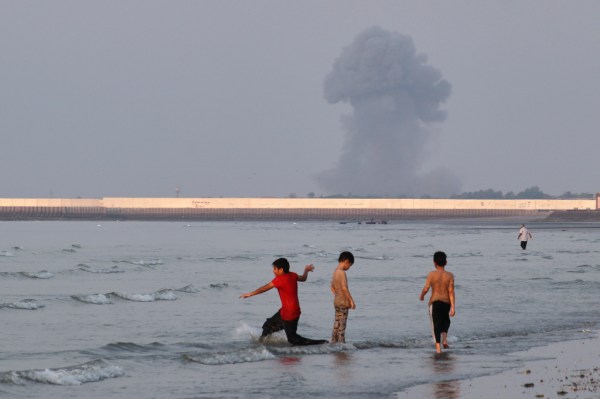
The 27-word announcement came via social media at 2:48 p.m. Thursday with minimal fanfare — the United States had conducted “a new wave of strikes for the sixth consecutive night to further degrade Iranian military capabilities.” Any pretense that the tenuous peace deal between the U.S. and Iran was alive, if not on life support, appears to be well and truly over.
Prior to that, U.S. Central Command had publicly announced that the U.S. military had carried out waves of strikes every day since Saturday. President Donald Trump has indicated the strikes would continue as well.
Recommended Stories
Despite the increased frequency of U.S. strikes, War Secretary Pete Hegseth and Gen. Dan Caine, the chairman of the Joint Chiefs of Staff, have not briefed the media since May 5, prior to the signing of the deal and its apparent collapse. Adm. Brad Cooper, the CENTCOM commander, has not held a briefing since then either.
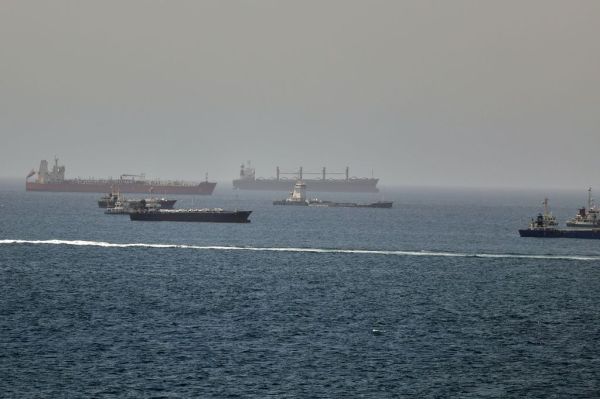
White House press secretary Karoline Leavitt told reporters on Thursday that the strikes were in response to Iran’s attacks on commercial vessels in the Strait of Hormuz, which she said violated the agreement.
Iran “was not permitted to fire on commercial vessels traveling through the Strait of Hormuz,” she said, but had chosen to do so, and Trump will not allow that “to continue without consequences for Iran.”
Most of the U.S. strikes over this time have primarily taken place along Iran’s coast, where many of the attacks on commercial vessels originated. Iran’s continued ability to carry out these attacks demonstrates that it maintains some capabilities even if earlier U.S. strikes degraded its defense industrial base capacity to rebuild those stockpiles.
Iran maintains that it has the right to require ships sailing through the Strait of Hormuz and off its coast to pay what essentially amounts to a toll system and threaten those that do not abide by its rules, but it goes against international maritime law.
“It’s clear that escalating military intervention by the U.S. will certainly exert a toll on Iran,” Mona Yacoubian, a Middle East expert with the Center for Strategic and International Studies, told the Washington Examiner, “but it’s not at all clear that that toll will lead Iran to relinquish its control over the strait, and I think that’s why this is actually a dangerous moment because both sides seem to be of the mind that they can use military force to break this impasse over the strait.”

Yacoubian said the two sides have started a “phase change” and not a “new phase” of the war because “we’re seeing a return to conflict, a resumption of conflict. We’re seeing the collapse of the [peace deal] and diplomatic efforts, but we’re not yet back at the level of intensity that we were at the initial part of the conflict.”
“This latest phase of the conflict, the focus has been almost exclusively on how do we wrench control of the strait away from Iran,” she said, adding that “the primary objective now appears to be reopening the strait without conditions.”
US escalation
As he has throughout the conflict, Trump has openly discussed conquering Kharg Island; targeting Iran’s Pickaxe Mountain, another one of Iran’s nuclear facilities; and going after dual-use infrastructure such as roads, railways, and bridges. He has yet to authorize a mission to do any of those things so far.
U.S. forces have carried out strikes on Kharg, as well as Greater Tunb Island, but attempting to conquer and hold the territory are much different missions. While the mission would put the troops in greater danger, if successful, it could give the U.S. leverage over Iran that it does not possess.
Spencer Faragasso, a senior fellow with the Institute for Science and International Security, downplayed the benefit of seizing Kharg Island, given that the military restarted its blockade of Iranian ports on Tuesday. He also noted that seizing the island does not fundamentally prevent the Iranians from continuing to attack commercial shipping.
“Kharg Island is Iran’s main exporting oil hub, but if there’s a blockade in place that’s preventing Iran from exporting oil, then you’re effectively doing the same thing as taking Kharg Island,” he told the Washington Examiner. “Seizing these islands doesn’t solve the issue of the strait. Neither does seizing the coastline. Iran can just continue to threaten the street from inland capabilities.”
Pickaxe mountain
Trump has threatened to “take out” another Iranian nuclear facility, known as Pickaxe Mountain, which U.S. forces did not target during Operation Midnight Hammer, when they went after the Fordow, Natanz, and Isfahan nuclear facilities last year.
“We’re going to take out Pickaxe Mountain,” Trump told Hugh Hewitt. “Tell the Iranians to be ready. Pickaxe is a possible, you know, possible target for a nice, big, fat shot right into the front door. And I think that you’ll, maybe you’ll see that.”
The facility is built within the Kuh-e Koland Gas La mountain near the Natanz enrichment plant. Iran is believed to have started building the facility in 2020, and it has not allowed international inspectors to visit Pickaxe Mountain prior to the start of the war.
The Air Force dropped multiple GBU-57 Massive Ordnance Penetrator bombs on the Natanz and Fordow nuclear facilities, both of which have underground components, during Operation Midnight Hammer. It is unclear if the bunker-buster bomb could penetrate the Pickaxe Mountain facility.
“There’s a lot of people out there trying to claim that the site is invulnerable and it’s out of reach of U.S. weapons,” Faragasso said. “That’s not exactly clear to us. The site, we have identified two possible ventilation shafts, although we cannot confirm definitively that these are ventilation shafts. We have not seen schematics of the facility under construction there, however, if these are the ventilation shafts, it would identify a weak point in the structure.”
Iran has a say, too
Over the course of the war, including this week, Iran has responded to U.S. operations in two primary ways: targeting commercial vessels to create a global energy crisis and going after Gulf States that host U.S. troops.
Those attacks are likely to intensify if the U.S. operations do the same because they maintain some capabilities.
The Iranians “have paths towards escalation, and they have paths towards response,” Faragasso said. “As long as they have missiles and drones capable of being launched, they can continue the pressure.”
Iran could target Gulf States’ oil production infrastructure, it could continue to carry out attacks in the strait, and it could push allies to get involved. Specifically, Iranian leaders have informed their Yemen-based Houthi partners to be ready to shut down shipping in the Red Sea if the U.S. strikes Tehran’s power infrastructure.
Should the Houthis start such attacks in the Red Sea and the Bab el Mandeb Strait, it would take the region’s two main oil export routes out and would exacerbate the energy crisis. While this threat has always been a possibility, the Houthis have not carried out attacks on commercial vessels off their coast during the conflict.