RFK Jr. testifies as MAHA coalition comes under strain: What to know

Published April 16, 2026 7:00am ET


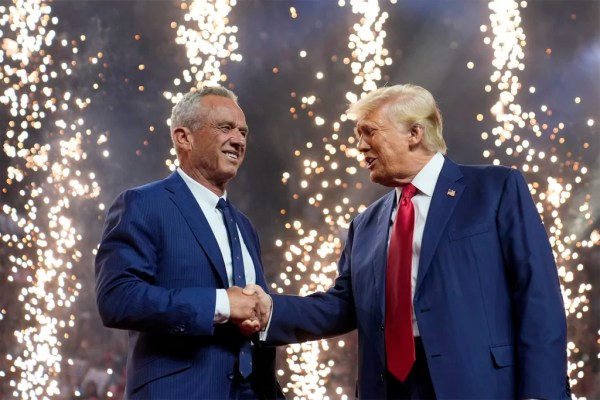
Health and Human Services Secretary Robert F. Kennedy Jr. is likely to receive pushback from both sides of the aisle during congressional hearings scheduled for the coming days on President Donald Trump’s 2027 budget request. 

Kennedy is kicking off the series of budget-related hearings at the House Ways and Means Committee and House Appropriations Committee on Thursday, marking his first appearances before Congress since September.

The secretary’s main objective will be to defend Trump’s 2027 budget request to cut HHS discretionary spending by roughly $16 billion compared to last year’s allotment from Congress. 

But the hearings also will serve as a check-up on the slightly more than one year of Kennedy’s leadership of HHS, which has been fraught with several controversies, including the turnover in leadership at the Centers for Disease Control and Prevention, infectious disease outbreaks, and rising healthcare costs.

Kennedy is also slated to testify before the House Energy and Commerce Committee on Tuesday, April 21, followed by back-to-back hearings on April 22 before the Senate Finance and Health, Education, Labor, and Pensions Committees. 

This block of hearings could prove a make-or-break moment for Kennedy, who has reportedly had tensions with certain Trump advisers over more controversial “Make America Healthy Again” policies that are unpopular with voters. White House advisers have reportedly told Kennedy and other HHS officials to lay low on vaccine policy reforms until after the midterm elections this fall. 

Former Attorney General Pam Bondi and Former Department of Homeland Security Secretary Kristi Noem each were fired by the president this spring following poor performances during congressional testimony. 

Here are a few themes to watch for during the budget hearings.

CDC without a director and vaccine turmoil

Troubles at the CDC will likely be a central feature of Democrats’ questions during the upcoming hearings. 

The nation’s premier public health advisory agency has been without a permanent director since Kennedy ousted the Senate-confirmed CDC Director, Susan Monarez, in August following a clash over vaccine policy. Monarez testified before the Senate afterward that she was fired for refusing to rubber-stamp Kennedy’s requests to slim down the childhood vaccine schedule. 

The Trump administration is well past the 210-day limit to appoint a new CDC director to go through the Senate confirmation process. Currently, National Institutes of Health Director Jay Bhattacharya is also overseeing the CDC.

Kennedy, who had a long career of anti-vaccine advocacy before public office, has also led the reshaping of the CDC’s Advisory Committee on Immunization Practices, whose decisions are directly tied to insurance coverage for vaccines.

The Ways and Means Committee hearing will be the first time Kennedy has testified before Congress since the ACIP recommended delaying the infant dose of the Hepatitis B vaccine, which prevents liver cancer later in life. It is also his first hearing since the CDC recommended cutting the number of childhood inoculations from 17 to 11. 

Both moves were blocked by a federal judge, who argued that ACIP and CDC overstepped their authority. 

Trump’s skinny HHS budget

Much of the hearing will focus on Trump’s $111.1 billion discretionary budget request for HHS, a 12.5% reduction compared to 2026 spending levels. 

The MAHA agenda is front and center in the president’s request, with an expansion of nutrition education and food safety modernization through various Food and Drug Administration programs. 

Included in the budget proposal is an allotment to establish the Administration for a Healthy America, nicknamed AHA. The new agency is ostensibly intended to save $5 billion by “creating efficiencies” in department programs through consolidating projects that are now divided between HHS’s 28 subagencies. 

Members on both sides of the aisle are also likely to bristle at the proposed $5 billion in cuts to the National Institutes of Health, the agency that funds basic medical science research projects at universities across the country. 

A bipartisan Congress ignored the Trump administration’s request last year to slash the NIH budget by 40%, instead increasing the agency’s funding by $415 million over the previous year.

Addressing rising healthcare costs

Kennedy will also likely advocate Trump’s agenda to lower healthcare costs, a leading domestic policy concern for voters heading to the polls in November’s midterm elections. 

The secretary’s testimony is an opportunity for him to press Congress to enact the president’s Great Healthcare Plan agenda, published by the White House this spring, which includes broad strokes of a plan to subsidize healthcare expenses through partially funded health savings accounts. It also includes codifying Trump’s efforts to lower prescription costs through negotiating with pharmaceutical companies to match the lowest international prices. 

Members on both sides of the aisle will undoubtedly press Kennedy on health insurance and prescription drug costs.

A Gallup poll last month found that healthcare affordability and access are the No. 1 issue for voters heading into this year’s elections, outpacing more traditional top-of-mind troubles such as the economy and inflation. 

A different Gallup poll from earlier this year found that 1 in 3 adults, about 82 million people, use a cost-cutting technique to offset medical bills, such as rationing prescriptions, borrowing money, or skipping meals. 

Abortion pill politics at FDA

Socially conservative Republicans will likely ask Kennedy this week about the status of an ongoing safety review of the abortion drug mifepristone.

Kennedy and FDA Commissioner Dr. Marty Makary promised during their Senate confirmation hearings last year that the agency would conduct an in-depth safety review of mifepristone following reports that complication rates in practice were significantly higher than the FDA warning label projections. 

Anti-abortion advocates argue that the FDA’s 2023 decision to remove in-person screening requirements for the drug has led to the slight increase in abortions nationwide since the Supreme Court overturned Roe v. Wade.

Ways and Means Committee Chairman Jason Smith (R-MO), as well as Vice Chairman Vern Buchanan (R-FL), and committee member Rep. David Schweikert (R-AZ), signed onto a letter with 172 other Republican representatives late last year calling on the FDA to reinstate in-person screening requirements for the pills. 

HUNDREDS OF HOSPICE PROVIDERS SUSPENDED IN LOS ANGELES OVER $600 MILLION IN SUSPECTED FRAUD

Several members of the Appropriations Committee, including Chairman Tom Cole (R-OK) also signed on to the November 2025 letter to the FDA.

Next week’s Senate hearings will also likely feature abortion-related questions from conservative senators, including Sens. Bill Cassidy (R-LA), James Lankford (R-OK), and Josh Hawley (R-MO).