

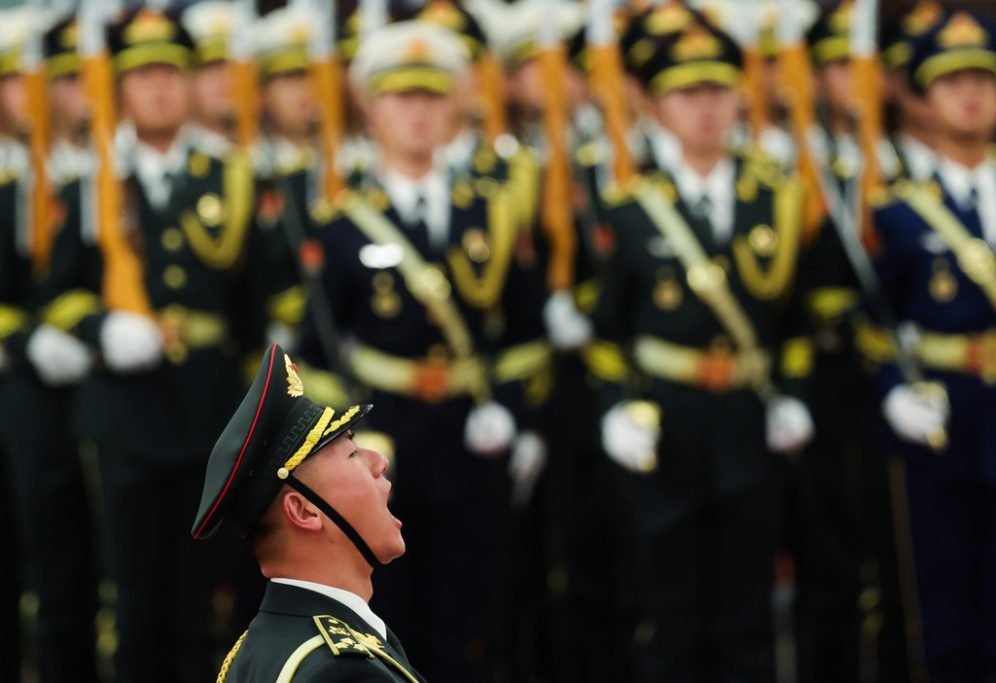
Chinese Communist leader Mao Zedong stated that “political power grows out of the barrel of a gun.”
Today, Communist China’s military power has never been greater. A new Pentagon report warns that the United States is “increasingly vulnerable” to attack. Worse still: China, well aware of its growing strength, is flexing its muscles.
Recommended Stories


China’s People’s Liberation Army launched “Justice Mission 2025,” a large-scale military exercise simulating a blockade of Taiwan’s major ports. China has long coveted the island democracy. Chinese President Xi Jinping has called for the PLA to be ready to conquer Taiwan by 2027. Many leading U.S. military officials have warned that the PLA is on track to achieve this goal.
By any metric, Justice Mission 2025 is audacious. The military drills are live-fire and are meant to showcase Beijing’s ability to cut off the island from outside support. The exercises are the largest to date and simulate strikes on both land and sea targets. The moves follow the recent U.S. announcement of a record-breaking $11.1 billion arms sale to Taiwan.
China’s bellicosity has been on display elsewhere, too. In late December 2025, images circulating online appear to show that China is militarizing commercial cargo ships. As the Asia Times found, satellite imagery shows a Chinese container vessel at a Shanghai shipyard, the Zhongda 79, “equipped with containerized vertical launch missile cells with a 60-round capacity, phased-array radars, close-in weapon systems, and electronic countermeasures, suggesting a modular ‘arsenal ship’ concept that could quickly convert civilian hulls into combat platforms.”
This capability wouldn’t expand the missile range, but it greatly improves the PLA’s capabilities, offering the ability to both saturate targets and make detection more difficult. And it is but another undeniable sign of the CCP’s intent. That intent is well-documented in the Pentagon’s recently released exposé on China’s military power.
Every year since 2000, the U.S. has published an annual report on China’s military capabilities. And every year the threat has grown. This year’s finding is no exception. Indeed, the investigation found that China’s defense budget rose by 5.2% from 2023 to 2024 — and that’s accounting for inflation. This increase, coming at a time when China has been plagued with significant economic ills, is a clear sign of the regime’s priorities. When Xi and his CCP henchmen say they want to seize Taiwan, they mean it.
Since the first full year of Xi’s term as General Secretary of the CCP, China’s announced defense budget has nearly doubled. And this, it must be stressed, is purely the “announced” figure — the actual number is almost certainly higher, as China has a history of hiding military expenditures.
The report found that the PLA “continues to refine military options to force Taiwan unification,” including via “amphibious invasion, firepower strike, and possibly a maritime blockade.” In keeping with these objectives, the PLA has undergone a new wave of reforms “focused on political discipline and military modernization.” Earlier this year, news broke of the dismissal of top PLA generals, leading some to speculate that China’s military would be ill-positioned to carry out the enormous undertaking of seizing Taiwan. But the opposite could be true — Xi could be purging those whom he feels are roadblocks to his goals.
IN FOCUS: THE CHINESE COMMUNIST PARTY POSES A GREATER THREAT THAN ISLAMISM
Unfortunately, there is little room for optimism when assessing China’s intentions. And it would be incorrect to think, as some in America do, that a conflict in the Indo-Pacific would be someone else’s problem. As the Pentagon noted, “China’s historic military buildup has made the U.S. homeland increasingly vulnerable.” At present, the balance of power in the region favors China.
Deterring a conflict with the world’s only other superpower must be the priority for America.
The writer is a Washington D.C.-based foreign affairs analyst. His views are his own.
