

In Focus delivers deeper coverage of the political, cultural, and ideological issues shaping America. Published daily by senior writers and experts, these in-depth pieces go beyond the headlines to give readers the full picture. You can find our full list of In Focus pieces here.
Stop me if you’ve heard this one: Democratic primary voters nominate a deeply flawed candidate in a crucial race by an overwhelming margin. Weeks later, the nominee becomes unelectable by embodying the red flags raised by skeptics — red flags the party and its media organs systematically suppressed. Party leaders pull their endorsements and begin trial-ballooning potential replacements as the final deadline for swapping out the dead-on-arrival nominee looms. And all the while, a strong but beatable Republican coasts into the general election.
Recommended Stories



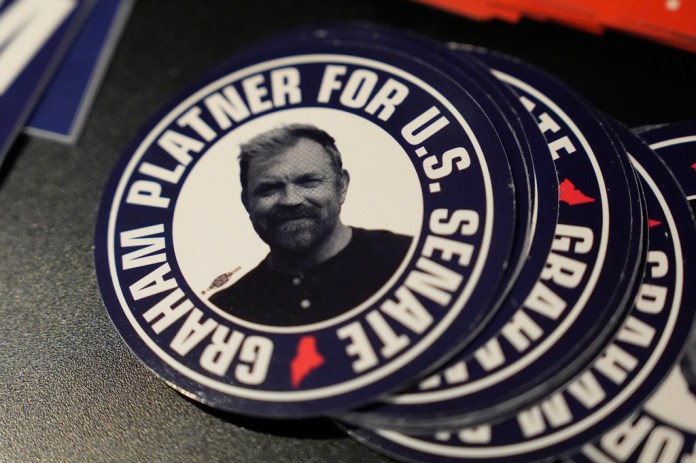
Graham Platner’s swift collapse in the Maine Senate race is giving Democrats a sickening sense of deja vu. Today, they must be asking themselves: Why does this keep happening to us?
Where the Platner and Joe Biden debacles rhyme — and where they don’t — offers clues.
Uniting both implosions is a badly diseased information system. By operating so blatantly on behalf of the Democratic Party in the Donald Trump era, the legacy media no longer serve left-of-center voters with the inconvenient but necessary facts to help them make informed choices. They exist merely to manage their perceptions.
In 2024, this meant insisting that Joe Biden’s cognitive faculties were firmly intact, and that the endless string of videos showing him wandering off and shaking hands with the air were “cheap fakes.” The White House press team supplied the term, and the legacy press parroted it, convincing rank-and-file Democrats that any mention of Biden’s decline stemmed from a sinister, Trumpworld conspiracy theory.
This helped Biden ward off a serious primary challenge. It only took a few minutes of a nationally televised debate with Trump to expose the farce.
The 2026 parallel is even more preposterous: The media’s insistence that Platner’s catalog of red flags — the Nazi tattoo, the Kik profile, and the abuse allegations made by a Republican woman — were merely relics of a troubled past. The New York Times, the Left’s paper of record, worked overtime to minimize the accusation, downplaying the veracity of Lyndsey Fifield’s accusation because of her political affiliation.
On Tuesday morning, Fifield described on X how the New York Times selectively reported the trove of evidence she supplied them about her disturbing relationship with Platner, which included violence and stalking. According to Fifield, the New York Times failed to contact friends who could corroborate key details and dismissed offers to speak with her ex-fiance or priest despite her diary documentation.
In the end, the New York Times report concluded that it “could not corroborate” the story. This gave Democratic voters the excuse to look past it. Five days after the report was published, Maine Democrats nominated Platner with 72% of the vote.
The story gets darker: Jenny Racicot, the woman behind Monday’s Politico rape allegation, apparently told the New York Times about the assault back in June, off the record, and only decided to go fully on the record with Politico after watching how the New York Times buried and discredited Fifield’s story.
Given the cache of sketchy information available, the disturbing rape allegations leveled at Platner on Monday by a fellow progressive should have surprised exactly no one. But thanks to the legacy media’s effort to manage perceptions, Democrats are now forced to confront in July what they should have reckoned with in June before votes were cast.
The Platner debacle has many parents, but it would never have been possible without a corrupt and pliant media. Neither would Biden’s reelection catastrophe have been possible.
It’s obvious why the New York Times, long a stalwart of the establishment, would shill for an establishment dud like Biden, but less so for a renegade progressive like Platner. The reason is that the New York Times and the party it serves had no better options — neither Platner nor Biden was chosen because they were strong, but because nothing else was on hand.
In 2024, Democrats swapped out Biden for an arguably worse nominee in Kamala Harris. Today, they are helpless to fend off the ascendant populist wing, giving them no choice but to wrap their arms around Platner, who caught fire with voters. The dirty secret here is that Biden and Platner, both terrible candidates, were the best options available.

Even if the establishment is successful in forcing Platner to withdraw, the party will be forced to swap in a nominee as radical — and as potentially combustible — as Platner, or else face an all-out mutiny from its radicalized base. Embracing Platner, along with the other young socialists winning Democratic primaries across the country, is a necessary evil for a political party locked completely out of federal power.
These debacles are not merely unfortunate, but are the result of years’ worth of failure to build a durable party infrastructure with a strong bench of candidates and a leadership group strong enough to manage its extreme factions and maintain authority. Today in Maine, just as in the 2024 election, the party and its mouthpieces are not setting the agenda and executing its vision, but flailing from one news cycle to the next, grasping for control and hoping a few things break their way.
As much as the Biden and Platner implosions are about the flaws of candidates, they are about the failure of party leadership to build an institution that heads off these problems before they reach the ballot.
None of this is to absolve Democratic voters. They have proven themselves gullible and unsophisticated time and again, guided by emotion, susceptible to cheap radicalism and paranoid delusions, and incapable of the pragmatism needed to win elections.
They paint Trump and the MAGA movement as drooling rubes — but since they haven’t figured out a way to beat them fair and square in the political arena, what does that make them? Dumber than the rubes, apparently. The weak party leadership and its corrupt legacy media would be powerless if voters didn’t keep following the crumbs they lay.
And how easy they are to manipulate! In 2024, they nominated Biden out of pathological obedience, a refusal to see what was plainly in front of them because the party told them not to. In 2026, they nominated Platner out of a pathological pursuit of ideological purity.
PLATNER, PAXTON, AND THE DEATH OF MORAL AUTHORITY
Somewhere between blind faith and blind defiance is the judgment it takes to actually win.
Can they find it by 2028? Or are the Biden and Platner debacles only a preview of the chaos to come?
