DC planning commission chair defends Trump arch against criticism that it violates height law

Published June 4, 2026 4:55pm ET | Updated June 4, 2026 4:55pm ET


National Capital Planning Commission Chairman William Scharf on Thursday suggested a federal law that restricts how tall buildings can be in Washington, D.C., does not apply to President Donald Trump’s proposed triumphal arch in the city, paving the way for the 250-foot project to receive full approval. 

Scharf, a Trump appointee, conceded during a commission meeting that the NCPC has long interpreted the Height of Buildings Act as applying to federal projects. After much deliberation, he has concluded that in the “best reading of the law,” the law is not applicable to federal construction, such as the proposed arch, telling colleagues that he finds “NCPC’s position is a little odd to me from a legal perspective.” Still, Scharf pushed Trump’s team to provide a formal legal justification for the commission to hold any decisive vote.
“I hope that the applicant team will provide clarity to us as we go forward in the form of some sort of legal opinion or legal rationale or justification, so that when and if this project comes before us for final approval, this commission can vote fully informed as to the legal issues that the Height of Buildings Act and the height of this project implicate,” he said. 

Thirty witnesses were scheduled to give testimony on the arch project on Thursday, as the hearing proffered an opportunity to provide feedback on Washington’s newest proposed monument, which was announced as part of Trump’s initiative to mark the country’s 250th birthday this year. Several expressed concern that “the grotesque size of the arch” would obstruct historic views between the Lincoln Memorial and Arlington National Cemetery and argued that the Height of Buildings Act should be invoked. 

“30 funeral services are conducted at Arlington National Cemetery every single day. 400,000 veterans and their families are interred there. The landscape between the Lincoln Memorial and Arlington was deliberately designed to honor that relationship,” Ed Stierli, the mid-Atlantic senior regional director for the National Parks Conservation Association, said. “A 250-foot arch at Memorial Circle, topped with the gilded statues and an observation deck, would be placed at the exact point where visitors transition from the Lincoln Memorial to the cemetery. Visitors approaching Arlington from Washington would no longer experience that measured, solemn procession across the bridge. They would instead pass through a structure that’s at fundamental odds with the character of the ground beneath it.” 

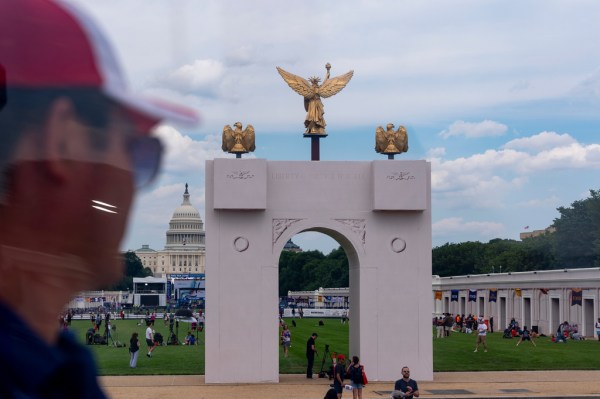
The proposed arch’s height stands between 166 and 190 feet. The figure rises to 250 when accounting for a 60‑foot central gold statue flanked by gold eagles that face east toward the Lincoln Memorial. The top of the monument would feature gold lettering with text from the Pledge of Allegiance on its east and west faces. 

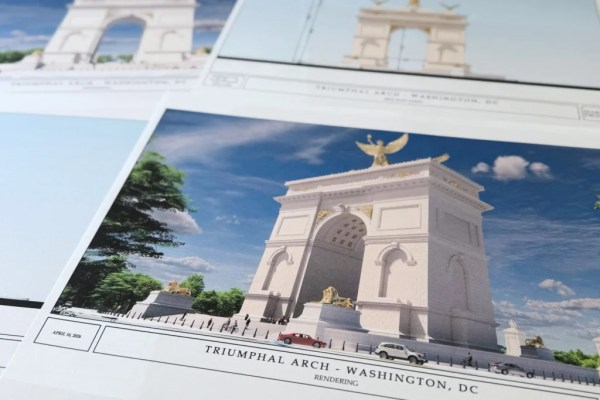
Artist renderings and diagrams for President Donald Trump's new triumphal arch released by the U.S. Commission of Fine Arts that is planned to be built in Washington between the Lincoln Memorial and Arlington National Cemetery, are photographed Friday, April 10, 2026.
Artist renderings and diagrams for President Donald Trump’s new triumphal arch released by the U.S. Commission of Fine Arts that is planned to be built in Washington between the Lincoln Memorial and Arlington National Cemetery, are photographed Friday, April 10, 2026. (AP Photo/Jon Elswick)

TRUMP ENDORSEMENT TRACKER: HERE’S WHO THE PRESIDENT HAS PICKED IN GOP MIDTERM ELECTION PRIMARIES

Scharf argued that there is precedent in bypassing the law, citing two 1932 projects he said exceeded the limits prescribed by the Heighted Buildings Act. He said the instances provoke questions about “whether NCPCs longstanding position as to the mandatory nature of the applicability of the height of buildings act of federal construction is in fact a correct reading of the law.

“I went down a very weird rabbit hole of studying every prior waiver granted by Congress against the Height of Buildings Act,” Scharf said. “One was an addition to the Masonic Temple here in Washington, DC, for which a congressional waiver was sought, and which Congress approved. The other was the construction of the National Archives building, which at 166 feet tall exceeds the Height Buildings Act, and no congressional waiver was ever sought for that, and Congress didn’t speak to that.”